
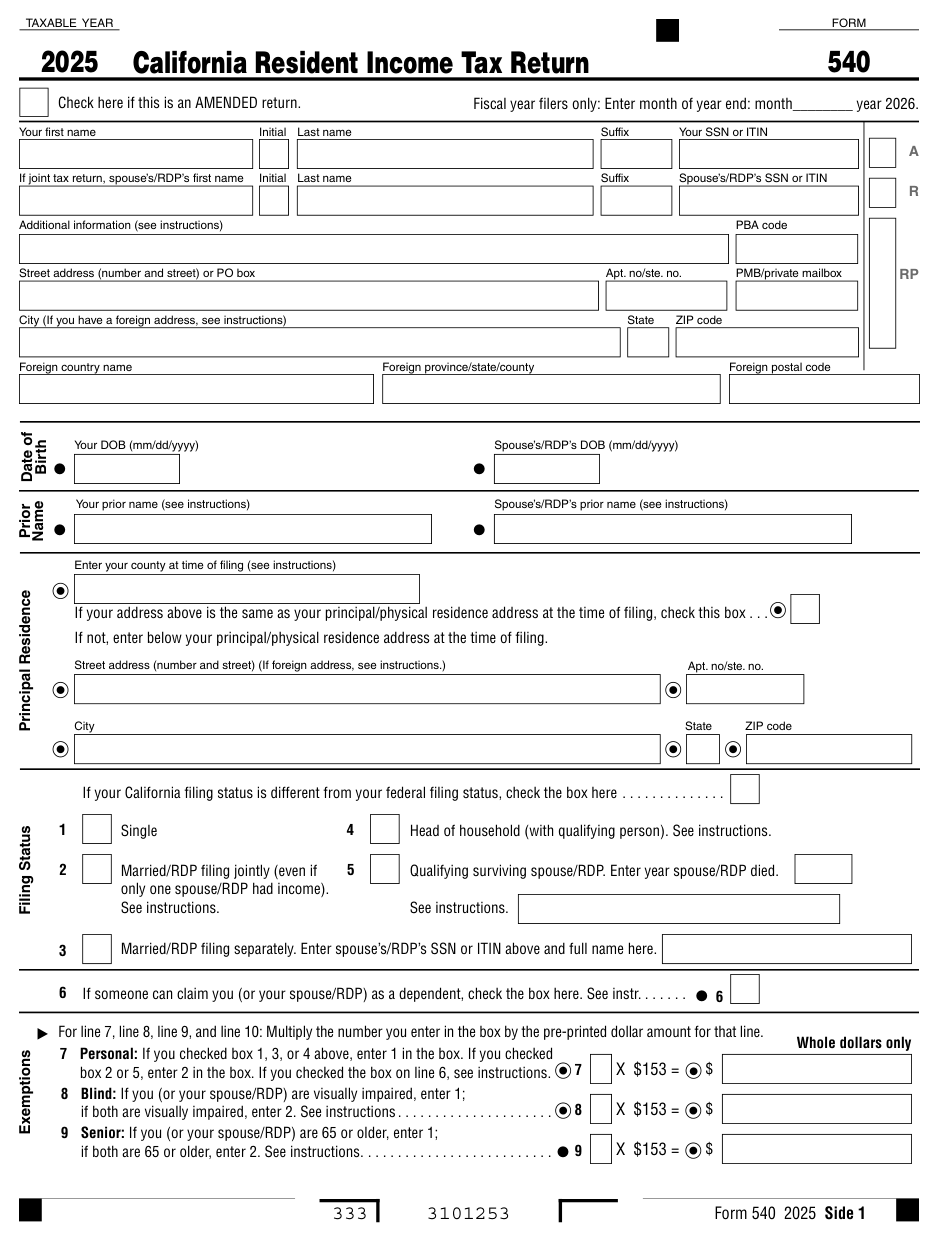
What is Form 540?
Quick answer: Form 540 is the income tax return a full-year California resident files with the Franchise Tax Board (FTB). It does not restate your whole tax picture from scratch — it starts from the federal adjusted gross income on your federal return, adjusts it for the places California law differs (on a separate worksheet, Schedule CA), applies California’s own standard deduction and tax rates, and then works through California credits, use tax, and payments. The form is six sides long and all six are filed. For 2025 returns the deadline is April 15, 2026, with an automatic extension to October 15, 2026 to file (not to pay). This guide is a plain-English walk-through of the official Form 540 instructions, line by line.
Form 540, California Resident Income Tax Return, is the standard state return for someone who lived in California for the entire tax year. It is filed with the Franchise Tax Board — California’s income tax agency, separate from the IRS and from the California Department of Tax and Fee Administration (CDTFA), which handles sales and use tax.
Three things about Form 540 trip up people who are used to a federal return. First, it is built on top of your federal return: line 13 is your federal AGI, copied straight across, and the California-only differences are handled on Schedule CA (540), a separate worksheet, rather than on the 540 itself. Second, California’s standard deduction is small — $5,706 for a single filer in 2025, less than a third of the federal figure — so many people who take the standard deduction federally end up itemizing for California. Third, the form is six sides long and the FTB wants all six, even the mostly-blank ones.
Key Figures — Tax Year 2025 (Form 540)
- California standard deduction: $5,706 single or married/RDP filing separately; $11,412 married/RDP filing jointly, head of household, or qualifying surviving spouse. These are far below the federal standard deduction.
- Personal exemption credit: $153 each for you, your spouse/RDP, blindness, and being 65 or older (line 7–9). Dependent exemption credit: $475 per dependent (line 10).
- Exemption credits phase out once federal AGI (line 13) is over $252,203 (single/MFS), $504,411 (MFJ/QSS), or $378,310 (head of household): the credit drops $6 for each $2,500 ($1,250 if MFS) of AGI over the threshold, per exemption.
- Tax rates run from 1% to 12.3% across nine brackets. Taxable income of $100,000 or less uses the Tax Table; over $100,000 uses the Tax Rate Schedules.
- Behavioral Health Services Tax (line 62): an extra 1% on taxable income over $1,000,000. This is the tax formerly called the Mental Health Services Tax.
- California EITC (line 75): available with earned income under $32,901 for 2025; no qualifying child required.
- Mail with a payment to PO Box 942867, Sacramento CA 94267-0001; refund or no amount due to PO Box 942840, Sacramento CA 94240-0001.
What Changed on the 2025 Form 540
What changed for 2025: the inflation-indexed figures all moved. The standard deduction rose to $5,706 / $11,412 (from $5,540 / $11,080), the personal exemption credit to $153 (from $149), and the dependent exemption credit to $475 (from $461). The exemption-credit phase-out now starts at $252,203 of federal AGI for single filers (up from $244,857).
Other changes for the 2025 return:
- Mental Health Services Tax → Behavioral Health Services Tax. Line 62 works exactly as before — 1% of taxable income over $1,000,000 — but every reference on the form and in the booklet now says “Behavioral Health.”
- New refundable film credit. Line 74 is the Program 4.0 California Motion Picture and Television Production Credit, which a qualified taxpayer can elect to have refunded.
- Military retirement exclusion. For 2025 through 2029, a qualified taxpayer can exclude up to $20,000 of federal military retirement pay or Survivor Benefit Plan annuity income. It is claimed as a subtraction on Schedule CA (540), not on the 540 itself.
- Alimony. California now conforms to the federal treatment (not deductible / not taxable) for divorce or separation agreements executed after December 31, 2025.
- Side 5 additions. Two new voluntary contribution funds (Pediatric Cancer Research; Parkinson’s Disease Research) and new Organ Donor Election consent checkboxes.
Which California Return Do You File?
Which one applies to you
- Form 540 — you were a California resident for the entire 2025 year. This guide.
- Form 540 2EZ — full-year resident, income only from wages/interest/pensions, taxable income under $100,000 ($200,000 married), no more than three dependents, standard deduction only. A shorter version of the same thing.
- Form 540NR — you were a nonresident of California for any part of 2025, or a part-year resident (you moved in or out during the year). Also use 540NR if you filed a joint federal return and one spouse was a nonresident.
California has no reciprocal agreements
Some states let a resident of a neighboring state skip a return by agreement. California has none of these with any state. Two consequences:
- If you live in California and earned wages in another state, you still report all of it on Form 540, then claim the Other State Tax Credit on Schedule S for tax paid to the other state on the same income.
- If you live in another state and earned California-source income (California wages, California rental property, a California business), you file Form 540NR, not Form 540.
You might not need this: if your income was below the filing thresholds in the next section and you had no California tax withheld, no California EITC to claim, and none of the “other situations” (a lump-sum distribution, AMT, recapture tax, etc.), you may not have to file at all. If California tax was withheld from your pay, file anyway — that is the only way to get it refunded.
Who Must File Form 540
You must file if your income is over the amount for your situation in the FTB’s 2025 chart. The gross-income test comes first; if you pass it you also apply the AGI test.
| Filing status | Age | Gross income — 0 / 1 / 2+ dependents | California AGI — 0 / 1 / 2+ dependents |
|---|---|---|---|
| Single or head of household | Under 65 | $22,941 / $38,774 / $50,649 | $18,353 / $34,186 / $46,061 |
| Single or head of household | 65 or older | $30,591 / $42,466 / $51,966 | $26,003 / $37,878 / $47,378 |
| Married/RDP filing jointly | Both under 65 | $45,887 / $61,720 / $73,595 | $36,711 / $52,544 / $64,419 |
| Married/RDP filing jointly | One 65+ | $53,537 / $65,412 / $74,912 | $44,361 / $56,236 / $65,736 |
| Married/RDP filing jointly | Both 65+ | $61,187 / $73,062 / $82,562 | $52,011 / $63,886 / $73,386 |
| Qualifying surviving spouse/RDP | Under 65 | $38,774 / $50,649 / — | $34,186 / $46,061 / — |
| Qualifying surviving spouse/RDP | 65 or older | $42,466 / $51,966 / — | $37,878 / $47,378 / — |
You must also file, regardless of income, if you owe certain taxes for 2025 (tax on a lump-sum distribution, tax on an IRA or MSA, AMT, recapture taxes, the child’s-unearned-income tax, and a few others), or to claim a refund of California tax that was withheld.
Before You Start
Before you start, gather these
- Your finished federal Form 1040 or 1040-SR — you copy federal AGI to line 13, and you attach the federal return only if you filed federal schedules beyond Schedule A or B.
- All Forms W-2 (California wages are box 16; California tax withheld is box 17) and any W-2G and 1099s showing California withholding.
- Forms 592-B and 593 if you had California backup or real-estate withholding — that goes on line 73, not line 71.
- Records for Schedule CA (540) differences: California-taxable interest from other states’ bonds, HSA contributions, the military retirement exclusion, IRC Section 529 items, and so on.
- Your prior-year California return — for the amount of any 2024 refund you applied to 2025, and for the “same filing status” check.
- Estimated payment records — 2025 Form 540-ES payments and any FTB 3519 extension payment go on line 72. Confirm the total in your MyFTB account.
- If you bought anything from an out-of-state retailer that did not charge California tax, your purchase records for the use tax line (line 91).
How Form 540 Is Organized
How the form is laid out
Side 1 — identity and exemptions
Name, SSN/ITIN, address, county, filing status (lines 1–5), the “someone can claim me as a dependent” box (line 6), and the exemption counts on lines 7–10.
Side 2 — income, deductions, tax
Line 11 (exemption dollar total), lines 12–19 (California wages, federal AGI, Schedule CA adjustments, California AGI, deduction, taxable income), and lines 31–35 (tax, exemption credits, tax subtotal).
Side 3 — credits and other taxes
Lines 40–48 (child-care credit, named credits, renter’s credit, total credits), lines 61–64 (AMT, Behavioral Health Services Tax, other taxes), lines 71–78 (payments), and lines 91–96 (use tax, health-coverage box, ISR penalty).
Sides 4–5 — money out and money back
Lines 97–100 (overpayment / tax due), the voluntary contribution list (codes 400–449, total on line 110), line 111 (amount you owe), lines 112–114 (interest and penalties), line 115 (refund), lines 116–117 (direct deposit), and the voter, organ-donor, and health-care-coverage sections.
Side 6 — signatures
Your signature (both spouses on a joint return), preparer information, and the third-party designee box.
The order that avoids rework: finish your federal return first (line 13 depends on it), then Side 1, then Schedule CA (540) so its totals are ready for lines 14 and 16, then straight down Side 2 to taxable income, then tax and credits, then the use tax line, and finally the refund-or-due math on Sides 4–5 before signing Side 6.
If you use tax software: it copies federal AGI to line 13, runs Schedule CA from your entries, chooses the Tax Table or the rate schedule for you, applies the exemption-credit phase-out, and e-files all six sides. What it cannot judge for you: whether you were a full-year resident (versus 540NR), which Schedule CA subtractions you qualify for, whether you owe use tax, and whether your direct-deposit routing and account numbers are correct. Check those yourself.
How to Complete Form 540, Line by Line
Filing status and exemptions (lines 1–11)
Lines 1–5 — Filing status. Use the same status as your federal return, with two California-only wrinkles: registered domestic partners (RDPs) who file single federally must file jointly or separately for California, and you may file separately for California if your spouse was an active-duty servicemember or a full-year nonresident with no California income.
Line 6. Check this box if someone else can claim you (or your spouse/RDP) as a dependent. If it is checked, your standard deduction is figured on a worksheet and can be as low as $1,350.
Lines 7–10 — Exemption counts. Enter the number in the small box; the form multiplies it by the printed amount. Line 7 personal ($153 each), line 8 blind ($153 each), line 9 senior/65-or-older ($153 each), line 10 dependents ($475 each). Line 11 adds lines 7–10 and carries to line 32.
In plain English: line 32 says “If your federal AGI is more than $252,203, see instructions.” That sentence means your exemption credits shrink. Run the AGI Limitation Worksheet: subtract the threshold for your status from your federal AGI, divide by $2,500 ($1,250 if married filing separately) and round up, multiply by $6 — that is how much each exemption is cut. Apply it separately to the line 7–9 exemptions and to the line 10 dependent exemptions; neither goes below zero.
Common trap: the line 7–9 exemptions are credits, not deductions — a flat dollar amount subtracted from tax, not from income. Do not add $153 to your standard deduction. The only figure that touches income is the standard or itemized deduction on line 18.
Income and California adjustments (lines 12–19)
Line 12 — California wages. The total of box 16 from your W-2s. This is an information line; it does not feed the tax math directly.
Line 13 — Federal AGI. Straight from federal Form 1040, line 11. This is the number the exemption-credit phase-out is measured against.
Lines 14 and 16 — Schedule CA adjustments. Complete Schedule CA (540) first. Its Part I, line 27, column B (subtractions) goes on line 14; column C (additions) goes on line 16.
In plain English: the booklet’s wording — “California adjustments – subtractions… column B” and “California adjustments – additions… column C” — is just bookkeeping for “income California taxes that the federal government doesn’t” (additions) and “income the federal government taxes that California doesn’t” (subtractions). Examples of subtractions: California lottery winnings, most Social Security benefits, the new military retirement exclusion, state tax refunds. Examples of additions: interest on another state’s municipal bonds, some HSA deductions.
Common trap: California does not tax Social Security benefits, but the 540 has no line for that — the subtraction happens on Schedule CA (540), Part I, line 7, column B, and only then flows to line 14. If you skip Schedule CA, you overpay.
| Line | What to enter |
|---|---|
| Line 15 | Subtracts line 14 from line 13. |
| Line 17 | Combines line 15 and line 16 to give California AGI. |
Line 18 — Deduction. Enter the larger of your California itemized deductions (Schedule CA (540), Part II, line 30) or your California standard deduction: $5,706 (single/MFS) or $11,412 (MFJ/HoH/QSS).
Common trap: because California’s standard deduction is so much smaller than the federal one, taxpayers who took the federal standard deduction often have more California itemized deductions than $5,706 — mortgage interest and charitable gifts alone can clear it. Do the Schedule CA (540), Part II math before you settle for the standard deduction. If you are married filing separately, you and your spouse must both itemize or both take the standard deduction.
Line 19 — Taxable income. Line 17 minus line 18, not below zero.
Figure your tax (lines 31–35)
Line 31 — Tax. If line 19 is $100,000 or less, use the Tax Table in the booklet. If it is over $100,000, use the Tax Rate Schedule for your filing status. The FTB also has an online tax calculator at ftb.ca.gov/tax-rates that does the arithmetic for you.
Worked example — Schedule Y, taxable income $125,000
Chris and Pat file jointly. Their taxable income on line 19 is $125,000, so they use Schedule Y (married/RDP filing jointly).
| Step | Figure |
|---|---|
| Their range on Schedule Y | over $115,084 but not over $145,448 |
| Taxable income minus the bottom of the range | $125,000 − $115,084 = $9,916 |
| Times the rate for the range (8%) | $9,916 × 0.08 = $793.28 |
| Plus the tax shown for the range | $793.28 + $3,974.82 = $4,768.10 |
| Enter on line 31 (rounded) | $4,768 |
Now the credits. Suppose they claim two personal exemptions and one dependent: line 11 is 2 × $153 + 1 × $475 = $781. Their federal AGI is under $504,411, so no phase-out. Line 32 is $781, and line 33 is $4,768 − $781 = $3,987 before any other credits.
Line 32 — Exemption credits. The line 11 amount, reduced by the AGI Limitation Worksheet if federal AGI is over the threshold for your status (see the plain-English note above).
Lines 33–35. Line 33 is line 31 minus line 32 (not below zero). Line 34 is tax from Schedule G-1 or FTB 5870A, if any. Line 35 adds them.
Credits (lines 40–48)
Line 40 — Nonrefundable Child and Dependent Care Expenses Credit. A percentage of the federal credit, and only if your California AGI is $100,000 or less. Married filing separately cannot claim it.
Lines 43–45 — Named credits. Enter each credit’s code and amount. To claim more than two, attach Schedule P (540).
Line 46 — Nonrefundable Renter’s Credit. A flat $60 (single/MFS) or $120 (MFJ/HoH/QSS) if you paid rent on your California principal residence for at least half of 2025 and your California AGI (line 17) is $53,994 or less (single/MFS) or $107,988 or less (the joint statuses). You do not attach anything, but keep the qualification record.
Lines 47–48. Line 47 totals lines 40–46; line 48 is line 35 minus line 47, not below zero.
Other taxes (lines 61–64)
Line 61 — Alternative Minimum Tax. Possible if your total income tops $92,749 (single/HoH), $123,667 (MFJ/QSS), or $61,830 (MFS) and you have certain preference items; figure it on Schedule P (540). A small business with under $1,000,000 of gross receipts is exempt from California AMT.
Line 62 — Behavioral Health Services Tax. If line 19 is over $1,000,000: (line 19 − $1,000,000) × 1%. This is the renamed Mental Health Services Tax.
Line 63 — Other taxes and credit recapture. Early-distribution tax (FTB 3805P), IRC 409A additional tax, credit recapture amounts.
Line 64 adds lines 48, 61, 62, and 63 — your total tax.
Payments (lines 71–78)
Line 71 — California income tax withheld. Total of W-2 box 17, W-2G box 15, and the California withholding boxes on your 1099s. Do not include tax withheld by other states, local tax, or amounts from Form 592-B or 593.
Line 72 — Estimated payments and extension payment. 2025 Form 540-ES payments, any 2024 overpayment applied to 2025, and any FTB 3519 payment.
Line 73 — Form 592-B / 593 withholding. Backup withholding and real-estate withholding go here, separately from line 71.
Line 74 — Program 4.0 film credit (refundable portion, if elected).
Lines 75–77 — Refundable credits from FTB 3514. Line 75 California EITC (earned income under $32,901 for 2025, no child required). Line 76 Young Child Tax Credit (a qualifying child under age 6). Line 77 Foster Youth Tax Credit (age 18–25, former foster youth). All three can produce a refund even if you owe no tax.
Line 78 totals lines 71–77.
Use tax, coverage, and the ISR penalty (lines 91–96)
Line 91 — Use tax. California use tax on things you bought from an out-of-state retailer that did not charge California tax (online orders, mail order). Use the Estimated Use Tax Lookup Table for small items, the Use Tax Worksheet for anything $1,000 or more.
Common trap: line 91 cannot be left blank. If you owe no use tax, you must check one of the two boxes below the line — “No use tax is owed” or “You paid your use tax obligation directly to CDTFA.” A blank line 91 is a processing error that can delay your refund.
Line 92 — Health-coverage box. Check it if you and your household had full-year coverage (Medicare Part A or C counts). If not, figure the Individual Shared Responsibility Penalty on form FTB 3853. Lines 93–96 reconcile payments against the penalty.
Overpayment, contributions, amount due (lines 95–114)
Lines 97–100. Line 97 is your overpayment; line 98 is any part you apply to 2026 estimated tax; line 99 is what’s left; line 100 is tax due if payments fell short.
Line 110 — Voluntary contributions. Optional donations from your refund, codes 400–449.
Line 111 — Amount you owe. If there is nothing on line 99, add lines 94, 96, 100, and 110.
Lines 112–113 — Interest and penalties (see “When Form 540 Is Due” below) and the underpayment-of-estimated-tax penalty (FTB 5805).
Line 114 — Total amount due. Line 111 plus lines 112 and 113. Line 115 — Refund. Line 99 minus lines 110, 112, and 113. Fill in lines 116–117 for direct deposit.
When Form 540 Is Due
The 2025 return is due April 15, 2026, and that is also the last day to pay without a late-payment penalty and interest. California grants an automatic extension to file to October 15, 2026 — no form is required for it. File FTB 3519 only if you are sending a payment with the extension; file by October 15 even if you cannot pay, so the late-filing penalty never starts.
If you pay estimated tax, California front-loads the 2026 installments unusually: 30% of the year’s required payment by April 15, 40% by June 15, nothing due September 15, and the last 30% by January 15, 2027.
The penalties, if you are late:
- Late payment — 5% of the unpaid tax, plus 0.5% for each month (or part of a month) it stays unpaid, up to 25%. Interest runs from April 15 and compounds daily. The penalty (not the interest) is waived if at least 90% of the tax was paid by April 15.
- Late filing — if you file after October 15, an additional penalty on top of late-payment, up to a combined 25% of the unpaid tax. If the return is more than 60 days late, the minimum penalty is the lesser of $135 or 100% of the tax due.
- First-time abatement — for tax year 2022 onward you can ask the FTB once to remove a timeliness penalty, if you have filed all required returns and have paid or arranged to pay what you owe.
- Underpayment of estimated tax (line 113) — charged if your withholding and credits were under 90% of your 2025 tax or under 100% of your 2024 tax (110% if your 2024 AGI was over $150,000, or $75,000 if married filing separately). No penalty if the tax due on line 100 is under $500 ($250 if married filing separately).
Where to Send Form 540
If you e-file, there is nothing to mail unless you are sending a check — then use FTB 3582 as the voucher. To file on paper:
| Situation | Mail Form 540 to |
|---|---|
| You owe a payment | Franchise Tax Board, PO Box 942867, Sacramento CA 94267-0001 |
| Refund, or no amount due | Franchise Tax Board, PO Box 942840, Sacramento CA 94240-0001 |
Assembling the return: send all six sides. Attach your W-2s and W-2Gs to the lower front. Attach a copy of your federal return only if you filed federal forms or schedules other than Schedule A or Schedule B. Make a check payable to “Franchise Tax Board,” write your SSN or ITIN and “2025 Form 540” on it, and enclose it without staples.
If a notice arrives: the most common FTB letters after a 540 are an identity-verification request (you confirm the return was yours before the refund is released), a math-error notice (the FTB recomputed a line and adjusted your refund or balance), a “Demand for Tax Return” (the FTB has income data and no return on file), and a balance-due notice with interest. A notice is not an audit. Read what it asks for, respond by the date on the letter, and if you disagree, reply in writing with the documents that support your figures.
Common Mistakes to Avoid
- Skipping Schedule CA (540). Social Security, California lottery winnings, and the military retirement exclusion are all removed there, not on the 540.
- Taking the $5,706 standard deduction without checking itemized. California’s standard deduction is small; many filers do better itemizing for state even when they took the federal standard deduction.
- Treating exemptions as deductions. Lines 7–10 are credits against tax on line 32, not subtractions from income.
- Forgetting the exemption-credit phase-out once federal AGI passes $252,203 / $378,310 / $504,411.
- Leaving line 91 blank. Enter a use tax amount or check one of the two boxes.
- Putting 592-B or 593 withholding on line 71. It goes on line 73.
- Mailing fewer than six sides, or sending the return to the wrong PO box for its payment status.
- Filing Form 540 when you moved during the year. A part-year resident files Form 540NR.
Frequently Asked Questions
Do I have to file a California return if I live in another state? Only if you had California-source income — and then you file Form 540NR, not Form 540. California has no reciprocal agreements, so out-of-state wages of a nonresident with no California work are not California income.
What is the California standard deduction for 2025? $5,706 for single or married/RDP filing separately; $11,412 for married/RDP filing jointly, head of household, or qualifying surviving spouse.
Does California tax Social Security benefits? No. The federally taxable amount is subtracted on Schedule CA (540) and flows to Form 540, line 14.
What are the California tax brackets for 2025? Nine brackets from 1% to 12.3%, plus the 1% Behavioral Health Services Tax on taxable income over $1,000,000. Taxable income of $100,000 or less uses the Tax Table instead of the rate schedule.
Do I need to file a federal extension to get the California extension? No. California’s extension to file is automatic to October 15, 2026. File FTB 3519 only if you are making an extension payment.
How long does a California refund take? The FTB generally issues e-file refunds within about three weeks and paper-return refunds in up to three months; identity verification or a math-error adjustment adds time.
Where do I mail Form 540? With a payment: PO Box 942867, Sacramento CA 94267-0001. Refund or no amount due: PO Box 942840, Sacramento CA 94240-0001.
Can I be charged the Behavioral Health Services Tax? Only if your taxable income on line 19 is over $1,000,000. It is 1% of the amount above $1,000,000.
Final Review Before You File
- Federal return is finished and line 13 matches federal Form 1040, line 11.
- Schedule CA (540) is complete and its line 27 column B / column C totals are on lines 14 and 16.
- Line 18 is the larger of the California standard deduction or California itemized deductions.
- Tax on line 31 came from the Tax Table (line 19 ≤ $100,000) or the correct Tax Rate Schedule (over $100,000).
- Exemption credits on line 32 are reduced if federal AGI is over the phase-out threshold.
- Line 91 has a use tax figure or one of the two boxes is checked.
- 592-B / 593 withholding is on line 73, not line 71.
- Direct-deposit routing and account numbers are checked with your bank.
- All six sides are included; W-2s are attached to the lower front; the return is signed.
- Mailed to the PO box that matches whether you owe a payment.
Sources & verification
- Issuing agency: California Franchise Tax Board
- Official documents: Form 540 (PDF) · instructions (PDF)
- Checked against: 2025 California Form 540 (six sides) + 2025 Personal Income Tax Booklet (Form 540 instructions, incl. 2025 California Tax Rate Schedules)
- Last verified: September 9, 2026
Spot an error or an out-of-date figure? Tell us and we will check it against the official source.
General information from the official form and its instructions, not advice for your circumstances. See the full disclaimer.
More California Tax Forms forms
- California Form 100 — Corporation Franchise or Income Tax Return 2025-2026
- California Form 540-ES — Estimated Tax for Individuals
- California Form 540NR — Nonresident or Part-Year Resident Income Tax Return 2025-2026
- California Form 568 — Limited Liability Company Return of Income 2025-2026
- California Form DE 4 — Employee’s Withholding Allowance Certificate
- California FTB 3514 — California Earned Income Tax Credit
- California FTB 3522 — LLC Tax Voucher
- California FTB 3893 — Pass-Through Entity Elective Tax Payment Voucher
- California Schedule CA (540) — California Adjustments, Residents