What is Form 540-ES?
Quick answer: Form 540-ES is California’s estimated tax voucher for anyone who expects to owe at least $500 ($250 if married filing separately) after withholding and credits — typically the self-employed, landlords, and investors. California’s installment schedule is unusual: instead of four equal 25% payments, it’s 30% by April 15, 40% by June 15, nothing on September 15, and the final 30% by January 15 of the following year. Meeting a safe harbor — generally 90% of the current year’s tax or 100% of last year’s (110% for higher earners) — avoids the underpayment penalty even if the estimate turns out low.
Like the IRS, California collects tax as income is earned rather than all at once the following April. Employees have California Personal Income Tax withheld through Form DE 4; income without withholding — self-employment earnings, rental income, investment gains — is paid in through Form 540-ES instead. What makes California distinctive is the lopsided 30/40/0/30 installment split, which has no equivalent on the federal 1040-ES.
Key Figures — Form 540-ES
- Required if expected tax after withholding and credits is at least $500 ($250 if married/RDP filing separately).
- Installment schedule: 30% due April 15, 40% due June 15, 0% due September 15, 30% due January 15 of the following year.
- Standard safe harbor: the lesser of 90% of the current year’s tax or 100% of last year’s tax.
- Higher-income safe harbor: 110% of last year’s tax instead of 100%, if last year’s California AGI was over $150,000 ($75,000 if married/RDP filing separately).
- Ultra-high-income taxpayers (California AGI of $1,000,000 or more, $500,000 if married/RDP filing separately) must base estimates on the current year’s tax — the prior-year safe harbors don’t apply to them.
- Mandatory e-pay: once any estimated or extension payment exceeds $20,000, or a return shows total tax over $80,000, every future payment must be made electronically — a paper check after that point risks a 1% penalty.
Who Must File Form 540-ES?
Anyone who expects to owe at least $500 ($250 if married/RDP filing separately) on their California return after withholding and credits generally needs to make estimated payments. This most often means:
- Self-employed individuals and independent contractors with no California withholding.
- Landlords with rental income.
- Investors with significant capital gains, interest, or dividends.
- Business owners and partners with pass-through income.
Common trap: filers with prior-year California AGI over $150,000 ($75,000 married/RDP filing separately) cannot rely on the standard 100% safe harbor — they need 110% of last year’s tax instead, or they risk an underpayment penalty even after paying what looks like a full prior-year match.
How to File Form 540-ES
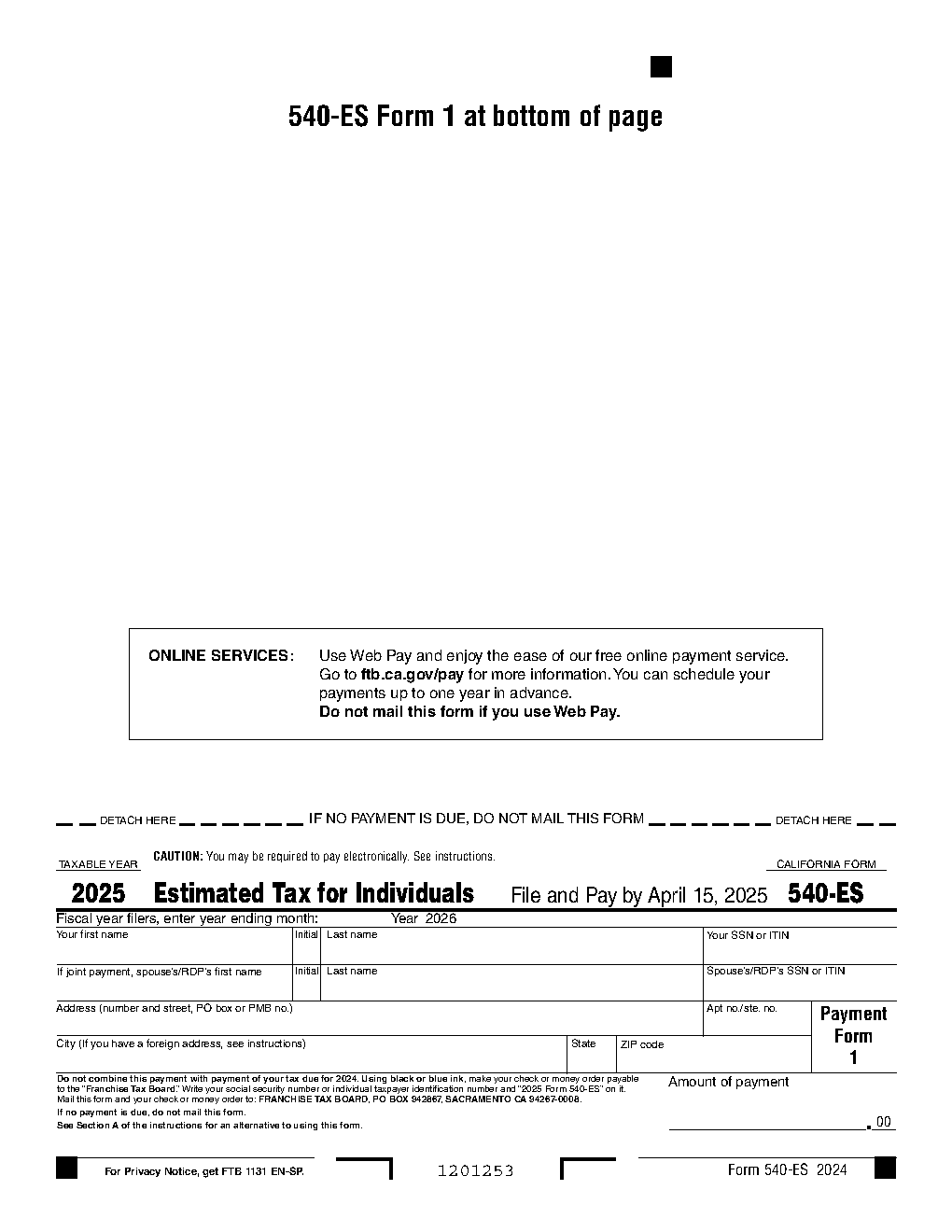
- Pay online with Web Pay at ftb.ca.gov/pay — free, and payments can be scheduled up to a year in advance. If using Web Pay, do not also mail the paper voucher.
- Or mail a voucher with a check or money order made payable to “Franchise Tax Board,” with your SSN or ITIN and “2025 Form 540-ES” written on it.
- If no payment is due for a given installment, do not mail the form at all.
- Once mandatory e-pay applies (a prior estimated/extension payment over $20,000, or total tax over $80,000), every future payment must be electronic regardless of amount.
When Is Form 540-ES Due?
The 30/40/0/30 schedule
| Installment | Percentage of required annual payment | Due date |
|---|---|---|
| 1st | 30% | April 15, 2026 |
| 2nd | 40% | June 15, 2026 |
| 3rd | 0% — nothing due | September 15, 2026 |
| 4th | 30% | January 15, 2027 |
The 3rd-quarter skip is unique to California — federal estimated tax is still due on the federal calendar that same September date, so don’t assume nothing is owed anywhere in September.
Skipping the 4th installment: file the complete 2026 return and pay the full balance due by January 31, 2027, and the January 15 payment can be skipped without a 4th-installment penalty.
Where to Mail Form 540-ES
Mail the voucher and payment to: Franchise Tax Board, PO Box 942867, Sacramento CA 94267-0008. Do not combine an estimated payment with a payment for a different tax year’s balance due — they must be sent separately, even to the same PO Box.
How to Complete Form 540-ES Line by Line
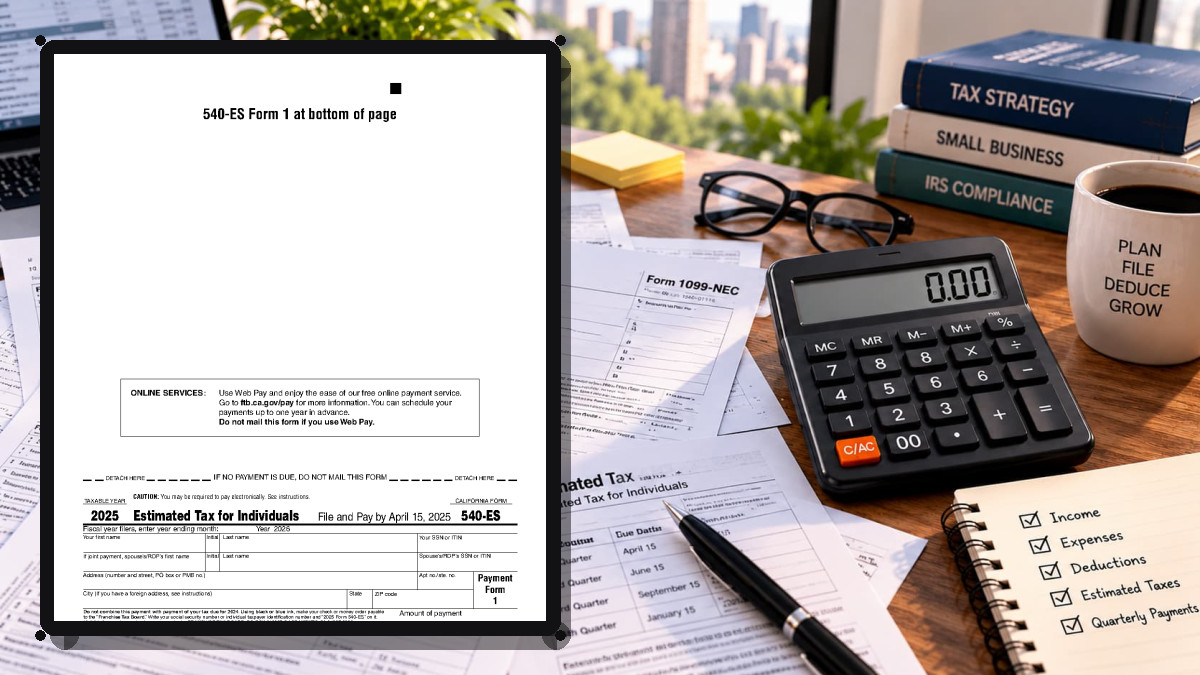
Fiscal year filers: enter the year-ending month if not on a calendar year.
Taxpayer information. First name, initial, last name, and SSN or ITIN; spouse’s/RDP’s information too if a joint payment.
Address. Number and street, PO box or PMB number, city, state, and ZIP code (with instructions for a foreign address).
Amount of payment. The dollar amount for that specific installment — 30%, 40%, 0%, or 30% of the year’s required total, per the schedule above, unless the annualized income installment method changes an individual payment.
Payment Form number. Each voucher (1 through 4) corresponds to its installment, so the FTB credits the payment to the right quarter.
Common Mistakes to Avoid
- Paying four equal 25% installments. California’s schedule is 30/40/0/30, not a flat quarter each time.
- Mailing a September payment out of habit. California’s 3rd installment is $0 — sending money anyway just becomes an early 4th-quarter payment.
- Using the 100% prior-year safe harbor without checking the AGI threshold. Over $150,000 ($75,000 MFS) in prior-year California AGI means 110% is required instead.
- Mailing a check after crossing the mandatory e-pay threshold. Once triggered, all future payments must be electronic or a 1% penalty applies.
- Combining an estimated payment with a prior-year balance-due payment in the same check or submission.
Frequently Asked Questions
Why is California’s estimated tax schedule 30/40/0/30 instead of four equal payments? That’s simply how California structures it — the state builds in a larger 2nd-quarter payment and skips the 3rd quarter entirely, unlike the federal system’s four equal installments.
Do I owe anything September 15 to California? No — the 3rd installment is 0%. (Federal estimated tax may still be due that date, which is a separate payment to the IRS.)
What’s the safe harbor to avoid a penalty? 90% of the current year’s tax, or 100% of last year’s tax — 110% if last year’s California AGI was over $150,000 ($75,000 married/RDP filing separately).
Can I skip the January payment? Yes, if you file the complete return and pay the full balance due by January 31 of the following year.
Where do I mail Form 540-ES? Franchise Tax Board, PO Box 942867, Sacramento CA 94267-0008.
Final Review Before Filing
- Expected shortfall after withholding and credits is checked against the $500/$250 threshold.
- The payment amount follows the 30/40/0/30 schedule, not four equal installments.
- The correct safe harbor (90% current year, 100% prior year, or 110% for higher AGI) is being targeted.
- The payment isn’t combined with a different tax year’s balance-due payment.
- Mandatory e-pay status is checked if a prior payment exceeded $20,000 or total tax exceeded $80,000.
- Payment is submitted via Web Pay or mailed to PO Box 942867, Sacramento CA 94267-0008, by the correct due date.
Sources & verification
- Issuing agency: California Franchise Tax Board
- Official documents: Form 540-ES (PDF)
- Checked against: Form 540-ES and published 2026 estimated tax guidance
- Last verified: September 16, 2026
Spot an error or an out-of-date figure? Tell us and we will check it against the official source.
General information from the official form and its instructions, not advice for your circumstances. See the full disclaimer.
More California Tax Forms forms
- California Form 100 — Corporation Franchise or Income Tax Return 2025-2026
- California Form 540 — Resident Income Tax Return 2025-2026
- California Form 540NR — Nonresident or Part-Year Resident Income Tax Return 2025-2026
- California Form 568 — Limited Liability Company Return of Income 2025-2026
- California Form DE 4 — Employee’s Withholding Allowance Certificate
- California FTB 3514 — California Earned Income Tax Credit
- California FTB 3522 — LLC Tax Voucher
- California FTB 3893 — Pass-Through Entity Elective Tax Payment Voucher
- California Schedule CA (540) — California Adjustments, Residents