
What is Form 540NR?
Quick answer: Form 540NR is the California Nonresident or Part-Year Resident Income Tax Return. You file it if you moved into or out of California during the year, or you were a nonresident who received California-source income. California taxes all your income while you lived in the state plus your California-source income while you were a nonresident, but it sets the tax rate by running your total income from all sources through the rate schedules, then applying that effective rate to your California taxable income. The return is due April 15, with an automatic extension to October 15 for filing only; tax is still due April 15.
The form works in two stages. First, Schedule CA (540NR) columns A through D compute your total adjusted gross income as if you had been a California resident all year; column E then isolates the items you received while a resident and those from California sources while a nonresident.
Because California applies an effective rate based on worldwide income, a nonresident with modest California income can still pay at a higher rate than the California income alone would suggest. If you were a resident of California for the entire year, you file Form 540 instead.
Key Figures — Form 540NR (2025 booklet)
- Who files: nonresidents who had California-source income, and individuals who moved into or out of California during the year.
- Due date: April 15 (April 15, 2026 for 2025 returns). Automatic extension for filing to October 15; use FTB 3519 for an extension payment.
- Tax computation: tax on total taxable income (line 19) divided by that income gives the California tax rate (line 36); multiply it by California taxable income (line 35). Use the tax table if line 19 is $100,000 or less, and the tax rate schedules above $100,000.
- Exemption credits are prorated: the CA exemption credit percentage (line 38) is California taxable income divided by total taxable income, up to 1.0000. For 2025 the credits begin to phase out when federal AGI exceeds $252,203 (single or married/RDP filing separately), $504,411 (joint or qualifying surviving spouse/RDP) or $378,310 (head of household).
- Estimated tax: installments of 30%, 40%, nothing, and 30% on April 15, June 15, September 15 and January 15; none is required if the tax due would be under $500 ($250 if married/RDP filing separately).
- Mandatory e-pay: once an estimated or extension payment exceeds $20,000, or an original return shows total tax over $80,000, all later payments must be electronic.
- Six sides: Form 540NR has six sides and you must send all of them; Side 6 must be signed.
Source: the Franchise Tax Board, 2025 540NR Tax Booklet. Last verified October 14, 2026.
Who Must File Form 540NR?
Use Form 540NR if you were a nonresident of California who received California-source income during the year, or you moved into or out of California during the year (a part-year resident). If you were a California resident the whole year, use Form 540 or Form 540 2EZ.
Nonresident members of pass-through entities may elect to file a group nonresident return on Form 540NR (FTB Pub. 1067 and Form FTB 1067A). Group returns can include fewer than two nonresident individuals; nonresident individuals with more than $1,000,000 of California taxable income can be included, but an additional 1% tax applies to their entire California taxable income.
Retirement income of a nonresident that is attributable to services performed in California and received after December 31, 1995 is not taxed by California; a pension attributable to out-of-state work that you receive after you become a California resident is taxable.
Special rules apply to military servicemembers domiciled outside California (military pay is excluded from California-source income, but their spouse’s nonmilitary income can still be taxed at a rate computed excluding military pay) and to Californians who work outside the state for an uninterrupted period of at least 546 consecutive days under an employment contract.
Common trap: assuming only your California income determines your rate. California computes the tax rate on your total income from all sources, so leaving out out-of-state income on Schedule CA (540NR) understates the rate.
How to File Form 540NR
- Complete your federal return first (Form 1040, 1040-SR or 1040-NR); Form 540NR is built from its numbers.
- Complete Schedule CA (540NR), columns A–D (income as a full-year resident) and E (income taxed by California), then Part IV for California adjusted gross income.
- Complete the exemption lines (7–11) and the income and deduction lines (12–19). Choose the larger of California itemized deductions or the California standard deduction on line 18.
- Compute the tax on line 31 and the ratio lines 32–39, or let tax software do it.
- Pay. Pay online with Web Pay, by credit card, or by EFW if you e-file. By check: make it payable to the “Franchise Tax Board,” write your SSN or ITIN and “2025 Form 540NR” on it, and enclose it unstapled. If you e-filed, mail a check with FTB 3582.
- Mail all six sides, signed on Side 6, to the right PO box, or e-file.
When Is Form 540NR Due?
The return and any tax owed are due April 15 (April 15, 2026 for tax year 2025). If you cannot file by then, California gives an automatic extension to October 15, with no form needed to file late, but the extension is only for filing: the amount you owe is due April 15, and interest and penalties run from that date. If April 15 falls on a weekend or holiday, the deadline moves to the next business day. People living or traveling outside the United States on April 15 have different dates; see FTB 3519. Estimated tax installments for the following year fall on April 15, June 15, September 15 and January 15.
Where to Mail Form 540NR
If you owe tax, mail the return to: Franchise Tax Board, PO Box 942867, Sacramento CA 94267-0001. If the return shows a refund or no amount due, mail it to: Franchise Tax Board, PO Box 942840, Sacramento CA 94240-0001. Enclose, but do not staple, any payment. Do not combine your tax payment and any estimated tax payment on one check.
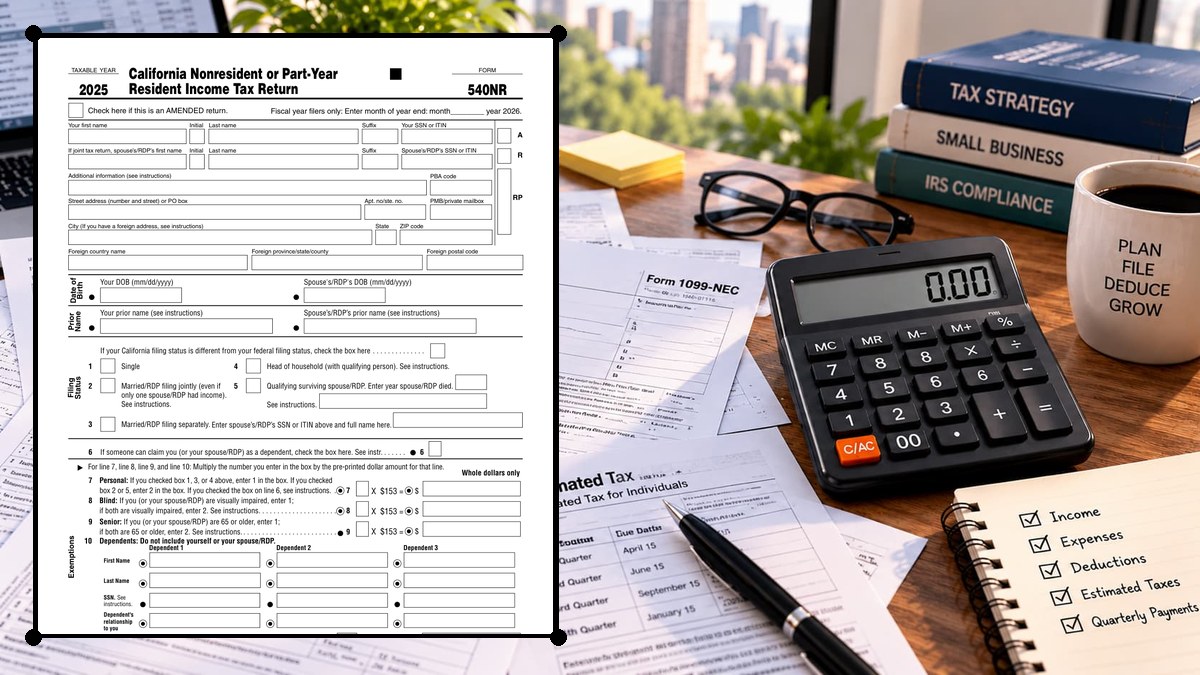
How to Complete Form 540NR Line by Line
Lines 1–11 — Filing Status and Exemption Credits
| Line | What to enter |
|---|---|
| Lines 1–5 | Filing status, which generally must match your federal status. Registered domestic partners who file single federally must file married/RDP jointly or separately for California, and a spouse who was a full-year nonresident with no California income, or a servicemember, may file separately even if you filed a joint federal return. |
| Line 6 | Checked if someone else can claim you as a dependent. |
| Lines 7–10 | The personal, blind, senior (65 or older by December 31) and dependent exemption credits; dependents must match your federal return. |
| Line 11 | Totals the exemption amount. |
Lines 12–19 — Wages, Federal AGI, Adjustments and Taxable Income
| Line | What to enter |
|---|---|
| Line 12 | California wages from Form W-2, box 16. |
| Line 13 | Federal AGI from line 11b of Form 1040, 1040-SR or 1040-NR. |
| Line 14 | Subtracts California adjustments from Schedule CA (540NR), Part II, line 27, column B. |
| Line 16 | Adds the adjustments from column C; a negative number is entered as a positive on the line instead. |
| Line 15 | The subtotal. |
| Line 17 | Adjusted gross income from all sources. |
| Line 18 | The California itemized or standard deduction. |
| Line 19 | Total taxable income. |
California does not conform to many federal changes under the One Big Beautiful Bill Act, so check Schedule CA for adjustments.
Lines 31–39 — Tax, California Rate and Prorated Exemption Credits
| Line | What to enter |
|---|---|
| Line 31 | Tax on line 19 from the tax table ($100,000 or less) or the tax rate schedule (over $100,000), or from FTB 3800 or 3803 for a child’s unearned income or a parent’s election. |
| Line 32 | California adjusted gross income from Schedule CA (540NR), Part IV, line 1. |
| Line 35 | California taxable income. |
| Line 36 | The California tax rate (the tax on total income divided by total taxable income, rounded to four decimal places). |
| Line 38 | The exemption credit percentage. |
| Line 39 | The prorated exemption credits, which an AGI limitation worksheet reduces above the AGI thresholds. |
Credits, Payments and Amount You Owe (Lines 81–125)
California credits and payments include withholding (line 81, California withholding only), real estate or other withholding from Forms 592-B and 593 (line 83), estimated tax payments, the California EITC (available with wage income or net self-employment earnings under $32,901), and payments made with FTB 3519.
| Line | What to enter |
|---|---|
| Line 121 | The amount you owe. |
| Line 122 | Interest and penalties. |
| Line 123 | The underpayment of estimated tax (attach FTB 5805 or 5805F). |
| Line 124 | The total amount due. |
| Line 125 | The refund or no-amount-due line. |
Signing, Amending and Group Returns
Sign Side 6 and send all six sides. To amend, file a new Form 540NR with the amended box checked and attach Schedule X explaining each change. If the IRS changes your federal return, report the change to the FTB within six months when it increases your California tax. A group nonresident return needs Form FTB 1067A attached.
Common Mistakes to Avoid
- Leaving out income taxed by other states on Schedule CA. Total income sets the rate, even though only California-source income is taxed.
- Mailing fewer than six sides. All six must be sent and Side 6 must be signed.
- Claiming the wrong exemption credit. Line 38 prorates credits, and high-AGI taxpayers are subject to the limitation worksheet.
- Combining checks. Prepare separate checks for your balance due and any next-year estimated payment.
- Claiming wrong withholding. Claim only California income tax withheld, and verify Form 592-B and 593 amounts.
- Treating the extension as a payment extension. The October 15 date is for filing only; pay by April 15.
- Using Form 540 when you moved during the year. A part-year resident files Form 540NR.
Frequently Asked Questions
Who files Form 540NR? Nonresidents with California-source income and people who moved into or out of California during the year.
How does California tax a nonresident? It taxes your California-source income, but sets the rate by running your total income from all sources through the rate schedules.
When is Form 540NR due? April 15, with an automatic extension to October 15 for filing; tax is due April 15.
Do I need to send all pages? Yes. Form 540NR has six sides and Side 6 must be signed.
Is nonresident retirement income taxed? California does not tax retirement income attributable to California services received by a nonresident after December 31, 1995.
Can nonresident partners file a group return? Yes, on a group Form 540NR with Form FTB 1067A; see FTB Pub. 1067.
Final Review Before Filing
- Your federal return is complete and matches the numbers carried over.
- Schedule CA (540NR) columns A–E and Part IV are complete.
- Your exemption credits are prorated using line 38 (and limited if AGI is high).
- Only California withholding is claimed.
- All six sides are sent, and Side 6 is signed.
- Payment is included or made online by April 15.
- The return is mailed to the correct PO box for tax due or refund.
Sources & verification
- Issuing agency: California Franchise Tax Board
- Official documents: Form 540NR (PDF) · 2025 540NR Tax Booklet (PDF)
- Checked against: Form 540NR (2025) and the 2025 540NR Tax Booklet
- Last verified: October 14, 2026
Spot an error or an out-of-date figure? Tell us and we will check it against the official source.
General information from the official form and its instructions, not advice for your circumstances. See the full disclaimer.
More California Tax Forms forms
- California Form 100 — Corporation Franchise or Income Tax Return 2025-2026
- California Form 540 — Resident Income Tax Return 2025-2026
- California Form 540-ES — Estimated Tax for Individuals
- California Form 568 — Limited Liability Company Return of Income 2025-2026
- California Form DE 4 — Employee’s Withholding Allowance Certificate
- California FTB 3514 — California Earned Income Tax Credit
- California FTB 3522 — LLC Tax Voucher
- California FTB 3893 — Pass-Through Entity Elective Tax Payment Voucher
- California Schedule CA (540) — California Adjustments, Residents