
What is Schedule CA (540)?
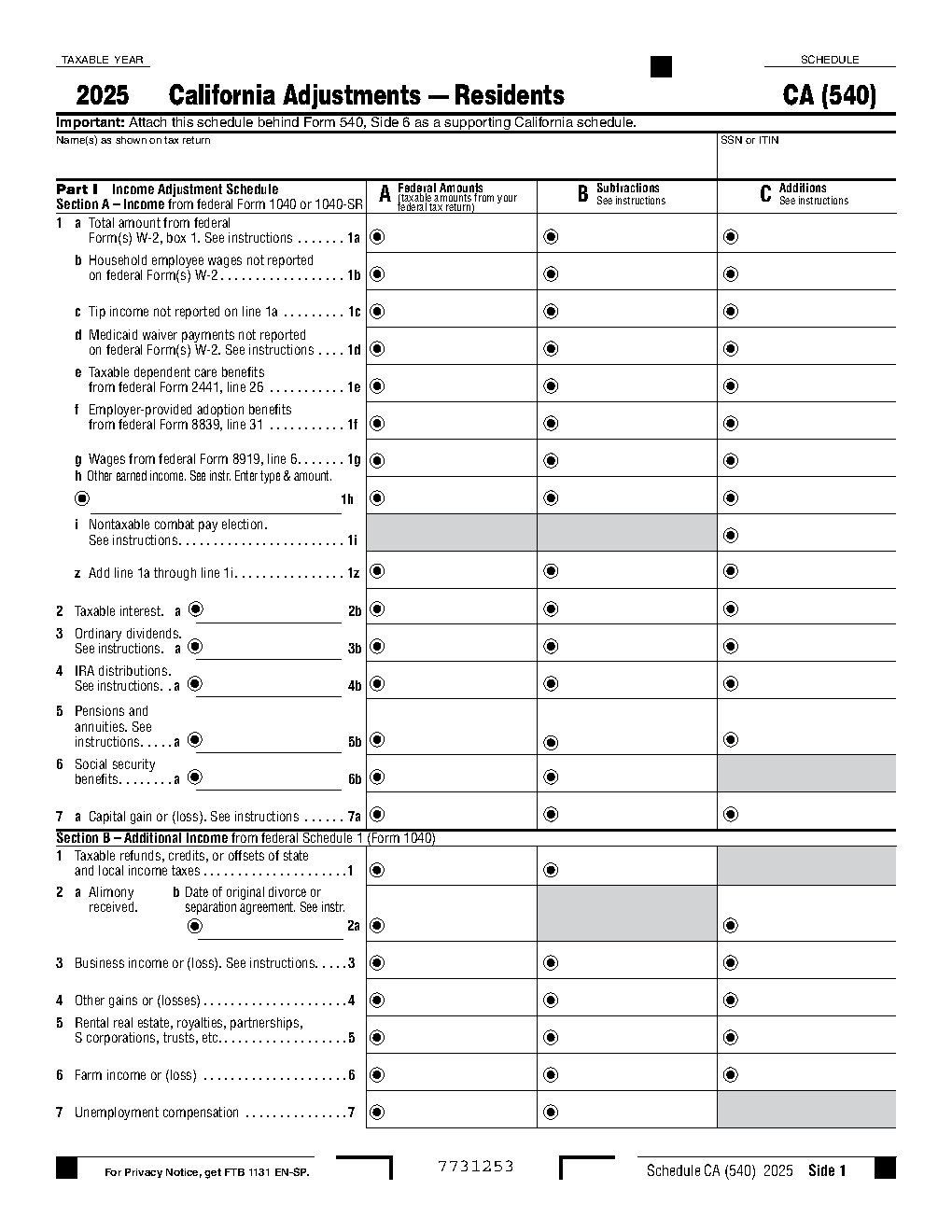
Quick answer: Schedule CA (540), California Adjustments — Residents, is the worksheet that turns your federal income into what California actually taxes. It walks every major federal income line through three columns — the federal amount, a subtraction column, and an addition column — because California and federal law disagree on a long list of items. The best-known subtraction is Social Security benefits, which California never taxes at all. Schedule CA is not filed on its own: it attaches behind Form 540, Side 6, and its column B and column C totals carry forward to Form 540, lines 14 and 16.
Federal adjusted gross income is the starting point for a California return, but California doesn’t tax income the same way the IRS does. Some income the IRS taxes, California exempts — Social Security is the largest example, along with California lottery winnings and certain retirement income. Some income the IRS doesn’t touch, California does — interest from another state’s municipal bonds is the classic case. Schedule CA (540) is where every one of these differences is itemized, line by line, matching the structure of the federal Form 1040 and Schedule 1 so each federal figure has a same-numbered California adjustment right next to it.
Key Figures — Tax Year 2025 (Schedule CA (540))
- Social Security benefits (line 6): fully subtracted — column C (additions) is blocked out, because California never taxes Social Security under any circumstances.
- Unemployment compensation (line 7, Section B): also fully subtracted — California does not tax unemployment benefits either.
- Military retirement exclusion (new for 2025–2029): up to $20,000 of federal military retirement pay or Survivor Benefit Plan annuity income can be subtracted.
- Schedule CA has two parts: Part I (income adjustments, Sections A and B) and Part II (itemized deductions, for anyone who itemizes instead of taking Form 540’s standard deduction).
- Part I, line 27 totals carry to Form 540: column B (subtractions) to line 14, column C (additions) to line 16. Part II’s line 30 (itemized deductions) feeds Form 540, line 18.
Who Must File Schedule CA (540)?
Any full-year California resident filing Form 540 who has at least one item that California treats differently from the federal government completes Schedule CA (540). This covers most retirees drawing Social Security, anyone with out-of-state municipal bond interest, and anyone itemizing deductions for California instead of taking the standard deduction.
Someone whose income has no California-federal differences at all can, in principle, skip Schedule CA — but this is uncommon, since Social Security alone (a subtraction almost every retired filer has) triggers the requirement.
How to File Schedule CA (540)
- Attach it behind Form 540, Side 6 — Schedule CA is never filed by itself.
- Work through Part I first, matching each federal income line to its California subtraction or addition, then total column B and column C on line 27.
- Complete Part II only if itemizing California deductions instead of taking Form 540’s standard deduction.
- Carry the totals forward: line 27 column B to Form 540 line 14, column C to Form 540 line 16, and Part II line 30 to Form 540 line 18 if itemizing.
When Is Schedule CA (540) Due?
Same deadline as Form 540: April 15, 2026 for the 2025 tax year, with California’s automatic extension to file to October 15, 2026 (not an extension to pay).
Where to Send Schedule CA (540)
Schedule CA is mailed together with Form 540, never separately. Use the same address as the 540: PO Box 942867, Sacramento CA 94267-0001 if a payment is enclosed, or PO Box 942840, Sacramento CA 94240-0001 for a refund or no amount due.
How to Complete Schedule CA (540) Line by Line
Part I, Section A — Income from federal Form 1040
Line 1a–1z: Wages and related income. Total W-2 box 1 wages, household employee wages not on a W-2, unreported tip income, Medicaid waiver payments, taxable dependent care benefits, employer-provided adoption benefits, and other earned income — each broken into its own sub-line, then added on line 1z.
Line 2 — Taxable interest. Column B commonly subtracts interest from U.S. government obligations that California doesn’t tax; column C adds interest from other states’ municipal bonds, which California does tax even though the IRS doesn’t.
Lines 3–5 — Dividends, IRA distributions, pensions and annuities. Adjusted where California’s tax treatment of retirement account distributions or dividend income differs from federal.
Line 6 — Social Security benefits. The full federally-taxable amount is subtracted in column B. Column C (additions) is not available on this line — California never taxes Social Security, so there is nothing to add back.
Line 7a — Capital gain or loss. Adjusted for differences in basis or holding-period rules between federal and California law, when they apply.
Part I, Section B — Additional income from federal Schedule 1
Line 1 — Taxable refunds, credits, or offsets of state and local income taxes. Generally subtracted in column B, since a state refund included in federal income was never taxed by California in the first place.
Line 2 — Alimony received. Adjusted based on when the divorce or separation agreement was executed, since California’s conformity to the federal alimony rules changed for agreements after December 31, 2025.
Lines 3–6 — Business income, other gains, rental/royalty/partnership/S-corp income, and farm income. Adjusted for any California-specific basis, depreciation, or passive-activity differences.
Line 7 — Unemployment compensation. Fully subtracted in column B. Like Social Security, column C is not available here — California does not tax unemployment benefits at all.
Common Mistakes to Avoid
- Skipping Schedule CA because “nothing seems different.” Social Security alone applies to nearly every retiree, and it must be subtracted here — Form 540 has no line for it directly.
- Filing Schedule CA separately from Form 540. It is always an attachment, never a stand-alone filing.
- Missing the new military retirement exclusion (up to $20,000, available 2025–2029) for a qualifying taxpayer.
- Forgetting that Social Security and unemployment have no addition-column entry — don’t try to force a number into column C on those lines.
- Not completing Part II before assuming the Form 540 standard deduction is the better option — many filers have more California itemized deductions than they expect.
Frequently Asked Questions
Do I always need to file Schedule CA (540)? If you have any income item California treats differently from the federal government — Social Security being the most common — yes. Otherwise it can be skipped, though this is rare in practice.
Is my Social Security taxed by California? No, never. It is fully subtracted on Schedule CA (540), line 6, column B.
Does California tax unemployment benefits? No. Like Social Security, unemployment compensation is fully subtracted on line 7 of Section B.
Where do Schedule CA’s totals go? Part I, line 27, column B (subtractions) goes to Form 540, line 14; column C (additions) goes to Form 540, line 16. Part II’s itemized-deduction total goes to Form 540, line 18.
Is there a new military retirement subtraction? Yes — for 2025 through 2029, up to $20,000 of federal military retirement pay or Survivor Benefit Plan annuity income can be excluded.
Final Review Before Filing
- Every federal income line has been checked against its Schedule CA subtraction or addition.
- Social Security benefits (line 6) and unemployment compensation (line 7) are fully subtracted, with nothing entered in the addition column.
- The military retirement exclusion is claimed if it applies.
- Part II is completed if itemizing California deductions.
- Line 27 column B and column C totals match what’s entered on Form 540, lines 14 and 16.
- Schedule CA is attached behind Form 540, Side 6 — not mailed separately.
Sources & verification
- Issuing agency: California Franchise Tax Board
- Official documents: Schedule CA (540) (PDF) · Schedule CA (540) instructions
- Checked against: 2025 Schedule CA (540) and its instructions
- Last verified: September 16, 2026
Spot an error or an out-of-date figure? Tell us and we will check it against the official source.
General information from the official form and its instructions, not advice for your circumstances. See the full disclaimer.
More California Tax Forms forms
- California Form 100 — Corporation Franchise or Income Tax Return 2025-2026
- California Form 540 — Resident Income Tax Return 2025-2026
- California Form 540-ES — Estimated Tax for Individuals
- California Form 540NR — Nonresident or Part-Year Resident Income Tax Return 2025-2026
- California Form 568 — Limited Liability Company Return of Income 2025-2026
- California Form DE 4 — Employee’s Withholding Allowance Certificate
- California FTB 3514 — California Earned Income Tax Credit
- California FTB 3522 — LLC Tax Voucher
- California FTB 3893 — Pass-Through Entity Elective Tax Payment Voucher