What is FTB 3514?
Quick answer: FTB 3514 figures the California Earned Income Tax Credit (CalEITC) — worth up to $3,756 for 2025 — plus, on the same form, the Young Child Tax Credit and the Foster Youth Tax Credit. Unlike the federal EITC, CalEITC does not require a qualifying child: a working individual earning up to about $32,900 for 2025 can claim it alone. It attaches to Form 540, Form 540 2EZ, or Form 540NR and can produce a refund even if no California tax is otherwise owed. Claiming it while knowing you don’t qualify can bar you from the credit for up to ten years, so the eligibility questions in Part I matter.
CalEITC is California’s own refundable credit for lower- and moderate-income working households, layered on top of (and separate from) the federal EIC. FTB 3514 is the single form that calculates all three related credits — CalEITC itself, the Young Child Tax Credit (YCTC) for a qualifying child under age 6, and the Foster Youth Tax Credit (FYTC) for filers age 18–25 who were formerly in foster care — since eligibility for the later two depends on first qualifying for CalEITC.
Key Figures — Tax Year 2025 (FTB 3514)
- Maximum CalEITC: $3,756 for 2025, for a working family or individual earning up to about $32,900.
- No qualifying child is required to claim CalEITC — unlike the federal EITC, an individual with no dependents can still qualify.
- You must report your date of birth (and spouse’s/RDP’s DOB if filing jointly) on the California return to claim the credit.
- The Young Child Tax Credit applies with a qualifying child under age 6; it’s also available with $0 earned income in cases where CalEITC itself would otherwise have applied.
- The Foster Youth Tax Credit applies to filers age 18–25 who were in California foster care at age 13 or older.
- Knowingly claiming CalEITC while ineligible can bar the credit for up to 10 years.
Who Must File FTB 3514?
Any working Californian with earned income up to roughly $32,900 for 2025 who wants to claim CalEITC files FTB 3514 — with or without a qualifying child. It’s also required to claim the Young Child Tax Credit (a qualifying child under 6) or the Foster Youth Tax Credit (filers 18–25, formerly in California foster care at 13 or older), since both ride on the same form.
Common trap: filers assume they need a qualifying child to claim any California credit on this form, the way the federal EITC often works in practice. CalEITC itself never requires one — a single filer with no dependents can qualify on earned income alone.
How to File FTB 3514
- Attach it to Form 540, Form 540 2EZ, or Form 540NR — FTB 3514 is not filed on its own.
- Report your date of birth (and your spouse’s/RDP’s, if filing jointly) directly on the California return — this is required to claim the credit, separate from the form itself.
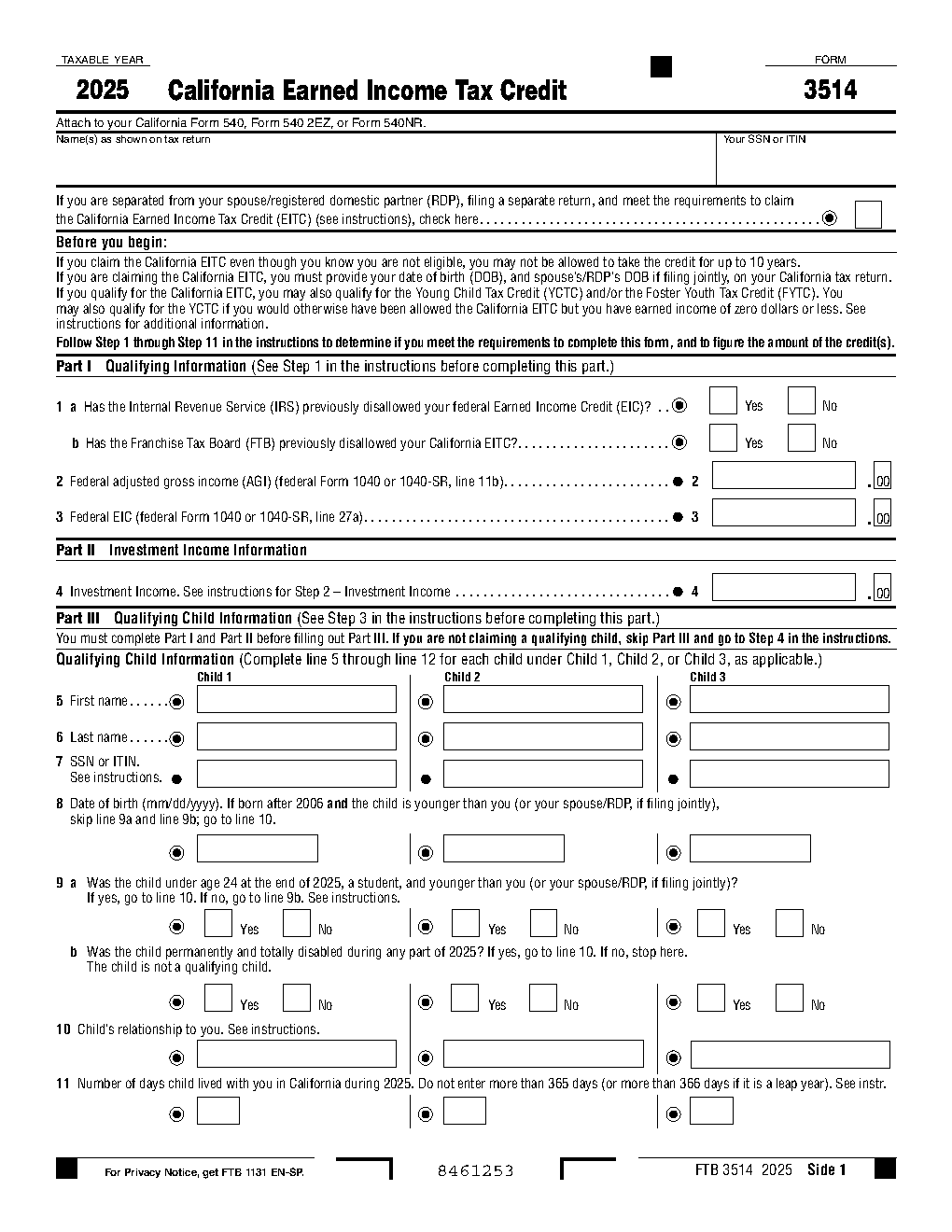
- Complete Part I and Part II first, then Part III only if claiming a qualifying child for the Young Child Tax Credit; skip Part III and go to the instructions’ Step 4 if not claiming a child.
- The credit amounts carry to Form 540: CalEITC to line 75, Young Child Tax Credit to line 76, Foster Youth Tax Credit to line 77.
When Is FTB 3514 Due?
Same deadline as the return it’s attached to — April 15, 2026 for the 2025 tax year, with California’s automatic extension to file to October 15, 2026.
Where to Send FTB 3514
FTB 3514 is mailed together with Form 540 (or 540 2EZ / 540NR), never separately, to the same address as the return: PO Box 942867, Sacramento CA 94267-0001 with a payment, or PO Box 942840, Sacramento CA 94240-0001 for a refund or no amount due.
How to Complete FTB 3514 Line by Line
Part I — Qualifying Information
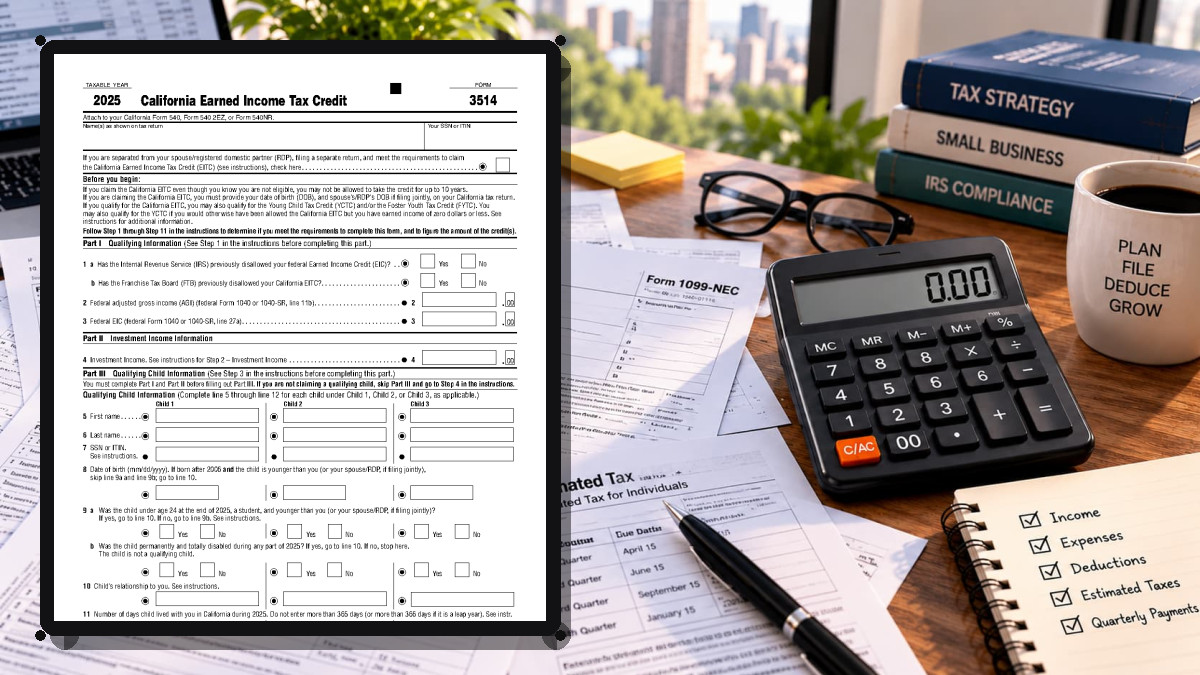
Line 1a: Has the IRS previously disallowed your federal Earned Income Credit? Yes/No.
Line 1b: Has the FTB previously disallowed your California EITC? Yes/No — a prior disallowance can affect current eligibility and may require additional documentation.
Line 2: Federal adjusted gross income, from federal Form 1040 or 1040-SR, line 11b.
Line 3: Federal EIC, from federal Form 1040 or 1040-SR, line 27a.
Part II — Investment Income
Line 4: Investment income. Interest, dividends, and similar investment income, calculated per the instructions — CalEITC, like the federal EITC, has an investment-income limit that can disqualify an otherwise-eligible filer.
Part III — Qualifying Child Information
Complete for up to three children (Child 1, Child 2, Child 3), only after Parts I and II are done. Skip entirely if not claiming a qualifying child.
Lines 5–6: First and last name of each qualifying child.
Line 7: Social Security number or ITIN.
Line 8: Date of birth. If the child was born after 2006 and is younger than the taxpayer (or spouse/RDP if filing jointly), skip lines 9a and 9b and go to line 10.
Line 9a: Was the child under 24 at the end of 2025, a student, and younger than the taxpayer? If yes, go to line 10; if no, go to line 9b.
Line 9b: Was the child permanently and totally disabled during any part of 2025? If yes, go to line 10; if no, the child does not qualify.
Line 10: Child’s relationship to the taxpayer.
Line 11: Number of days the child lived with the taxpayer in California during 2025 — not more than 365 days (366 in a leap year).
Common Mistakes to Avoid
- Assuming a qualifying child is required for CalEITC. It isn’t — only for the Young Child Tax Credit and, separately, the Foster Youth Tax Credit criteria.
- Filing FTB 3514 without also entering date of birth on the return. That’s a separate, required step, not covered by the form alone.
- Skipping Part II’s investment-income check. Exceeding the investment-income limit can disqualify an otherwise-eligible earner.
- Claiming the credit despite knowing you don’t qualify. This risks a ban on the credit for up to 10 years, not just a one-time denial.
- Forgetting the Foster Youth Tax Credit if you’re 18–25 and were in California foster care at 13 or older — it’s easy to overlook since it’s the least-known of the three credits on this form.
Frequently Asked Questions
Do I need a qualifying child to claim CalEITC? No. Working individuals without dependents can qualify based on earned income alone.
How much is the CalEITC worth? Up to $3,756 for 2025, for earned income up to about $32,900.
What other credits does this form calculate? The Young Child Tax Credit (qualifying child under 6) and the Foster Youth Tax Credit (filers 18–25, former foster youth), both of which build on CalEITC eligibility.
What happens if I claim CalEITC and I’m not actually eligible? If you knew you weren’t eligible, you may be barred from claiming the credit for up to 10 years.
Where does FTB 3514 attach? Behind Form 540, Form 540 2EZ, or Form 540NR — it’s never filed by itself.
Final Review Before Filing
- Part I’s disallowance history questions (1a, 1b) are answered accurately.
- Federal AGI and federal EIC (lines 2–3) match the federal return.
- Investment income (Part II) is checked against the CalEITC limit.
- Part III is completed for each qualifying child, or skipped entirely if none is claimed.
- Date of birth is entered on the California return itself, not just on this form.
- FTB 3514 is attached behind Form 540, 540 2EZ, or 540NR.
Sources & verification
- Issuing agency: California Franchise Tax Board
- Official documents: FTB 3514 (PDF)
- Checked against: 2025 FTB 3514 and its instructions booklet
- Last verified: September 16, 2026
Spot an error or an out-of-date figure? Tell us and we will check it against the official source.
General information from the official form and its instructions, not advice for your circumstances. See the full disclaimer.
More California Tax Forms forms
- California Form 100 — Corporation Franchise or Income Tax Return 2025-2026
- California Form 540 — Resident Income Tax Return 2025-2026
- California Form 540-ES — Estimated Tax for Individuals
- California Form 540NR — Nonresident or Part-Year Resident Income Tax Return 2025-2026
- California Form 568 — Limited Liability Company Return of Income 2025-2026
- California Form DE 4 — Employee’s Withholding Allowance Certificate
- California FTB 3522 — LLC Tax Voucher
- California FTB 3893 — Pass-Through Entity Elective Tax Payment Voucher
- California Schedule CA (540) — California Adjustments, Residents