
What is Form IT-203?
Quick answer: Form IT-203 is the New York State return for people who were nonresidents or part-year residents in 2025 and had income from New York sources. It works in two steps: you first calculate a base tax as if you had been a full-year resident, then apply an income percentage (New York income divided by total federal income) to find the tax actually owed to New York. Full-year residents file Form IT-201 instead. For tax year 2025 the return was due April 15, 2026, or October 15, 2026 with an approved extension.
Commuters who live in New Jersey, Connecticut or Pennsylvania but work in New York, people who moved into or out of the state during the year, and owners of New York rental property or business interests all use IT-203. New York taxes income earned or received while you lived in the state, plus New York source income earned while you lived elsewhere. Everything else stays out of the New York tax base, but it still counts in the calculation that sets your rate.
Because the form shows a Federal amount column next to a New York State amount column on every income line, most of the work is deciding which dollars belong in the second column. Form IT-203-B (Nonresident and Part-Year Resident Income Allocation and College Tuition Itemized Deduction Worksheet) helps with that allocation.
Key Figures — Tax Year 2025 (Form IT-203)
- Filing test for nonresidents: you must file if you have New York source income and your New York adjusted gross income (Federal amount column, line 31) is more than your New York standard deduction.
- You must also file to claim a refund of New York State, New York City or Yonkers tax withheld, or to claim refundable or carryover credits.
- Standard deduction: $8,000 single, $16,050 married filing jointly, $8,000 married filing separately, $11,200 head of household.
- Dependent exemption: $1,000 per dependent listed in item I.
- Income percentage (line 45) is the New York State amount on line 31 divided by the Federal amount on line 31, rounded to four decimal places and entered as a decimal such as 0.3333.
- Due date: April 15, 2026; October 15, 2026 with an extension on Form IT-370.
Source: the New York State Department of Taxation and Finance, 2025 Form IT-203 and Form IT-203-I instructions. Last verified September 29, 2026.
Who Must File Form IT-203?
You file Form IT-203 if you were a nonresident of New York for all of 2025 or a part-year resident, and at least one of these is true:
- you had income from a New York source and your New York adjusted gross income in the Federal amount column is more than your New York standard deduction;
- you want a refund of New York State, New York City or Yonkers tax withheld from your pay or unemployment benefits;
- you want to claim New York refundable or carryover credits;
- you were a part-year resident subject to the separate tax on lump-sum distributions (Form IT-230); or
- you had a New York net operating loss without a matching federal one.
For nonresidents, New York source income includes income from real or tangible property in New York, services performed in the state, a business carried on in New York, your share of New York partnership, S corporation, estate and trust income, and New York lottery prizes over $5,000. For part-year residents it is all income received while you lived in New York plus the New York source income from the period you lived elsewhere. If one spouse was a full-year resident and the other was not, each files a separate return unless you both elect to file a joint IT-201.
Common trap: commuters often assume that because their employer withholds New York tax they have nothing more to do. A nonresident who worked in New York must still file to reconcile the withholding and get any of it back.
How to File Form IT-203
- Complete lines 1 through 31 first. Every income line has a Federal amount and a New York State amount; the filing test compares line 31 (Federal amount) with your standard deduction.
- Complete Form IT-203-B when you need to allocate income or the college tuition itemized deduction; part-year residents with accrual items use Schedule A of that form.
- Attach other forms that apply, such as Form IT-203-ATT for credits and other taxes, Form IT-196 for itemized deductions, and Form IT-225 for other modifications.
- E-file if you can; paper filers should use black ink, whole dollars and an X (not a check mark) in boxes.
- Pay by check only with Form IT-201-V, or by electronic funds withdrawal or Online Services.
When Is Form IT-203 Due?
The 2025 return was due April 15, 2026. If you filed Form IT-370 and paid what you owed by that date, you have until October 15, 2026 to file. Any tax not paid by April 15 still accrues interest and penalties.
Where to Mail Form IT-203
- With a payment (check or money order and Form IT-201-V): State Processing Center, PO Box 15555, Albany NY 12212-5555.
- Without a payment: State Processing Center, PO Box 61000, Albany NY 12261-0001.
How to Complete Form IT-203 Line by Line
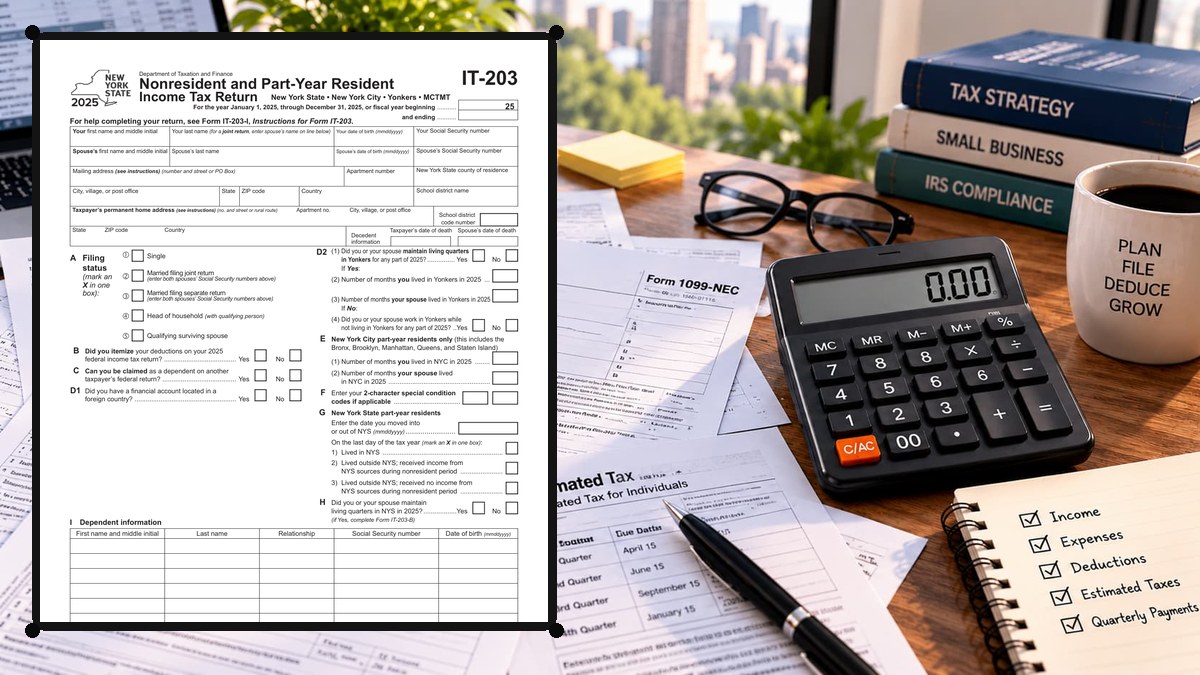
Page 1 — Filing Status and Residency Items (A–I)
Item A: Filing status. Single, married filing joint, married filing separate, head of household, or qualifying surviving spouse. For joint or separate returns, enter both spouses’ Social Security numbers.
Items B, C and D1. Whether you itemized federally, whether you can be claimed as a dependent, and whether you had a foreign financial account.
Item D2 and item E. D2 covers Yonkers living quarters and work. E applies only to New York City part-year residents and asks for months lived in the city.
Item F: Special condition codes. Two-character codes when a listed condition applies, such as the code for Build America Bond interest.
Items G and H: Part-year residents. Item G asks for the date you moved into or out of New York and where you lived on the last day of the year: in New York; outside New York with New York source income; or outside New York with none. Item H asks whether you or your spouse maintained living quarters in New York in 2025. If Yes, you must complete Schedule B on Form IT-203-B.
Item I: Dependents. Name, relationship, Social Security number and date of birth for each dependent; each is worth a $1,000 exemption on line 35.
Lines 1–19 — Federal and New York Income
Report each income type twice. The Federal amount column copies your federal return: wages (line 1), interest, dividends, state refunds (line 4), business income (line 6, with Schedule C), capital gains, IRA and pension income, rental and partnership income (line 11, with Schedule E), farm income, unemployment compensation, taxable Social Security and other income. The New York State amount column contains only the part that is New York source income, or, for part-year residents, income from your resident period plus New York source income from the rest of the year. Line 19 is federal adjusted gross income.
Lines 20–32 — Additions, Subtractions and New York AGI
Additions cover interest on other states’ bonds (line 20), public employee 414(h) contributions (line 21) and items from Form IT-225 (line 22). Subtractions cover state tax refunds (line 24), government pensions (25), taxable Social Security (26), U.S. government bond interest (27), the pension and annuity exclusion (28, up to $20,000, allocated if the income came from inside and outside New York) and other items (29). Line 31 is New York adjusted gross income in both columns. Line 32 repeats the Federal amount from line 31.
Lines 33–36 — Deduction, Exemptions and Taxable Income
Enter the larger of the New York standard deduction or the itemized deduction from Form IT-196 on line 33 and mark the matching box. Subtract it from line 32 (line 34), subtract $1,000 for each dependent (line 35), and the result on line 36 is New York taxable income as if you were a full-year resident.
Lines 37–46 — Base Tax and Income Percentage
Line 38 is the state tax on that amount. Subtract the household credit (line 39), the child and dependent care credit (line 41) and the New York earned income credit (line 43) to reach the base tax on line 44. Line 45 is the income percentage: New York State amount from line 31 divided by Federal amount from line 31, as a decimal rounded to four places (enter 0 if either amount is zero or less). Line 46 multiplies the base tax by that decimal, which gives the allocated New York State tax.
Lines 47–58 — Credits, City Taxes and Use Tax
Line 47 takes nonrefundable credits from Form IT-203-ATT and line 49 adds other New York taxes from the same attachment. Lines 51 to 55 handle part-year New York City resident tax and Yonkers surcharges (Form IT-360.1), the nonresident Yonkers earnings tax (Form Y-203) and the Metropolitan Commuter Transportation Mobility Tax. Line 56 is sales or use tax and must not be left blank; enter 0 if you owe none. Line 57 is for voluntary contributions and line 58 is the grand total.
Lines 59 to End — Payments, Refund or Amount Owed
Line 60 covers the part-year New York City school tax credit, and line 61 other refundable credits from Form IT-203-ATT. Lines 62 to 64 report New York State, New York City and Yonkers tax withheld from your W-2s and 1099-Gs. Line 65 is estimated tax payments and any amount paid with Form IT-370. Add them on line 66; if that exceeds line 59 the difference is your overpayment, which you can take as a refund or apply to 2026 estimated tax. If line 66 is smaller than line 59 you owe the difference. Enter bank details for direct deposit or withdrawal, then sign and date the return.
Common Mistakes to Avoid
- Filing IT-201 as a part-year resident. IT-201 is for full-year residents only; it would tax all your income as a resident.
- Putting all income in the New York column. Only New York source income (and resident-period income for part-year residents) belongs there.
- Skipping Form IT-203-B when item H says you kept living quarters in New York.
- Entering the income percentage as a percentage. Enter 0.3333, not 33.33%.
- Leaving line 56 blank. Use tax must be reported or the line must show 0.
- Not filing because only withholding was paid. Refunds of withheld New York tax require a return.
- Letting an extension push the payment date. IT-370 extends time to file, not time to pay.
Frequently Asked Questions
Which return do I file if I lived in New York only part of the year? Form IT-203. Form IT-201 is only for those who were residents for the entire year.
Do commuters from New Jersey or Connecticut file IT-203? Yes, if they earned income in New York and meet the filing test, or if they want a refund of New York tax withheld.
How is the New York tax calculated? You first compute tax as if you were a full-year resident, then multiply it by the income percentage on line 45.
Can I e-file IT-203? Yes. Tax software that supports it is the fastest route to a refund.
Is there a separate New York City return? No. Part-year New York City resident tax, Yonkers taxes and MCTMT are all reported on IT-203.
Final Review Before Filing
- Residency status is nonresident or part-year for 2025, not full-year resident.
- Item G dates and item H answers are complete for part-year residents.
- Every income line has both the Federal and the New York State amount.
- Form IT-203-B is attached when required.
- The income percentage on line 45 is a four-place decimal.
- Line 56 has an amount or a 0.
- Credit forms and IT-201-V (if paying by check) are enclosed.
- Signed, and mailed to the correct PO box for payment or no payment.
Sources & verification
- Issuing agency: New York State Department of Taxation and Finance
- Official documents: Form IT-203 (PDF) · Form IT-203-I instructions (PDF)
- Checked against: 2025 Form IT-203 and 2025 Form IT-203-I
- Last verified: September 29, 2026
Spot an error or an out-of-date figure? Tell us and we will check it against the official source.
General information from the official form and its instructions, not advice for your circumstances. See the full disclaimer.
More New York Tax Forms forms
- New York Form IT-201 — Resident Income Tax Return 2025-2026
- New York Form IT-201-X — Amended Resident Income Tax Return 2025-2026
- New York Form IT-2104 — Employee’s Withholding Allowance Certificate
- New York Form IT-2105 — Estimated Tax Payment Voucher for Individuals
- New York Form IT-214 — Claim for Real Property Tax Credit for Homeowners and Renters
- New York Form IT-370 — Application for Automatic Six-Month Extension of Time to File for Individuals
- New York Form NYS-45 — Quarterly Combined Withholding, Wage Reporting, and Unemployment Insurance Return
- New York Form ST-100 — New York State and Local Quarterly Sales and Use Tax Return