

What is Schedule ICR?
Quick answer: Schedule ICR is attached to Form IL-1040 to claim three nonrefundable Illinois credits: the Property Tax Credit, the K-12 Education Expense Credit, and the Volunteer Emergency Worker Credit. The Property Tax Credit is 5% of the Illinois property tax paid on your principal home; the education credit is 25% of qualifying K-12 costs above the first $250, capped at $750 per family; the volunteer credit is a fixed amount that requires a certificate from the state. Together the three cannot exceed the tax you owe. The total from Line 13 goes to Form IL-1040, Line 16. This guide is a plain-English companion to the Schedule ICR instructions, line by line.
Schedule ICR is the worksheet that calculates Illinois’s three main nonrefundable individual credits and limits them to the tax you actually owe. It works down a chain: it starts from your income tax, subtracts the credit for tax paid to other states, then lets the Property Tax Credit reduce what is left, then the K-12 Education Expense Credit reduces what remains after that, then the Volunteer Emergency Worker Credit. Whatever tax is already covered blocks the next credit.
The schedule collects the property tax you paid on your principal residence and its property index number, your qualifying K-12 education expenses per student, and your volunteer emergency worker certificate number. Completing it correctly matters because each credit is capped, the credits run in a fixed order, the education credit needs a completed worksheet and school receipts, and higher-income filers are shut out of two of the three.
Key Figures — Tax Year 2025 (Schedule ICR, revision R-12/25)
- Property Tax Credit: 5% (0.05) of Illinois property tax paid during the year on your principal residence (Line 4g).
- K-12 Education Expense Credit: 25% (0.25) of qualifying expenses above the first $250, capped at $750 per family (Lines 7b–7d).
- Volunteer Emergency Worker Credit: $500 per awarded person, or $1,000 if married filing jointly and both spouses were awarded; requires a certificate issued by the Illinois Department of Revenue (Line 10c).
- All three credits combined cannot exceed your tax due (the Line 3 → Line 6 → Line 9 chain).
- Income limit: the Property Tax Credit and the K-12 Education Expense Credit are not allowed if your adjusted gross income is over $500,000 (married filing jointly) or $250,000 (all other filers). The Volunteer Emergency Worker Credit has no such limit.
- You must complete Form IL-1040 through Line 14, and Schedule CR if applicable, before this schedule.
- Source: Illinois Department of Revenue — 2025 Schedule ICR (revision R-12/25).
- Last verified: 2026-09-08
Who Must File Illinois Schedule ICR?
File Schedule ICR if you are claiming any of:
The Illinois Property Tax Credit — you owned and paid property tax during the year on the Illinois real estate that is your principal residence, and your income is under the AGI limit. Renters do not qualify; the tax must have been paid on a home you own.
The K-12 Education Expense Credit — you paid more than $250 in qualifying tuition, book fees, or lab fees for a dependent full-time K-12 student under 21 enrolled at an Illinois public, nonpublic, or home school, and your income is under the AGI limit.
The Volunteer Emergency Worker Credit — you (or your spouse) received a Volunteer Emergency Worker Credit Certificate from the Illinois Department of Revenue for the year.
Who should not file it. Anyone with no property tax, no qualifying education expenses, and no volunteer certificate; renters claiming a “property tax credit” they are not entitled to; and higher-income filers claiming the property tax or education credit above the AGI limit.
How to File Illinois Schedule ICR
- Attach it to Form IL-1040. Complete Form IL-1040 through Line 14 (and Schedule CR if you paid tax to another state) first, then complete Schedule ICR, then enter Line 13 on Form IL-1040, Line 16.
- Electronically: MyTax Illinois and approved software include Schedule ICR and run the caps and ordering for you.
- By mail: Attach the completed schedule, and the school receipts for the education credit, to your IL-1040.
Before you start, get your property tax bill (with the property index number and the amount actually paid during the year), receipts from each student’s school showing qualifying amounts, and your volunteer emergency worker certificate number if you have one.
When to Submit Illinois Schedule ICR
Schedule ICR has no separate deadline. File it attached to Form IL-1040 by that return’s due date — April 15, 2026 for the 2025 calendar year, with Illinois’s automatic six-month filing extension (to October 15, 2026) available. If you miss a credit on your original return, you can claim it later by filing Form IL-1040-X with Schedule ICR attached, within the amended-return refund window.
Where to Send Illinois Schedule ICR
Send it with your Form IL-1040; do not mail it separately.
- By mail: Attach it behind the IL-1040, along with each student’s school receipts, and mail the return to Illinois Department of Revenue, PO Box 19027, Springfield, IL 62794-9027 (payment enclosed) or PO Box 19041, Springfield, IL 62794-9041 (no payment).
- Electronically: File it with the IL-1040 through MyTax Illinois or approved software; keep the receipts with your records.
- Amended returns: Check the box at the top of Schedule ICR indicating it is attached to Form IL-1040-X.
How to Complete Illinois Schedule ICR Line by Line
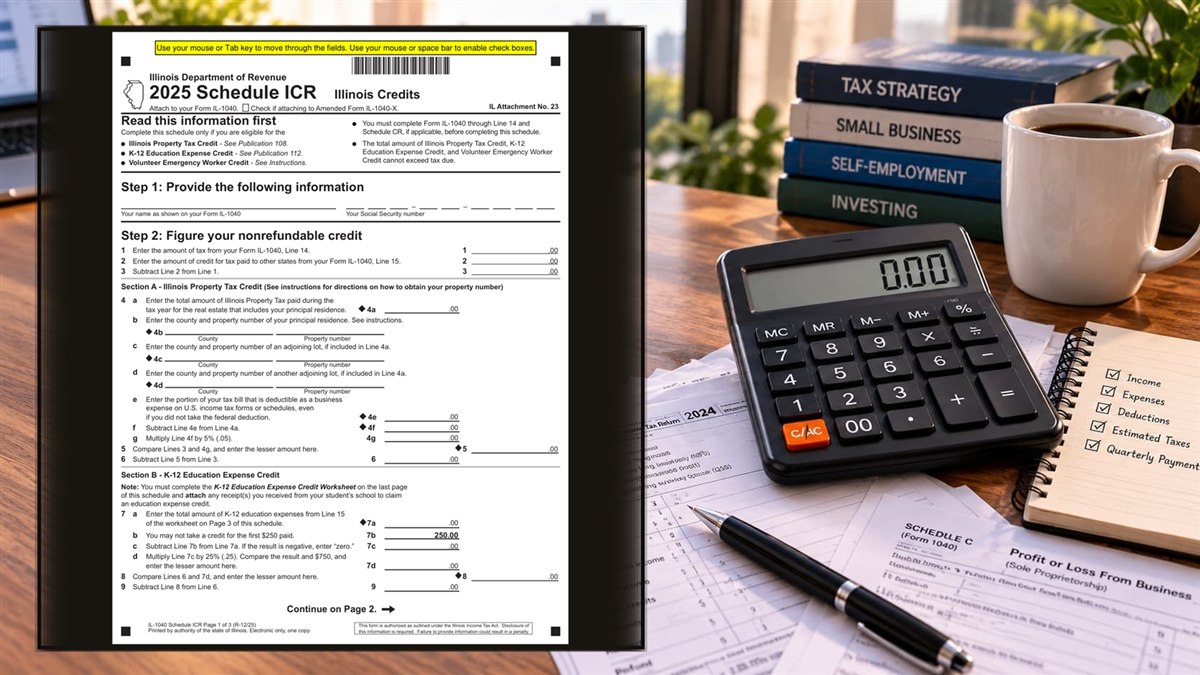
Step 1 — Provide the following information
Name and Social Security number: Enter them exactly as on your Form IL-1040.
Step 2 — Figure your nonrefundable credit
Line 1: Enter the tax from Form IL-1040, Line 14.
Line 2: Enter the credit for tax paid to other states from Form IL-1040, Line 15.
Line 3: Subtract Line 2 from Line 1. This is the tax available to absorb the ICR credits.
Section A — Illinois Property Tax Credit
Line 4a: Enter the total Illinois property tax you paid during the tax year on the real estate that includes your principal residence. Use the amount actually paid during the year, not the amount billed.
Line 4b: Enter the county and property index number of your principal residence, from your property tax bill.
Line 4c: Enter the county and property number of an adjoining lot if its tax is included in Line 4a.
Line 4d: Enter the county and property number of a second adjoining lot if its tax is included in Line 4a.
Line 4e: Enter the portion of your property tax bill that is deductible as a business expense on a federal return, even if you did not claim the federal deduction (for example, a home office). This portion is not eligible for the credit.
Line 4f: Subtract Line 4e from Line 4a.
Line 4g: Multiply Line 4f by 5% (0.05). This is your tentative Property Tax Credit.
Line 5: Enter the lesser of Line 3 and Line 4g. This is your allowed Property Tax Credit.
Line 6: Subtract Line 5 from Line 3. This is the tax left for the next credit.
Section B — K-12 Education Expense Credit
Line 7a: Enter the total qualifying K-12 education expenses from Line 15 of the worksheet on Page 3.
Line 7b: The first $250 of expenses does not count; this line is preprinted as 250.00.
Line 7c: Subtract Line 7b from Line 7a. If the result is negative, enter zero.
Line 7d: Multiply Line 7c by 25% (0.25), then enter the lesser of that result and $750. This is your tentative Education Expense Credit.
Line 8: Enter the lesser of Line 6 and Line 7d. This is your allowed Education Expense Credit.
Line 9: Subtract Line 8 from Line 6. This is the tax left for the next credit.
Section C — Volunteer Emergency Worker Credit
Line 10a: Enter your Volunteer Emergency Worker Credit Certificate number from the Illinois Department of Revenue.
Line 10b: Enter your spouse’s certificate number if your spouse also received one.
Line 10c: Enter $500 if you or your spouse were awarded the credit; enter $1,000 if married filing jointly and both of you were awarded it.
Line 11: Enter the lesser of Line 9 and Line 10c. This is your allowed Volunteer Emergency Worker Credit.
Line 12: Subtract Line 11 from Line 9.
Section D — Total Nonrefundable Credit
Line 13: Add Lines 5, 8, and 11. This is your total ICR credit. Enter it on Form IL-1040, Line 16.
K-12 Education Expense Credit Worksheet (Page 3)
Line 14: For each qualifying student, enter the student’s name (Column A), Social Security number (B), grade (C), Illinois school name or “home school” (D), Illinois school city (E), school type — P for public, N for nonpublic, H for home school (F), and total qualifying tuition and book/lab fees (G). List a student separately for each school attended during the year; attach more pages in the same format if you have more than ten entries.
Line 15: Add Column G for Lines 14a through 14j, plus any attached pages. This is your total qualified education expenses. Enter it here and on Step 2, Line 7a. Intentionally submitting false information is a crime under the Illinois Income Tax Act.
Common Mistakes to Avoid
- Claiming a property tax credit as a renter. The credit is only for property tax you paid on a home you own.
- Using the billed amount, not the paid amount. Line 4a is the property tax actually paid during the tax year.
- Skipping the $250 floor. The first $250 of K-12 expenses never counts (Line 7b).
- Exceeding the $750 education cap. The credit cannot be more than $750 per family regardless of expenses.
- Forgetting school receipts. The education credit requires the worksheet and attached receipts from each school.
- Claiming the volunteer credit without a certificate. Section C requires a certificate issued by the Department.
- Ignoring the income limit. The property tax and education credits are not allowed above $250,000 AGI ($500,000 married filing jointly).
- Expecting a refund from these credits. All three are nonrefundable and cannot exceed your tax.
Frequently Asked Questions
How much is the Illinois Property Tax Credit? 5% of the Illinois property tax you paid during the year on your principal residence, limited to your remaining tax.
Can renters claim the property tax credit? No. It applies only to property tax paid on a home you own.
How much is the K-12 Education Expense Credit? 25% of qualifying expenses over the first $250, up to $750 per family.
What education expenses qualify? Tuition, lab fees, and book fees for a full-time K-12 student under 21 at an Illinois public, nonpublic, or home school. Supplies, uniforms, and transportation generally do not.
Do I need my property index number? Yes. Enter the county and property number from your tax bill on Line 4b.
Why did my credit come out smaller than expected? The credits are capped and run in order; once your tax is used up, later credits are reduced to zero.
Can I claim these credits on an amended return? Yes. Attach Schedule ICR to Form IL-1040-X within the amended-return refund window.
Is there an income limit? Yes, for the property tax and education credits — AGI over $250,000 ($500,000 married filing jointly) disqualifies them. The Volunteer Emergency Worker Credit is not income-limited.
Final Review Before Filing
- Form IL-1040 is complete through Line 14, and Schedule CR is done if it applies.
- Line 4a is the property tax actually paid during the year on your principal residence.
- The county and property index number are entered on Line 4b.
- Any business-use portion of the property tax is removed on Line 4e.
- Line 4g equals Line 4f × 0.05.
- The K-12 worksheet on Page 3 is complete and school receipts are attached.
- Line 7d does not exceed $750.
- Section C is used only with a valid certificate number.
- Line 13 equals the sum of Lines 5, 8, and 11 and is entered on IL-1040, Line 16.
- Your AGI is within the limit for the property tax and education credits ($250,000, or $500,000 married filing jointly).
Sources & verification
- Issuing agency: Illinois Department of Revenue
- Official documents: Schedule ICR (PDF) · instructions (PDF)
- Checked against: 2025 Schedule ICR (R-12/25) + instructions
- Last verified: September 8, 2026
Spot an error or an out-of-date figure? Tell us and we will check it against the official source.
General information from the official form and its instructions, not advice for your circumstances. See the full disclaimer.
More Illinois Tax Forms forms
- Illinois Form IL-1040 — Individual Income Tax Return 2025-2026
- Illinois Form IL-1040-X — Amended Individual Income Tax Return 2025-2026
- Illinois Form IL-1065 — Partnership Replacement Tax Return 2025-2026
- Illinois Form IL-1120 — Corporation Income and Replacement Tax Return 2025-2026
- Illinois Form IL-W-4 — Employee’s and Other Payee’s Illinois Withholding Allowance Certificate
- Illinois Form RUT-50 — Private Party Vehicle Use Tax Transaction Return
- Illinois Schedule NR — Nonresident and Part-Year Resident Computation of Illinois Tax 2025-2026