
What is Form 100?
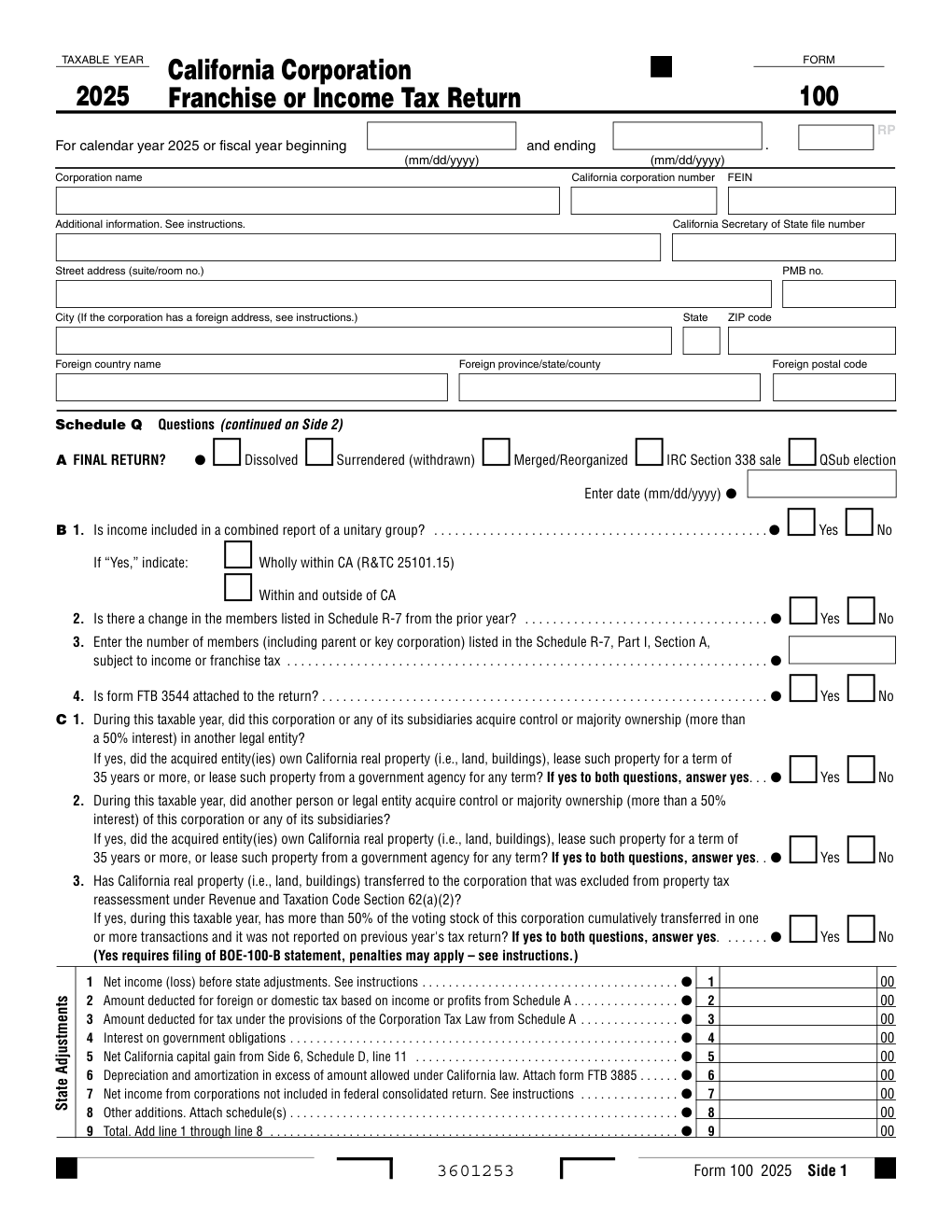
Quick answer: Form 100 is California’s Corporation Franchise or Income Tax Return. A C corporation that is incorporated or qualified in California, or doing business here, files it and pays at least the $800 minimum franchise tax (not owed in the first taxable year of a corporation that incorporated or qualified through the Secretary of State). The tax rate is 8.84% of net income (10.84% for banks and financial corporations). The return is due the 15th day of the 4th month after year-end, with an automatic extension to the 15th day of the 11th month, but the tax is still due on the original date.
California taxes corporations in two ways. The franchise tax applies to corporations incorporated or qualified in the state or doing business in it, and is measured by the year’s income. The income tax applies to corporations that earn California-source income without doing business here. Both use the same rates and the same Form 100.
S corporations file Form 100S, corporations electing the water’s-edge method file Form 100W, and LLCs or partnerships that are classified as partnerships file Form 568 or Form 565 instead.
Key Figures — Form 100 (2025 booklet)
- Tax rate: 8.84% for corporations; 10.84% for banks and financial corporations.
- Minimum franchise tax: $800, owed whether the corporation is active, inactive or operating at a loss; domestic qualified inactive gold or quicksilver mining corporations pay $25.
- First-year relief: a corporation that incorporated or qualified through the Secretary of State has no minimum franchise tax in its first taxable year and pays the measured tax instead.
- Due date: the 15th day of the 4th month after the close of the taxable year (April 15 for a calendar-year corporation).
- Extension: file by the 15th day of the 11th month without a written request; the full tax is still due by the original date (FTB 3539 if you owe).
- Electronic payment: required once an estimated or extension payment exceeds $20,000 or total tax liability exceeds $80,000; the penalty for not paying electronically is 10%.
- NOL and credits: the NOL carryover deduction is suspended for 2024, 2025 and 2026 if taxable income is $1,000,000 or more, and credits are limited to $5,000,000 for taxable years beginning in 2024, 2025 and 2026.
Source: the Franchise Tax Board, 2025 Corporation Tax Booklet (Form 100 and instructions). Last verified October 14, 2026.
Who Must File Form 100?
File Form 100 if you are a corporation (including an LLC that elected to be taxed as a corporation) that is incorporated or organized in California, qualified or registered to do business here, or doing business in California, and also if you earn California-source income as a corporation without doing business here.
“Doing business” is broader than many expect. For 2025 a corporation is doing business if it actively engages in any transaction for profit in California, is organized or commercially domiciled here, or exceeds one of the thresholds: California sales over the lesser of $757,070 or 25% of total sales, California property over the lesser of $75,707 or 25% of total property, or California payroll over the lesser of $75,707 or 25% of total compensation. Even an isolated transaction may be enough.
Other filers of Form 100 include banks and financial corporations, REITs, RICs, REMICs, publicly traded partnerships that are not eligible for the federal election, and certain exempt homeowners’ associations and political organizations with taxable income over $100.
Special cases: corporations that meet Public Law 86-272 protection and file no combined report do not include their income on line 18 (write “PL 86-272” at the top), but they still owe the minimum franchise tax if they are doing business in, incorporated in or qualified in California.
Common trap: assuming a corporation with no income or no activity owes nothing. The $800 minimum franchise tax applies to active, inactive and loss-making corporations alike, after the first taxable year.
How to File Form 100
- Pick the right return: Form 100, or Form 100S for an S corporation, or Form 100W for water’s-edge filers.
- Choose a computation method. Either the federal reconciliation method (start with federal Form 1120 income on line 1 and make state adjustments on lines 2–16) or Schedule F, the California computation method, if there is no federal return or separate state records.
- Apportion if needed. If only part of the income comes from California, complete Schedule R and carry its result to line 18, then answer “Yes” to Question N.
- Assemble in order: Form 100, Schedule R if required, supporting schedules, a copy of the federal return if required, and FTB 5806 if required. Do not staple.
- Pay. Corporations over the EFT thresholds must pay electronically. Others can mail a check payable to the Franchise Tax Board, with the California corporation number and “2025 Form 100” on it, or use FTB 3586 with an e-filed return.
- File electronically if you can. Business e-file is available for Form 100, 100W, 100S and 100X.
When Is Form 100 Due?
The return is due on or before the 15th day of the 4th month after the close of the taxable year, which is April 15 for a calendar-year corporation. If that date is a weekend or holiday, it moves to the next business day. A corporation that cannot file by then may file on or before the 15th day of the 11th month without a written extension request, except entities suspended on or after the original due date. The extension is only for filing. The full tax must be paid by the original due date; if tax is owed, send FTB 3539 with the payment, or pay electronically. Farmers’ cooperative associations file by the 15th day of the 9th month.
Where to Mail Form 100
Return with payment: Franchise Tax Board, PO Box 942857, Sacramento CA 94257-0501. Return without payment, refund return, or return paid electronically: PO Box 942857, Sacramento CA 94257-0500. E-filed return with FTB 3586: PO Box 942857, Sacramento CA 94257-0531. Private delivery services use FRANCHISE TAX BOARD, SACRAMENTO CA 95827, never a PO box.

How to Complete Form 100 Line by Line
Top of the Return and Line 1 — Federal Reconciliation or Schedule F
Use black or blue ink, print the name and address in capital letters and round to whole dollars. A first-year domestic corporation’s fiscal year begins on the date of incorporation. Line 1 is federal ordinary income (loss) from trade or business before any NOL and special deductions when you use the federal reconciliation method, or the amount from Schedule F, line 30, if you compute income under California law. Under the reconciliation method, attach the federal return.
Lines 2–16 — State Adjustments to Income
These lines convert federal income to California income: additions such as
| Line | What to enter |
|---|---|
| Line 8 | (other additions, with an itemized attachment). |
| Line 5 | And subtractions such as. |
| Lines 10 and 11 | (dividends, from Schedule H). |
| Line 13 | (capital gain from the federal return). |
| Line 14 | (charitable contributions, limited to 10% of California net income and to the adjusted basis of contributed assets). |
| Line 15 | (other deductions, with a schedule). |
Line 15 also removes exempt interest and certain California exclusions, such as wildfire settlements, for a corporation that included them as federal income.
Lines 17–18 — Net Income After Adjustments and for State Purposes
| Line | What to enter |
|---|---|
| Line 17 | Net income (loss) after state adjustments. |
| Line 18 | Equals line 17 if all income comes from California; if only a portion does, complete Schedule R first and enter its line 35. |
A net loss on line 18 requires the 2025 form FTB 3805Q.
Lines 19–21 — NOL, EZ/TTA/LAMBRA and Disaster Loss Deductions
| Line | What to enter |
|---|---|
| Line 19 | The NOL carryover, from FTB 3805Q, Part III, line 3. For 2024 through 2026 an NOL carryover deduction is suspended if taxable income is $1,000,000 or more, and the NOL cannot reduce current income below zero. |
| Line 20 | The EZ, TTA or LAMBRA NOL carryover, under the same suspension; these zones no longer generate new NOLs. |
| Line 21 | The disaster loss deduction, which is not subject to the suspension. |
Lines 23–29 — Tax, Credits, Balance and AMT
| Line | What to enter |
|---|---|
| Line 23 | Applies 8.84% (10.84% for banks and financial corporations), or the minimum franchise tax if higher. |
| Lines 24–26 | Credits: enter up to two on lines 24 and 25 and put the rest on Schedule P (100), carrying the total to line 26. For taxable years beginning in 2024 through 2026, total credits cannot reduce tax by more than $5,000,000 (the Low-Income Housing Credit is excluded). |
| Line 28 | Line 23 minus line 27, or the applicable minimum franchise tax, whichever is more. |
| Line 29 | Alternative minimum tax from Schedule P (100). |
Lines 32–37 — Estimated Tax, Withholding and Use Tax
| Line | What to enter |
|---|---|
| Line 32 | Estimated tax paid for the year, including tax an LLC paid for the corporation as a nonconsenting nonresident member (write “LLC” and attach Schedule K-1 (568)). |
| Line 33 | Withholding from Form 592-B or 593, attached to the lower front of Side 1. |
| Line 37 | Use tax on out-of-state purchases; a business that has, or must hold, a California seller’s permit, or has more than $10,000 of untaxed purchases a year, reports use tax to the California Department of Tax and Fee Administration instead. |
Lines 40–44 — Tax Due or Overpayment, Credit, Refund and Penalties
| Line | What to enter |
|---|---|
| Lines 40 and 41 | Show franchise or income tax due or an overpayment, adjusted by Schedule J. |
| Line 42 | Credits an overpayment to next year’s estimated tax; the choice cannot be reversed to offset a prior-year balance. |
| Line 43 | The refund, with direct deposit in lines 43a–43c. |
| Line 44 | Penalties and interest; attach FTB 5806 only if you use Exception B or C to compute or eliminate the underpayment penalty. |
Common Mistakes to Avoid
- Skipping the minimum franchise tax for an inactive or loss-making corporation after its first year.
- Treating the extension as a payment extension. Tax is due on the original date; use FTB 3539 or pay electronically.
- Missing the electronic payment rule. Over $20,000 for an estimated or extension payment, or $80,000 total liability, triggers mandatory electronic payment and a 10% penalty if ignored.
- Claiming an NOL carryover at $1,000,000 or more of taxable income in 2024–2026. The deduction is suspended.
- Forgetting Schedule R when only part of the income is from California.
- Filing Form 100 for an S corporation. That entity files Form 100S.
- Reporting use tax on the return when the business must report it to CDTFA.
Frequently Asked Questions
What is the California corporate tax rate? 8.84% of net income, and 10.84% for banks and financial corporations.
What is the minimum franchise tax? $800 for most corporations subject to the franchise tax, including inactive ones; it does not apply in the first taxable year of a corporation that incorporated or qualified through the Secretary of State.
When is Form 100 due? The 15th day of the 4th month after year-end; the automatic filing extension runs to the 15th day of the 11th month.
Does the extension give me more time to pay? No. The full tax is due by the original due date.
Does an LLC ever file Form 100? Yes, if the LLC elected to be taxed as a corporation.
Can I e-file Form 100? Yes. Business e-file is available for Form 100, 100W, 100S and 100X.
Final Review Before Filing
- The entity is a corporation (not an S corporation or a partnership-classified LLC).
- Line 1 uses either the federal reconciliation or Schedule F method.
- Schedule R is attached if only part of the income is from California.
- The tax on line 23 is at least the minimum franchise tax when it applies.
- The NOL and credit limits for 2024–2026 are applied.
- Estimated tax, extension and withholding payments are on lines 32 and 33.
- Payment is electronic if the EFT thresholds were crossed.
Sources & verification
- Issuing agency: California Franchise Tax Board
- Official documents: Form 100 (PDF) · 2025 Corporation Tax Booklet (PDF)
- Checked against: Form 100 (2025) and the 2025 Form 100 Booklet
- Last verified: October 14, 2026
Spot an error or an out-of-date figure? Tell us and we will check it against the official source.
General information from the official form and its instructions, not advice for your circumstances. See the full disclaimer.
More California Tax Forms forms
- California Form 540 — Resident Income Tax Return 2025-2026
- California Form 540-ES — Estimated Tax for Individuals
- California Form 540NR — Nonresident or Part-Year Resident Income Tax Return 2025-2026
- California Form 568 — Limited Liability Company Return of Income 2025-2026
- California Form DE 4 — Employee’s Withholding Allowance Certificate
- California FTB 3514 — California Earned Income Tax Credit
- California FTB 3522 — LLC Tax Voucher
- California FTB 3893 — Pass-Through Entity Elective Tax Payment Voucher
- California Schedule CA (540) — California Adjustments, Residents