
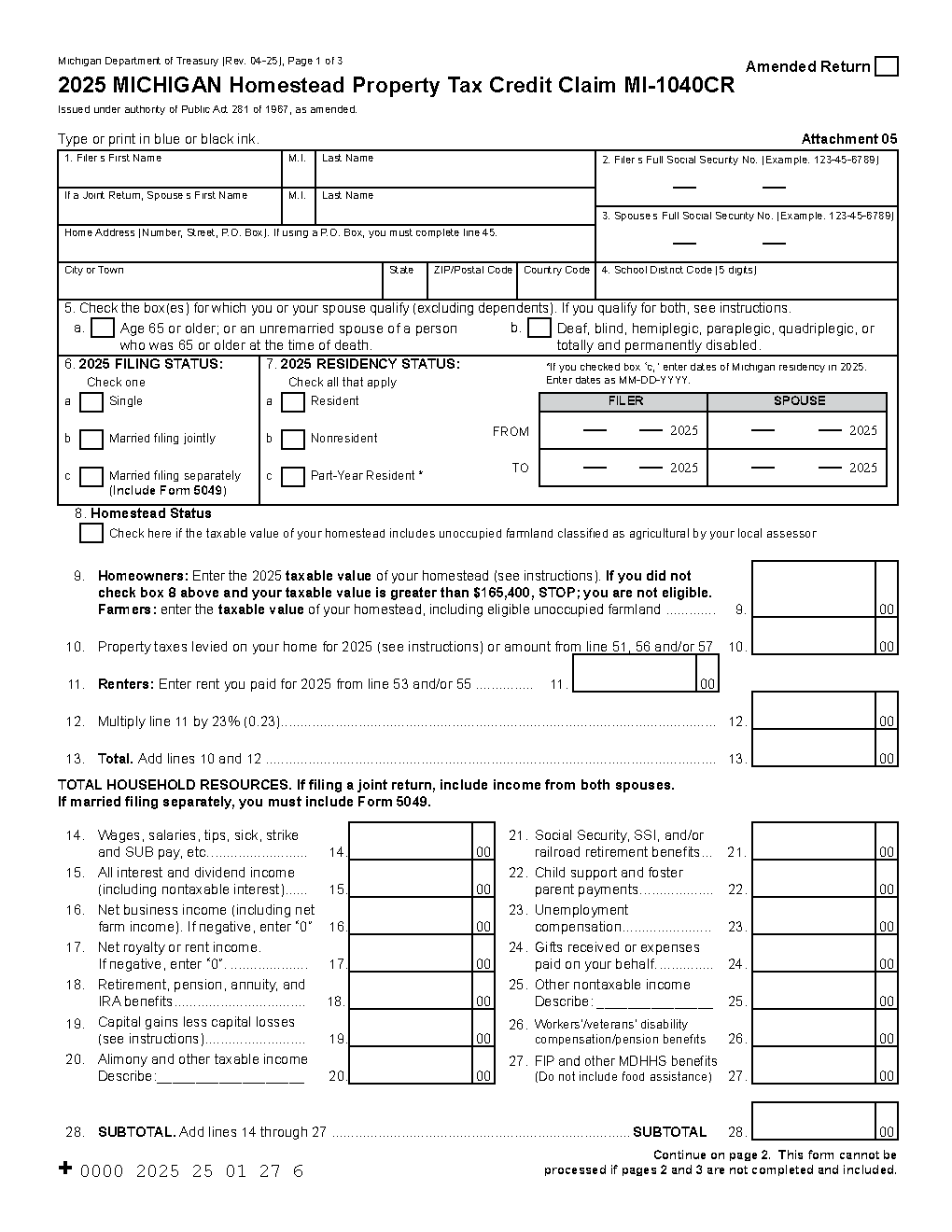
What is Form MI-1040CR?
Quick answer: Form MI-1040CR, the Homestead Property Tax Credit Claim, refunds Michigan homeowners and renters part of the property tax (or rent) that exceeds a set share of their income. For 2025, the credit generally equals 60% of the amount your property taxes (or 23% of rent, treated as an equivalent) exceed 3.2% of your total household resources — up to a maximum credit of $1,900. Filers age 65 or older with income at $30,000 or less, and filers who are totally and permanently disabled, can qualify for up to 100% instead of 60%. The credit phases out entirely once total household resources exceed $71,500 or the homestead’s taxable value exceeds $165,400. It can be filed on its own, even by someone who owes no Michigan income tax.
Michigan created the homestead credit to soften property tax’s disproportionate weight on lower- and moderate-income households, since property tax bills don’t scale down with income the way wages might. Both owners and renters can qualify — renters use a portion of their rent (23% for most rentals) as a stand-in for property tax paid.
MI-1040CR is often filed as a stand-alone claim, separate from a full MI-1040, by taxpayers whose only reason to file with Michigan is this credit — for example, a retiree with income below the filing threshold for income tax but still eligible for the property tax credit.
Key Figures — Tax Year 2025 (Michigan MI-1040CR)
- Household resources limit: $71,500 or less to qualify at all.
- Homestead taxable value limit: $165,400 or less.
- Base credit rate: 60% of the amount property tax (or 23% of rent) exceeds 3.2% of total household resources.
- Enhanced credit rate: up to 100% for filers age 65+ with income of $30,000 or less, and for filers who are totally and permanently disabled.
- Maximum credit: $1,900 for 2025.
- Partial-year occupancy: the maximum credit is prorated by the percentage of the year (days occupied ÷ 365) the homestead was actually occupied.
Who Must File Michigan Form MI-1040CR?
Not a mandatory filing — MI-1040CR is a credit claim, so nobody is required to file it, but any Michigan resident who owned or rented their homestead during the year, has total household resources of $71,500 or less, and (for owners) a homestead taxable value of $165,400 or less can potentially benefit from filing it.
Both owners and renters qualify. Renters use 23% of rent paid as their property-tax equivalent for the credit calculation instead of an actual tax bill.
Filers who owe no Michigan income tax can still file MI-1040CR to claim the credit as a refund — it is not limited to people who also file a full MI-1040.
Veterans and blind filers may get a larger credit using the related MI-1040CR-2 instead — if eligible for both, file whichever produces the larger credit.
How to File Michigan Form MI-1040CR
- File with or without a full MI-1040. Attach it to the income tax return if filing one; file it on its own if not otherwise required to file.
- Gather documentation: the property tax statement (owners) or a landlord-signed rent certificate/lease showing rent paid (renters), and records of all income sources making up total household resources.
- Compute total household resources, which is broader than taxable income — it includes most nontaxable income too, such as the nontaxable portion of Social Security.
- E-file or mail through the same channels as the MI-1040.
When Is Michigan Form MI-1040CR Due?
- April 15, 2026 for the 2025 tax year, the same deadline as the MI-1040, whether filed together or on its own.
- Up to four years to claim it retroactively: an eligible taxpayer who didn’t file in a prior year can generally still claim that year’s credit within four years of the original due date.
Where to Mail Michigan Form MI-1040CR
If filed with a full MI-1040, it is mailed together to the address matching whether a payment is enclosed (Lansing, MI 48929 with payment; Lansing, MI 48956 without). If filed on its own as a stand-alone credit claim, mail to: Michigan Department of Treasury, Lansing, MI 48956.
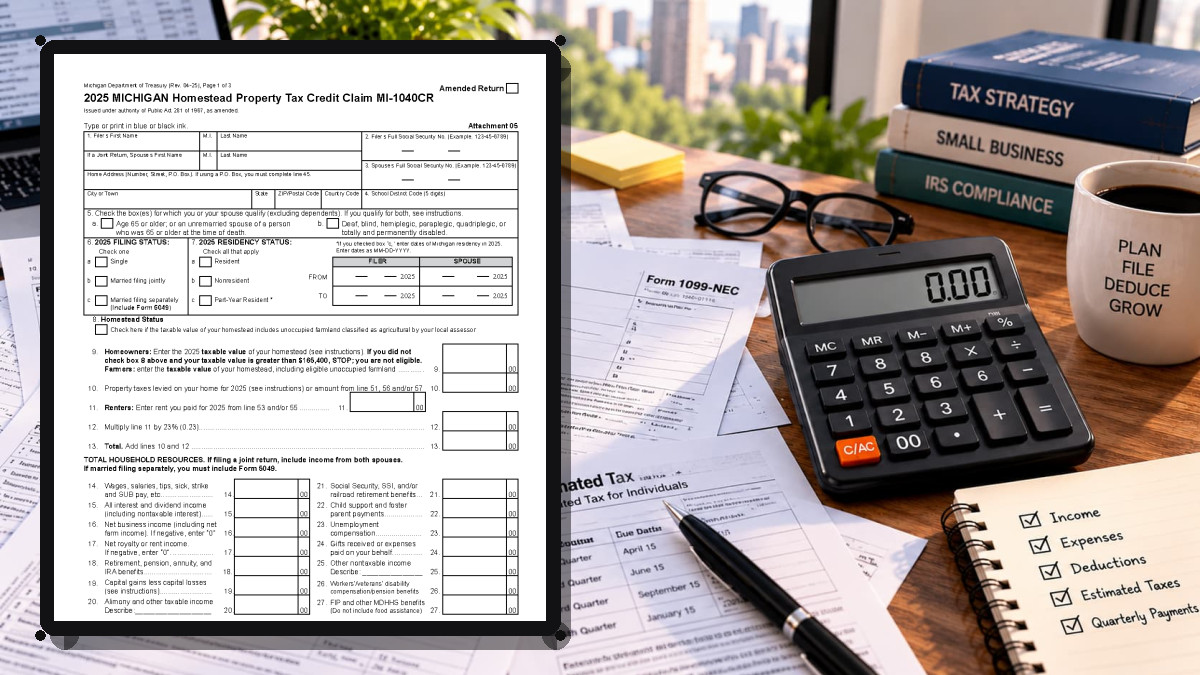
How to Complete Michigan Form MI-1040CR Line by Line
Filer and homestead information. Name, Social Security number, and the address of the homestead being claimed — it must be the filer’s principal residence in Michigan for the period claimed.
Homestead taxable value or rent paid. Owners enter the homestead’s taxable value (from the property tax statement) and the property tax billed for the year. Renters enter total rent paid and multiply it by 23% to arrive at the property-tax equivalent used in the credit formula.
Total household resources. All taxable and most nontaxable income for the filer and spouse (if married) — wages, self-employment income, Social Security (including the nontaxable portion), pensions, and most other income sources.
3.2% threshold. Total household resources multiplied by 3.2% — property tax (or the rent equivalent) above this amount is what the credit is based on.
Credit rate. 60% of the excess for most filers; up to 100% for filers 65 or older with income of $30,000 or less, or for filers who are totally and permanently disabled.
Maximum credit and phase-out. The result is capped at $1,900 for 2025, then reduced to zero once household resources exceed $71,500 or, for owners, the homestead’s taxable value exceeds $165,400.
Partial-year occupancy percentage. If the homestead was occupied for only part of the year, divide days occupied by 365 and apply that percentage to the maximum credit before comparing it to the calculated amount.
Common Mistakes to Avoid
- Assuming a full MI-1040 is required. MI-1040CR can be filed on its own by someone who owes no Michigan income tax.
- Using taxable income instead of total household resources. The credit calculation uses a broader measure that includes most nontaxable income too.
- Renters forgetting the 23% conversion. Rent paid isn’t used directly — it’s multiplied by 23% to estimate the property-tax portion.
- Missing the enhanced rate for seniors 65+ with income at or below $30,000, or for totally and permanently disabled filers, and only claiming the standard 60% rate.
- Not prorating for a partial year after moving mid-year, which changes the maximum credit available.
- Assuming the credit is gone if a prior year was missed. A retroactive claim is generally available within four years of the original due date.
Frequently Asked Questions
Can renters claim the homestead property tax credit? Yes — 23% of rent paid is used as the property-tax equivalent in the credit calculation.
What’s the maximum credit for 2025? $1,900, prorated if the homestead was occupied for only part of the year.
Do I need to file a full Michigan income tax return to claim this credit? No. MI-1040CR can be filed on its own if the credit is the only reason to file.
What if I’m a senior or disabled? Filers 65+ with income of $30,000 or less, and totally and permanently disabled filers, can receive up to 100% of the excess instead of the standard 60%.
What income limits apply? Total household resources must be $71,500 or less, and for homeowners, the taxable value of the home must be $165,400 or less.
Can I still claim a credit I missed from a prior year? Generally yes, within four years of that year’s original due date.
Final Review Before Filing
- Total household resources are at or below $71,500.
- Homestead taxable value (if an owner) is at or below $165,400.
- Renters have converted rent paid to the 23% property-tax equivalent, not used the raw rent figure.
- The correct credit rate (60%, or up to 100% for seniors 65+/disabled filers) is applied.
- Partial-year occupancy is prorated if the homestead changed during the year.
- The property tax statement or rent certificate supporting the claim is on hand.
- The claim is mailed or e-filed by April 15, 2026, whether alone or with a full MI-1040.
Sources & verification
- Issuing agency: Michigan Department of Treasury
- Official documents: Form MI-1040CR (PDF) · General Information / Instructions (PDF)
- Checked against: 2025 MI-1040CR and its instructions
- Last verified: September 16, 2026
Spot an error or an out-of-date figure? Tell us and we will check it against the official source.
General information from the official form and its instructions, not advice for your circumstances. See the full disclaimer.
More Michigan Tax Forms forms
- Michigan Form 151 — Authorized Representative Declaration (Power of Attorney)
- Michigan Form 3372 — Sales and Use Tax Certificate of Exemption
- Michigan Form 5081 — Sales, Use and Withholding Taxes Annual Return
- Michigan Form 518 — Registration for Michigan Taxes
- Michigan Form 5713 — Request for Hearing/Informal Conference
- Michigan Form MI-W4 — Employee’s Michigan Withholding Exemption Certificate
- Michigan MI-1040ES 2026 — Estimated Individual Income Tax Voucher
- Michigan Schedule 1 (Form 3423) — Additions and Subtractions Instructions