


What is Form 151?
Quick answer: Form 151, Authorized Representative Declaration, is Michigan’s power-of-attorney form for tax and debt matters. It authorizes a named individual or entity — an accountant, attorney, family member, or firm — to receive confidential taxpayer information from and communicate with the Michigan Department of Treasury on the taxpayer’s behalf. Without it, Treasury cannot legally discuss a taxpayer’s account with anyone but the taxpayer. The authorization takes effect on the date signed (or a later stated date) and stays in effect until revoked or until any expiration date entered on the form.
Michigan law strictly prohibits Treasury employees from disclosing confidential tax information to anyone other than the taxpayer or a properly authorized representative. Form 151 is what establishes that authorization — it’s required before a tax preparer, attorney, or anyone else can discuss an account, receive notices, or participate in a hearing on the taxpayer’s behalf.
The representative’s actual authority depends entirely on which boxes are checked on the form. A taxpayer can grant narrow authority (just enough for the representative to receive information and speak on their behalf) or general authority (broad power to act on any tax return or debt), and can separately choose whether the representative also receives copies of future letters and notices.
Key Figures — Michigan Form 151
- Part 1: Taxpayer or debtor’s name, address, phone, and fax.
- Part 2: Used only to revoke a prior authorization, in whole or in part.
- Part 3: Names the representative — an individual, or an entity (appointing a firm authorizes every individual within it, such as any attorney or paralegal at that firm).
- Part 4 (Type of Authority): Box 1 (receive/inspect confidential information), Box 2 (make oral or written presentations), Box 5 (general authority over any return or debt) — at least Boxes 1 and 2 are required for a representative to participate in a hearing or informal conference.
- Part 5: Must be completed separately for the representative to receive copies of future Treasury letters and notices — general authority under Part 4 alone does not include this.
- Validity: Effective on the date signed unless a later start date is entered; stays in effect until revoked or until any stated expiration date.
Who Must File Michigan Form 151?
Any Michigan taxpayer or debtor who wants someone else — a tax preparer, accountant, attorney, family member, or firm — to access their confidential tax information or communicate with Treasury on their behalf files Form 151. This is commonly needed to let a representative participate in an informal conference, respond to an audit, or simply call Treasury about an account without the taxpayer on the line.
It is also used in reverse: a taxpayer who previously authorized someone and wants to end that authorization files Form 151 with Part 2 completed to revoke it.
How to File Michigan Form 151
- Complete Parts 1, 3, and 4 at minimum — taxpayer information, who the representative is, and what authority they are being given.
- Complete Part 5 separately if the representative should also receive copies of future letters and notices — this is not automatic even with general authority under Part 4.
- Submit to the office handling the matter: individual income tax questions go to the Customer Contact Center; business registration matters go to the Registration Section (which also accepts submission through Michigan Treasury Online); collections matters go to Treasury’s Collections division; suspected fraud matters go to the Discovery and Tax Enforcement (Fraud) Unit.
When Is Michigan Form 151 Due?
Form 151 has no fixed annual deadline — submit it whenever a representative needs to act on the taxpayer’s behalf, ideally before that representative needs to contact Treasury (for example, before an informal conference or before calling about an account). It becomes effective on the date signed unless a later start date is entered, and stays in effect until revoked or until any expiration date entered on the form.
Where to Mail Michigan Form 151
The correct address depends on which part of Treasury the request concerns:
- Individual income tax questions: Michigan Department of Treasury, Customer Contact Center, Individual Correspondence Section, PO Box 30058, Lansing, MI 48909 (fax 517-636-4488).
- Business registration matters: Michigan Department of Treasury, Customer Contact Center, Registration Section, PO Box 30778, Lansing, MI 48909 — or submit electronically through Michigan Treasury Online, or email a PDF to Treas-Registration-151@michigan.gov.
- Collections matters: Michigan Department of Treasury, Collections, PO Box 30168, Lansing, MI 48909 (fax 517-241-5045).
- Suspected fraud / Discovery and Tax Enforcement: Michigan Department of Treasury, Attn: Fraud Unit, PO Box 30140, Lansing, MI 48909 (fax 517-636-4156).
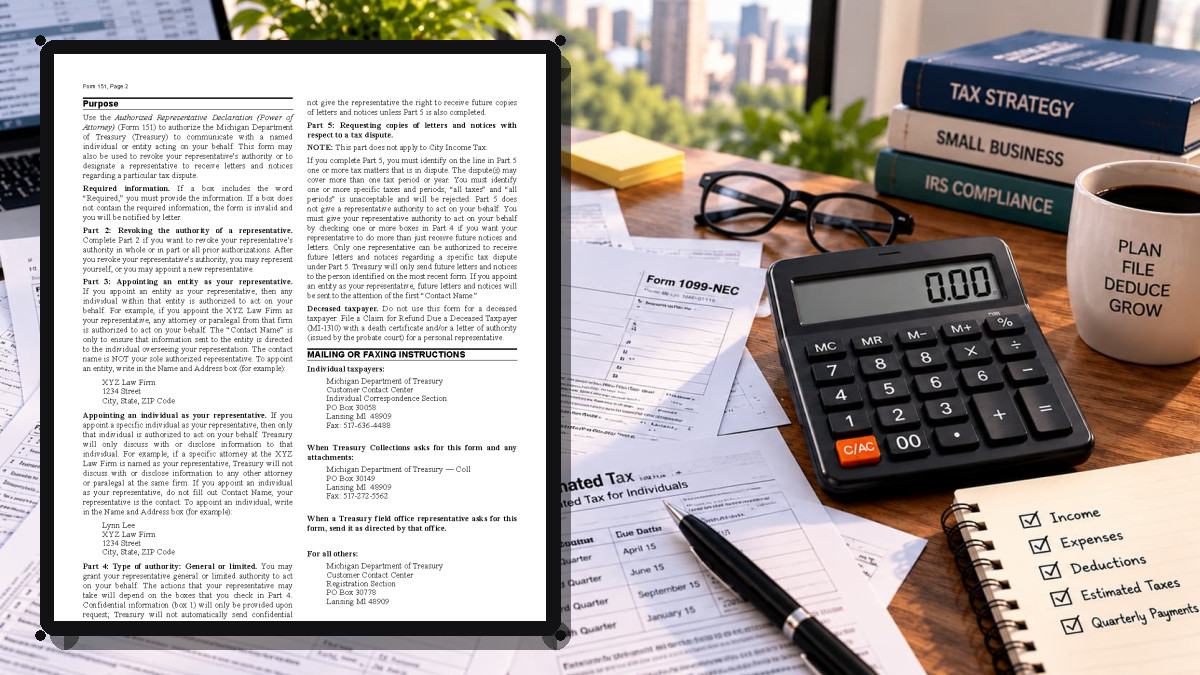
How to Complete Michigan Form 151 Line by Line
Part 1 — Taxpayer information. Name, address, telephone number, and fax number (if applicable) of the taxpayer or debtor granting authority.
Part 2 — Revoke authority. Completed only when canceling a prior authorization, in whole or in part, or revoking all previous authorizations at once. Leave blank when granting a new authorization.
Part 3 — Appoint a representative. Name and address of the representative. Appointing an individual limits Treasury to discussing the matter with only that person; appointing an entity (such as a law firm) authorizes any individual within that entity to act on the taxpayer’s behalf.
Part 4 — Type of authority. Check Box 1 to let the representative receive and inspect confidential information on request. Check Box 2 to let them make oral or written presentations of fact or argument. Check Box 5 for general authority to act on any tax return or debt. Boxes 1 and 2 together are the minimum needed for a representative to participate in a hearing or informal conference.
Part 5 — Copies of notices. Must be completed for the representative to also receive copies of future Treasury letters and notices — checking general authority in Part 4 does not include this by default.
Signature. The taxpayer (or an authorized officer, for a business) signs and dates the declaration.
Common Mistakes to Avoid
- Checking only Box 5 (general authority) and assuming it covers a hearing appearance. Boxes 1 and 2 are what’s actually required for a representative to participate in a hearing or informal conference.
- Assuming general authority includes copies of notices. Part 5 must be completed separately for the representative to receive future letters and notices.
- Sending it to the wrong office. Individual income tax, business registration, collections, and fraud matters each have their own submission address.
- Forgetting to complete Part 2 when trying to revoke a prior authorization — silence does not cancel an existing Form 151.
- Leaving no expiration date when a limited-time authorization was intended, which leaves the authorization in effect until actively revoked.
Frequently Asked Questions
How long does Form 151 stay valid? It takes effect on the date signed (or a later date entered) and remains valid until revoked or until any expiration date entered on the form.
Can I authorize a whole firm instead of one person? Yes — appointing an entity in Part 3 authorizes any individual within that entity to act on the taxpayer’s behalf.
Does general authority let my representative get copies of my mail from Treasury? No. Part 5 must be completed separately for that, even if general authority was granted under Part 4.
How do I cancel a Form 151 I already filed? File a new Form 151 with Part 2 completed to revoke the prior authorization, in whole or in part.
Can my representative speak for me at an informal conference? Only if the Form 151 on file has at least Boxes 1 and 2 checked under Part 4.
Final Review Before Filing
- Part 1 taxpayer information is complete and matches Treasury’s records.
- Part 3 correctly names the representative — an individual or an entity, as intended.
- Part 4 has the right boxes checked for the intended authority (Boxes 1 and 2 for hearing participation).
- Part 5 is completed if the representative should also receive copies of notices.
- Any intended start or expiration date is entered, if the authorization is not meant to be open-ended.
- The form is signed and sent to the correct Treasury office for the matter involved.
Sources & verification
- Issuing agency: Michigan Department of Treasury
- Official documents: Form 151 (PDF) · Authorized Representative Declaration guidance page
- Checked against: Form 151 (Rev. 11-21) and Treasury’s published guidance and FAQ
- Last verified: September 16, 2026
Spot an error or an out-of-date figure? Tell us and we will check it against the official source.
General information from the official form and its instructions, not advice for your circumstances. See the full disclaimer.
More Michigan Tax Forms forms
- Michigan Form 3372 — Sales and Use Tax Certificate of Exemption
- Michigan Form 5081 — Sales, Use and Withholding Taxes Annual Return
- Michigan Form 518 — Registration for Michigan Taxes
- Michigan Form 5713 — Request for Hearing/Informal Conference
- Michigan Form MI-W4 — Employee’s Michigan Withholding Exemption Certificate
- Michigan MI-1040CR — Homestead Property Tax Credit Claim
- Michigan MI-1040ES 2026 — Estimated Individual Income Tax Voucher
- Michigan Schedule 1 (Form 3423) — Additions and Subtractions Instructions