What is Form 5081?
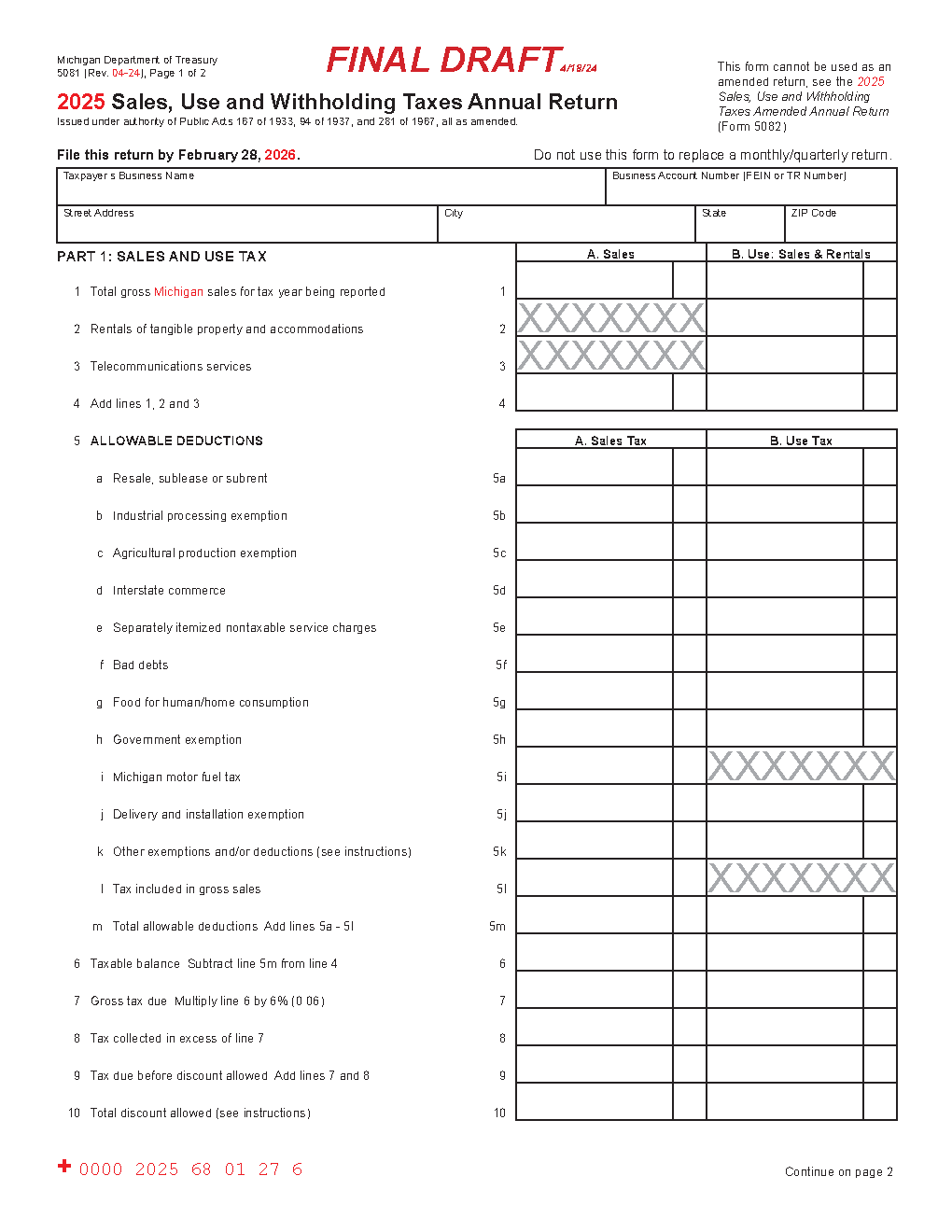
Quick answer: Form 5081, Sales, Use and Withholding Taxes Annual Return, is the once-a-year reconciliation every Michigan business with a Sales, Use, and Withholding (SUW) tax account files, even in a year with zero activity. It totals the year’s sales tax, use tax, and income tax withholding, reconciles that total against the monthly or quarterly Form 5080 payments already made during the year, and settles any balance due or overpayment. It is due February 28 following the tax year — so the 2025 annual return is due February 28, 2026 — and can be filed through Michigan Treasury Online (MTO), by paper, or through tax software.
Form 5081 exists because most Michigan businesses pay sales, use, and withholding tax throughout the year on Form 5080 (monthly or quarterly), estimating as they go. Form 5081 is the year-end true-up: it recalculates the actual totals for the full year and compares them against what was already remitted, producing either a balance due or a refund/credit.
Every business registered for a Michigan SUW account files it — sole proprietors, LLCs, partnerships, corporations, and nonprofits with unrelated business income, as well as remote sellers past Michigan’s economic nexus threshold and marketplace facilitators. Filing is required even if the business had no sales or withholding activity that year.
Key Figures — Michigan Form 5081
- Due date: February 28 following the tax year (the next business day if that falls on a weekend or holiday).
- Sales and use tax rate: 6% generally, with a special 4% rate on residential utility sales.
- Vendor (early-payment) discount: two-thirds of 1% of sales and use tax, capped at $20,000 per month, available only if every monthly/quarterly return that year was filed on time.
- Remote-seller economic nexus threshold: $100,000 in annual Michigan sales, which requires registering and filing.
- Late-filing penalty: $10 per day if no tax is due; if tax is due, 5% of the tax per month, up to a 25% maximum, plus interest.
- Audit window: four years from the original due date.
Who Must File Michigan Form 5081?
Every business with an active Michigan Sales, Use, and Withholding (SUW) tax account files Form 5081 annually — regardless of legal structure (sole proprietor, LLC, partnership, corporation) and regardless of whether the account also has employees on payroll. Nonprofits with unrelated business income, remote sellers past the $100,000 Michigan economic nexus threshold, and marketplace facilitators are included.
Zero-activity businesses still file. A registered SUW account that had no sales, no use tax, and no withholding for the year does not get to skip Form 5081 — a zero return is still due.
How to File Michigan Form 5081
- Michigan Treasury Online (MTO): The fastest method — usually processed within one business day, with an instant confirmation number. Beginning with 2025 annual returns (due in 2026), larger employers are required to e-file rather than file on paper.
- Paper by mail: Allow four to six weeks for processing; send by certified mail for proof of filing.
- Third-party tax software: Usually processed within one business day, with confirmation from the software provider.
Before filing, gather all twelve months’ (or four quarters’) Form 5080 filings for the year, W-2s issued (to reconcile withholding), and sales/exemption records including any Form 3372 exemption certificates collected from customers.
When Is Michigan Form 5081 Due?
- February 28 following the close of the tax year — the 2025 annual return is due February 28, 2026, covering calendar year 2025, not 2026.
- Next business day rule: If February 28 falls on a weekend or federal holiday, the deadline moves to the next business day.
- No extension mechanism specific to Form 5081 beyond Treasury’s general late-filing relief provisions.
Where to Mail Michigan Form 5081
Paper filers mail the return to: Michigan Department of Treasury, PO Box 30401, Lansing, MI 48909-7901. Filing through Michigan Treasury Online avoids mailing entirely and confirms receipt immediately.
How to Complete Michigan Form 5081 Line by Line
Part 1 — Sales and Use Tax
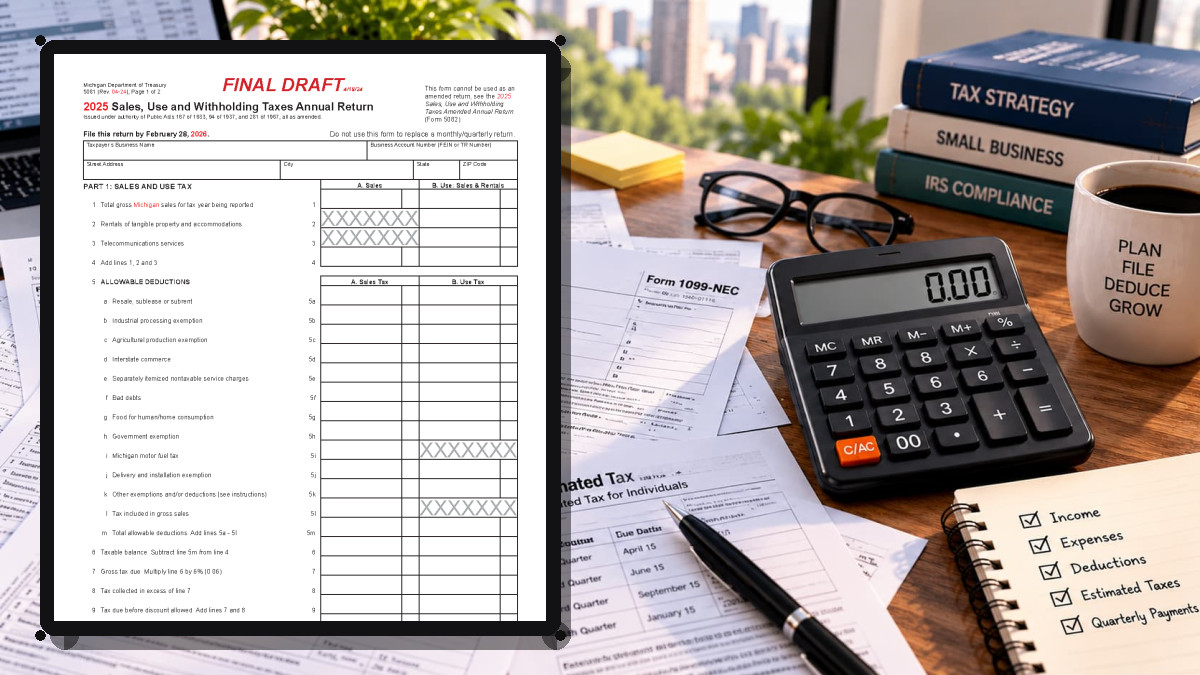
Gross sales. Total dollar amount from all sales of tangible personal property and taxable services for the full year, before any deductions — this includes exempt sales, sales for resale, and out-of-state sales, which are backed out later as deductions.
Rentals. Gross receipts from short-term rentals (generally under 30 continuous days) of tangible property or lodging, including related fees.
Allowable deductions. Sales for resale, sales to exempt entities backed by a valid Form 3372, interstate commerce sales, food for home consumption, prescription drugs, and returns/allowances are subtracted from gross sales — the annual return’s worksheet breaks these out by category.
Tax calculated. 6% is applied to taxable sales and rentals; a special 4% rate applies to residential utility sales.
Vendor discount. An early-payment discount of two-thirds of 1% of sales and use tax, capped at $20,000 per month, available only when every monthly or quarterly return for the year was filed on time.
Part 2 — Use Tax on Purchases
Use tax on out-of-state and untaxed purchases. The cost basis of goods bought from out-of-state vendors that did not collect Michigan tax, plus the value of any inventory items withdrawn for personal or business use, is reported here and taxed at the same 6% rate.
Part 3 — Withholding Tax and Reconciliation
Michigan income tax withheld. The total Michigan income tax withheld from employee wages, pension distributions, and certain 1099 payments for the year — this figure must match the total Michigan withholding shown across all W-2s and applicable 1099s issued.
Payments made during the year. The sum of everything already remitted through monthly or quarterly Form 5080 filings, plus any prior-year credit carried forward and any EFT prepayments made by accelerated filers.
Balance due or overpayment. The full-year tax calculated in Parts 1–3 minus the payments already made. A positive result is a balance due; a negative result is an overpayment, which can be requested as a refund or applied to next year’s liability.
Common Mistakes to Avoid
- Skipping the return in a zero-activity year. A registered SUW account still owes a Form 5081, even with nothing to report.
- Reporting the wrong tax year. The February 28, 2026 deadline covers calendar year 2025 activity — not the year in which you are filing.
- Losing the vendor discount over one late monthly return. The discount requires every return during the year to have been filed on time, not just most of them.
- Withholding total not matching W-2s. Treasury reconciles the withholding reported here against the Michigan tax shown on issued W-2s and 1099s — mismatches trigger notices.
- Claiming a sale-for-resale or exempt-entity deduction without a valid Form 3372 on file from the buyer.
- Ignoring economic nexus as a remote seller. $100,000 in annual Michigan sales requires registering and filing, even without a physical presence in the state.
Frequently Asked Questions
Do I need to file Form 5081 if my business had no activity this year? Yes. A zero return is still required for any active SUW account.
When is Form 5081 due? February 28 following the tax year — for example, February 28, 2026 for the 2025 tax year.
What is the Michigan sales and use tax rate? 6% generally, with a special 4% rate on residential utility sales.
What if I overpaid during the year? Form 5081 lets you choose a refund or apply the overpayment as a credit toward next year’s liability.
Can I file Form 5081 online? Yes — Michigan Treasury Online (MTO) is the fastest method, typically processed within one business day.
What triggers the vendor discount? Filing every monthly or quarterly Form 5080 return on time throughout the year; a single late return can disqualify the discount.
Final Review Before Filing
- All twelve months’ (or four quarters’) Form 5080 filings for the year are on hand for reconciliation.
- Gross sales, deductions, and use tax are reported for the correct tax year.
- Every exempt or resale deduction claimed is backed by a valid Form 3372 on file.
- Withholding reported matches the Michigan tax shown on issued W-2s and 1099s.
- The vendor discount is only claimed if every return that year was filed on time.
- The balance due is paid, or the overpayment election (refund vs. credit forward) is made.
- The return is filed by February 28, by MTO, paper, or approved software.
Sources & verification
- Issuing agency: Michigan Department of Treasury
- Official documents: Form 5081 (PDF) · Form 5081 Instructions (PDF)
- Checked against: 2025 Form 5081 and its instructions
- Last verified: September 16, 2026
Spot an error or an out-of-date figure? Tell us and we will check it against the official source.
General information from the official form and its instructions, not advice for your circumstances. See the full disclaimer.
More Michigan Tax Forms forms
- Michigan Form 151 — Authorized Representative Declaration (Power of Attorney)
- Michigan Form 3372 — Sales and Use Tax Certificate of Exemption
- Michigan Form 518 — Registration for Michigan Taxes
- Michigan Form 5713 — Request for Hearing/Informal Conference
- Michigan Form MI-W4 — Employee’s Michigan Withholding Exemption Certificate
- Michigan MI-1040CR — Homestead Property Tax Credit Claim
- Michigan MI-1040ES 2026 — Estimated Individual Income Tax Voucher
- Michigan Schedule 1 (Form 3423) — Additions and Subtractions Instructions