


What is Form MI-W4?
Quick answer: Form MI-W4 is Michigan’s “Employee’s Michigan Withholding Exemption Certificate.” Every new employee gives a completed MI-W4 to their employer — not to the Michigan Department of Treasury directly — so the employer knows how many personal and dependent exemptions to use when withholding Michigan income tax from wages. The federal Form W-4 cannot substitute for it. Michigan withholds at a flat 4.25% rate for 2026, and each exemption claimed on Line 6 shelters $5,900 of wages from withholding for the year. An employee can also claim full exemption from withholding on Line 8 if none is expected to be owed, wages are exempt, or the employee lives in a Renaissance Zone. Employers keep the form on file and forward a copy to Treasury only when an employee claims 10 or more exemptions or claims exemption from withholding entirely.
Form MI-W4 is issued under Public Act 281 of 1967 and exists purely to set Michigan income tax withholding — it has no bearing on federal withholding, which is handled separately by the federal Form W-4. A new hire completes it before their first paycheck; an existing employee can also file a replacement MI-W4 any time their exemptions or residency status change.
The form collects identifying information, the number of exemptions the employee is entitled to claim, an optional additional flat-dollar amount to withhold, and — for employees who owe no Michigan tax at all — a claim of full exemption from withholding. Getting it right matters because too few exemptions over-withholds every paycheck all year, while claiming exemption without actually qualifying can leave an employee owing tax (plus possible penalties) at filing time.
Key Figures — Tax Year 2026 (Michigan MI-W4)
- Michigan income tax withholding rate: a flat 4.25% of taxable wages.
- Personal and dependent exemption value (Line 6): $5,900 per exemption for 2026, up from $5,800 in 2025.
- Line 8 exemption from withholding is valid only if: (a) no Michigan tax liability is expected this year, (b) the specific wages are exempt from withholding, or (c) the employee’s permanent home is in a Renaissance Zone.
- A new or updated MI-W4 must be filed within 10 days of any decrease in exemptions or a change from nonresident to resident status.
- Employers must forward a copy to Treasury if an employee claims 10 or more exemptions, or claims exemption from withholding: Michigan Department of Treasury, Tax Technical Section, PO Box 30477, Lansing, MI 48909.
- The form is filed with the employer, never mailed to Treasury by the employee directly (unless the employer requires it for its own records-forwarding process).
Who Must Complete Michigan Form MI-W4?
Every new Michigan employee completes an MI-W4 for their employer before their first paycheck, so the employer can withhold Michigan income tax correctly. Existing employees file a new one whenever their exemptions decrease or their residency status changes from nonresident to resident — Michigan requires this within 10 days.
Employees who expect no Michigan tax liability for the year, whose wages are specifically exempt from withholding, or whose permanent home is in a Renaissance Zone can claim full exemption from withholding on Line 8 instead of listing exemptions on Line 6.
Nonresidents working in a reciprocal state — Michigan has reciprocity agreements with Illinois, Indiana, Kentucky, Minnesota, Ohio, and Wisconsin — generally are not subject to Michigan withholding on wages earned in Michigan if they live in one of those states; check with the employer’s payroll department on the correct exemption to claim in that situation.
How to File Michigan Form MI-W4
- Give it to your employer, not Treasury. The completed MI-W4 goes to the employer’s payroll or HR department, which keeps it on file and uses it to calculate withholding.
- The federal W-4 is not a substitute. A separate Michigan form is always required, even if the federal W-4 is also on file.
- Employers only forward a copy to Treasury when the employee claims 10 or more exemptions or claims exemption from withholding — this is the employer’s responsibility, not the employee’s.
Before completing the form, an employee should know their filing status and dependent count as they expect to claim on their Michigan MI-1040, and should decide whether any of the three Line 8 exemption reasons genuinely applies.
When Is Michigan Form MI-W4 Due?
- New hires: Before the first pay period, so the employer has it on file when running the first payroll. Employees who fail to file one are withheld from without any exemptions at all.
- Changes during the year: A new MI-W4 is due within 10 days of any decrease in the number of exemptions claimed, or a change in residency status from nonresident to resident.
- No annual re-filing requirement. Unlike an income tax return, MI-W4 has no yearly deadline — it stays in effect until replaced.
Where to Mail Michigan Form MI-W4
The employee never mails this form to Treasury — it is handed or submitted directly to the employer. The employer, in turn, mails a copy to Treasury only for the two situations noted above:
- Employee claims 10+ exemptions, or claims exemption from withholding: Michigan Department of Treasury, Tax Technical Section, PO Box 30477, Lansing, MI 48909
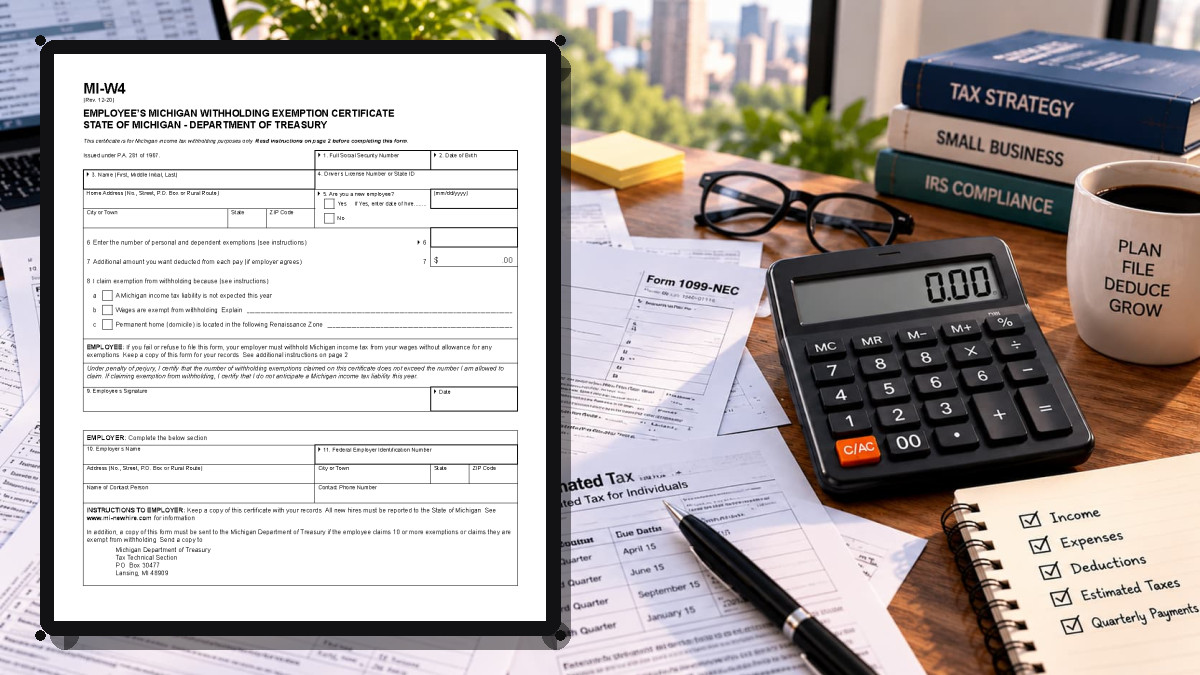
How to Complete Michigan Form MI-W4 Line by Line
Employee identification (Lines 1–5)
Line 1: Full Social Security number. Required for Treasury to match the employer’s withholding records to the employee’s return.
Line 2: Date of birth.
Line 3: Name and home address. First, middle initial, last name, and complete home address including city, state, and ZIP.
Line 4: Driver’s license number or state ID number.
Line 5: New employee status. Check Yes or No; if Yes, enter the date of hire. This lets the employer meet Michigan’s new-hire reporting requirement.
Exemptions and withholding (Lines 6–9)
Line 6: Number of personal and dependent exemptions. Enter the number of exemptions expected on the Michigan MI-1040 for the year — this cannot exceed what the employee is actually entitled to claim. Each exemption is worth $5,900 of wages sheltered from withholding for 2026.
Line 7: Additional amount to withhold. An optional flat dollar amount per pay, on top of the standard withholding, if the employer agrees to withhold it. Useful for covering side income or avoiding an underpayment at filing time.
Line 8: Claim of exemption from withholding. Check one reason if claiming full exemption instead of completing Line 6: (a) no Michigan income tax liability is expected this year; (b) specific wages are exempt from withholding, with an explanation written in; or (c) the employee’s permanent home (domicile) is in a named Renaissance Zone.
Line 9: Employee’s signature and date. Required — the certification states, under penalty of perjury, that the exemptions claimed do not exceed what the employee is entitled to and, if claiming exemption, that no Michigan tax liability is anticipated.
Employer section (Lines 10–11)
Line 10: Employer’s name and address.
Line 11: Federal Employer Identification Number (FEIN), plus a contact name and phone number for the business.
The employer keeps the completed certificate with its payroll records and forwards a copy to Treasury only if the employee claimed 10 or more exemptions on Line 6 or claimed exemption from withholding on Line 8. Employers must also report all new hires to the State of Michigan separately, at mi-newhire.com.
Common Mistakes to Avoid
- Sending it to Treasury instead of the employer. The MI-W4 is an employer-facing form; only the employer forwards a copy to Treasury, and only in specific cases.
- Assuming the federal W-4 covers Michigan too. It does not — a separate MI-W4 is always required for state withholding.
- Claiming exemption on Line 8 without actually qualifying. This can leave a real Michigan tax bill — plus penalties — at filing time if a liability turns out to exist after all.
- Not updating the form within 10 days after exemptions decrease or residency changes from nonresident to resident, as Michigan requires.
- Using the outdated $5,800 exemption figure. For 2026, each exemption on Line 6 is worth $5,900.
- Leaving Line 9 unsigned. An unsigned certificate is not valid, and the employer must withhold without exemptions until a signed one is on file.
Frequently Asked Questions
Do I send my MI-W4 to the Michigan Department of Treasury? No. Give it to your employer. Your employer only forwards a copy to Treasury if you claim 10 or more exemptions or claim exemption from withholding.
Can I use my federal W-4 instead of the MI-W4? No. Michigan requires its own separate withholding certificate.
What happens if I don’t file an MI-W4 at all? Your employer must withhold Michigan income tax from your wages without any exemptions, which typically over-withholds.
How much is each exemption worth in 2026? $5,900 of wages sheltered from Michigan withholding per exemption claimed on Line 6.
What is Michigan’s withholding rate? A flat 4.25% of taxable wages for 2026.
I live in Ohio and work in Michigan — do I owe Michigan withholding? Generally no. Michigan has a reciprocity agreement with Ohio (and Illinois, Indiana, Kentucky, Minnesota, and Wisconsin), so residents of those states are typically not subject to Michigan withholding on Michigan wages.
How often do I need to refile an MI-W4? Only when something changes — a decrease in exemptions or a nonresident-to-resident status change requires a new one within 10 days. Otherwise it stays in effect indefinitely.
Final Review Before Filing
- Full Social Security number, date of birth, and current home address are correct.
- Line 6 exemptions match what you actually expect to claim on your MI-1040 — not more.
- If claiming exemption on Line 8, the reason checked (a, b, or c) genuinely applies to you.
- Any Line 8(b) explanation of exempt wages is filled in, not left blank.
- The certificate is signed and dated on Line 9.
- The form is given to your employer — not mailed to Treasury yourself.
- A reminder is set to refile within 10 days if exemptions decrease or residency status changes.
Sources & verification
- Issuing agency: Michigan Department of Treasury
- Official documents: Form MI-W4 (PDF) · 2026 Michigan Income Tax Withholding Guide (Form 446)
- Checked against: MI-W4 (Rev. 12-20) and the 2026 Michigan Income Tax Withholding Guide
- Last verified: September 16, 2026
Spot an error or an out-of-date figure? Tell us and we will check it against the official source.
General information from the official form and its instructions, not advice for your circumstances. See the full disclaimer.
More Michigan Tax Forms forms
- Michigan Form 151 — Authorized Representative Declaration (Power of Attorney)
- Michigan Form 3372 — Sales and Use Tax Certificate of Exemption
- Michigan Form 5081 — Sales, Use and Withholding Taxes Annual Return
- Michigan Form 518 — Registration for Michigan Taxes
- Michigan Form 5713 — Request for Hearing/Informal Conference
- Michigan MI-1040CR — Homestead Property Tax Credit Claim
- Michigan MI-1040ES 2026 — Estimated Individual Income Tax Voucher
- Michigan Schedule 1 (Form 3423) — Additions and Subtractions Instructions