What is Form ST-100?
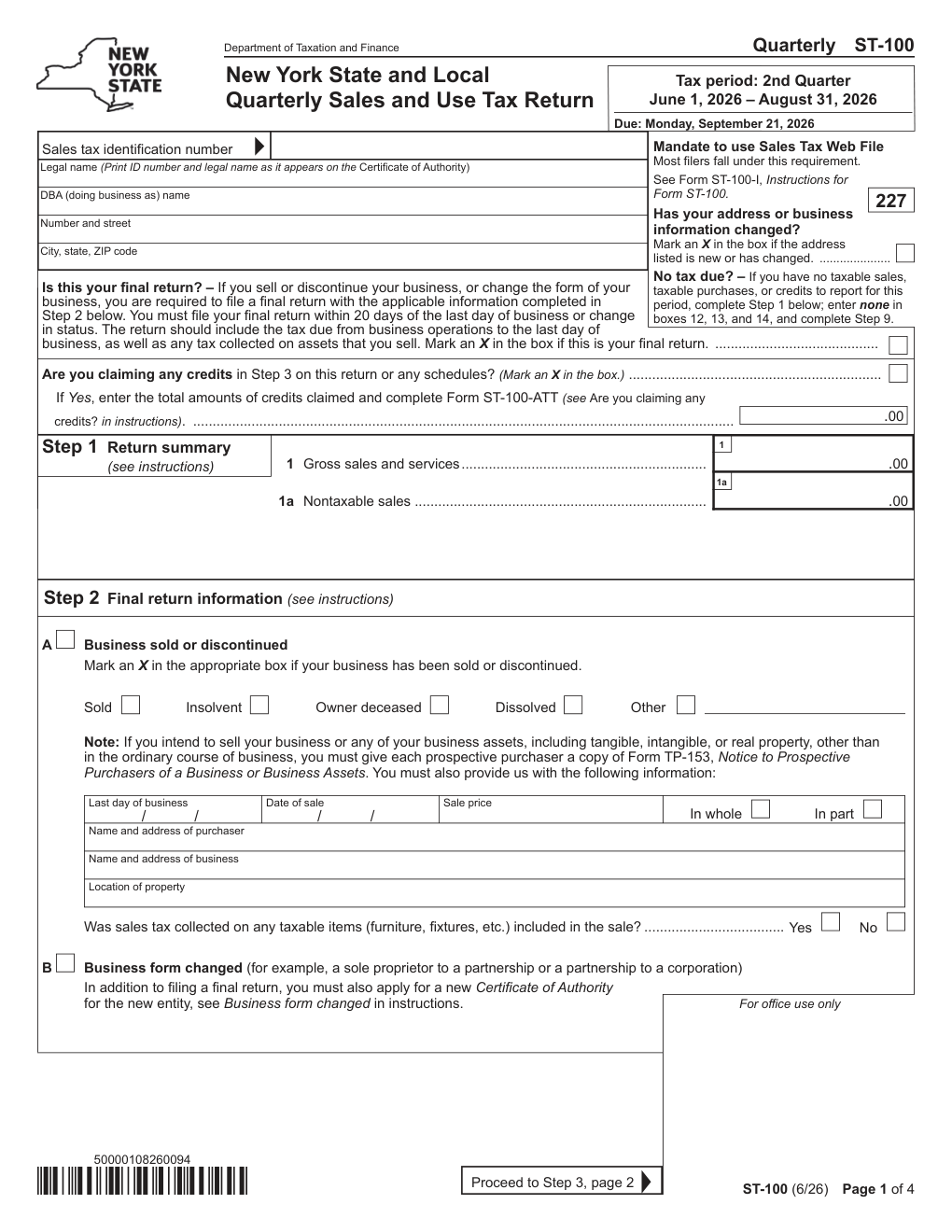
Quick answer: Form ST-100 is the quarterly sales and use tax return for New York vendors registered with a sales tax Certificate of Authority. It reports gross sales, the taxable receipts and purchases for each taxing jurisdiction, special taxes and fees, and any credits, and it is filed even when you owe nothing. Most vendors must file it electronically through Sales Tax Web File. The June 1 – August 31, 2026 return was due Monday, September 21, 2026. Vendors with $300,000 or more of taxable receipts, purchases, rents and amusement charges in a quarter must file monthly instead.
New York sales tax has a state part and layered local parts, so ST-100 is built around jurisdictions: each sale or purchase goes on the line for the place where it was delivered or used. Businesses with sales in only one county see a short list of lines, but those that deliver across the state or into the Metropolitan Commuter Transportation District (MCTD) use more of the form.
The return is due whether or not you collected any tax. You are also responsible for turning over all the tax you collected, even if it is more than the tax that was actually due.
Key Figures — Quarterly Filing (Form ST-100)
- Tax period on the current form: June 1 – August 31, 2026, due Monday, September 21, 2026. The due date is printed at the top of every ST-100.
- State rate: 4% for the state-only jurisdiction line (code NE 0021); local rates are printed in Column E for each jurisdiction.
- Monthly filing: required if taxable receipts, purchases subject to tax, rents and amusement charges total $300,000 or more in a quarter.
- Vendor collection credit: 5% of taxes and fees reported, maximum $200 per return, only if filed on time and paid in full.
- Late filing, no tax due: $50 penalty.
- Late payment penalty: 10% for the first month plus 1% for each later month, up to 30%.
Source: the New York State Department of Taxation and Finance, Form ST-100 and Form ST-100-I for the June 1 – August 31, 2026 tax period. Last verified September 29, 2026.
Who Must File Form ST-100?
Any business registered as a sales tax vendor with a Certificate of Authority must file a sales tax return for each period, even with no taxable sales, purchases or credits. Quarterly filers use ST-100; larger vendors file monthly returns. The instructions say you must use Sales Tax Web File if you are subject to the corporation tax e-file mandate, or if you prepare your own tax documents without a professional, use a computer to prepare them and have broadband internet access. To Web File, you need a Tax Online Services account.
Beyond the regular return, you must file a final return if you stop operating, sell, transfer or assign the business, or change your entity type, for example from a sole proprietorship to a corporation, which also requires a new Certificate of Authority. A final return is due within 20 days of the last day of business.
Common trap: filers with no sales skip the return. A no-tax-due return still must be filed, and a late no-tax-due return costs a $50 penalty.
How to File Form ST-100
- Web File it through your Tax Online Services account if you are required to; otherwise mail the paper return.
- Include every page of the return and any schedule, even pages with no entries, and enter your sales tax identification number and name at the top of each page.
- Complete Steps 1 to 9 in order, starting with the return summary and ending with your signature.
- If you have no tax due, complete Step 1, write “none” in boxes 12, 13 and 14, and complete Step 9.
- Pay by check or money order in U.S. funds payable to New York State Sales Tax, writing your sales tax ID number, “ST-100” and the last day of the filing period on it, and send it with the return.
- Claim credits by marking the box, entering the amount and attaching Form ST-100-ATT; separately file Form AU-11 for overpayment refunds and do not attach it to the return.
When Is Form ST-100 Due?
The due date is printed at the top of each form. The June 1 – August 31, 2026 quarter was due Monday, September 21, 2026. Quarterly periods run March–May, June–August, September–November and December–February, and returns are generally due on the 20th day after the period ends, or the next business day when that day falls on a weekend. Check the form or your Tax Online Services account for the exact date. Final returns are due within 20 days of your last day of business. If you are required to file monthly, you continue until you no longer meet the $300,000 threshold for four consecutive quarters.
Where to Mail Form ST-100
If you are not required to Web File, mail the return, attachments and payment to: NYS Sales Tax Processing, PO Box 15168, Albany NY 12212-5168. Private delivery services must be ones designated in Publication 55.
How to Complete Form ST-100 Line by Line
Top of the Return — Identification and Status
Confirm your sales tax identification number, legal name and address. Mark the box if your address or business information has changed, and use Form DTF-96 (address) or Form DTF-95 (other changes) for updates. Mark the final return box only if the business has closed. Mark the credits box if you are claiming credits in Step 3 or on schedules, enter the total and attach Form ST-100-ATT.
Step 1 — Return Summary (Boxes 1 and 1a)
| Line | What to enter |
|---|---|
| Box 1 | Gross sales and services: all taxable, nontaxable and exempt sales from your New York locations and from locations outside the state delivered into it, including those facilitated for marketplace sellers. Do not include the sales tax itself or sales reported on Form ST-100.10. |
| Box 1a | Nontaxable sales, whether or not an exemption document was required from the purchaser. |
A grocer includes sales of exempt food items here; a parts store includes sales to a repair shop that gave it a Form ST-120 resale certificate.
Step 2 — Final Return Information
Complete only if this is your final return. Mark the reason (sold, insolvent, owner deceased, dissolved, other) and give the last day of business, date of sale, sale price and buyer details. If you sell the business or its assets, give each prospective buyer Form TP-153 and report tax collected on the assets you sold. For an entity change, apply for a new Certificate of Authority at least 20 days beforehand and file Form AU-196.10 at least 10 days beforehand.
Step 3 — Sales and Use Tax by Jurisdiction (Columns A–F, Boxes 2–14)
Report each sale and each taxable purchase for the jurisdiction where the sale was delivered or the purchase was used. Column C is taxable sales and services (without tax), Column D is purchases subject to tax, such as out-of-state purchases with no New York tax paid or purchases used in a higher-rate jurisdiction, Column E is the printed rate, and Column F is (C + D) multiplied by E. Credits, for example for bad debts or returned merchandise, are shown as negative numbers with a minus sign. Enter totals from schedules in boxes 2, 2a and 3 through 5, subtotal the columns in boxes 6 to 8 on page 2, carry the subtotals to boxes 9 to 11 on page 3, and total the columns in boxes 12 to 14.
Steps 4 and 4A — Special Taxes and Fees
Step 4 covers taxable receipts from passenger car rentals, peer-to-peer car sharing, information and entertainment services through telephony and telegraphy, and vapor products; multiply by the rate and total the result in box 15a. Step 4A is the waste tire management and recycling fee, reported by number of items times the fee due per item into box 15b. Retailers with a physical New York location may keep $0.25 per new tire. Box 15c adds 15a and 15b.
Steps 5 and 6 — Credits and Taxes Due
Step 5 (box 16) totals credit for prepaid sales tax on cigarettes, an overpayment carried forward from a prior period after an approved Form AU-11, and advance payments reported on Form ST-330. Step 6 computes box 17, Taxes due: box 14 plus box 15c minus box 16.
Steps 7–9 — Vendor Credit, Total Due and Signature
Qualifying vendors take a credit of 5% of taxes and fees reported, up to $200, in box 18. If you file late or do not pay in full, you lose the credit and enter penalty and interest in box 19.
| Line | What to enter |
|---|---|
| Box 20 | The total amount due. |
| Box 21 | The amount you are paying, which should match. |
Sign the paper return (Web File counts as an electronic signature) and add the paid preparer and third-party designee sections if used.
Common Mistakes to Avoid
- Not filing when there are no sales. A no-tax-due return is still required, with a $50 penalty if late.
- Including sales tax in Column C. Taxable sales are reported before tax.
- Reporting sales on the wrong jurisdiction line. Use the place of delivery, not where the business is located.
- Forgetting purchases that owe use tax in Column D.
- Claiming the vendor credit on a late or short-paid return. The credit is lost.
- Attaching Form AU-11 to the return. It must be filed separately.
- Filing quarterly when you should file monthly. $300,000 in a quarter moves you to monthly returns.
Frequently Asked Questions
Who must file Form ST-100? Vendors with a New York sales tax Certificate of Authority who file quarterly, even if they had no sales.
Can I file on paper? Only if you are not required to use Sales Tax Web File.
What happens if I file late? A $50 minimum penalty for no tax due; with tax due, 10% for the first month plus 1% per month up to 30%, plus interest.
What is the vendor collection credit? 5% of taxes and fees reported, up to $200 per return, for on-time, fully paid returns.
Where do I mail a paper return? NYS Sales Tax Processing, PO Box 15168, Albany NY 12212-5168.
How do I close my sales tax account? File a final return and mark the final return box within 20 days of your last day of business.
Final Review Before Filing
- You are filing for the correct quarter and by the due date printed on the form.
- Sales tax ID number and name appear on every page.
- Step 1 gross and nontaxable sales are completed.
- Each sale and purchase is on the correct jurisdiction line.
- Credits are shown as negative numbers and Form ST-100-ATT is attached if needed.
- Boxes 17 through 21 are calculated and match the payment.
- Payment made to New York State Sales Tax with ID, ST-100 and period end date.
- Signed (or Web Filed) and mailed to PO Box 15168 if on paper.
Sources & verification
- Issuing agency: New York State Department of Taxation and Finance
- Official documents: Form ST-100 (PDF) · Form ST-100-I instructions (PDF)
- Checked against: the Form ST-100 and Form ST-100-I for the June 1 – August 31, 2026 quarter
- Last verified: September 29, 2026
Spot an error or an out-of-date figure? Tell us and we will check it against the official source.
General information from the official form and its instructions, not advice for your circumstances. See the full disclaimer.
More New York Tax Forms forms
- New York Form IT-201 — Resident Income Tax Return 2025-2026
- New York Form IT-201-X — Amended Resident Income Tax Return 2025-2026
- New York Form IT-203 — Nonresident and Part-Year Resident Income Tax Return 2025-2026
- New York Form IT-2104 — Employee’s Withholding Allowance Certificate
- New York Form IT-2105 — Estimated Tax Payment Voucher for Individuals
- New York Form IT-214 — Claim for Real Property Tax Credit for Homeowners and Renters
- New York Form IT-370 — Application for Automatic Six-Month Extension of Time to File for Individuals
- New York Form NYS-45 — Quarterly Combined Withholding, Wage Reporting, and Unemployment Insurance Return