


What is Form 01-114?
Quick answer: Form 01-114 is the Texas Sales and Use Tax Return (long form). Texas sellers report total sales, taxable sales, taxable purchases and the state and local tax they owe for each reporting period, and pay it to the Comptroller. Returns are due on the 20th day of the month after the period ends (the next business day if that is a weekend or holiday). A return must be filed for every period, even with no sales. The state rate printed on the form is 6.25%, and paying on time earns a 0.5% timely filing discount.
Texas has no personal income tax, so sales tax is one of the main taxes businesses deal with. Filing a return is not optional even in a slow month: the Comptroller expects a return for every period, and late returns bring penalties.
The form you need depends on how complicated your business is. The long form (01-114) is for businesses with more than one location, more than one local taxing authority, prepayments, credits and a few other cases; simpler businesses may be able to use a shorter return, so check with the Comptroller (800-252-5555) if you are unsure which one applies to you.
Key Figures — Form 01-114 (Rev. 8-25/41)
- State sales tax rate: 6.25% (printed on the form as .062500); local taxes are added by city, transit authority, county and special purpose district.
- Due date: the 20th day of the month following the end of the monthly, quarterly or yearly reporting period.
- Timely filing discount: 0.5% (.005) of the tax due when the return and payment are on time.
- Late penalties: 5% for 1–30 days late, 10% for 31–60 days, and 10% plus interest beyond 60 days.
- Late filing: an additional $50 penalty each time a return is filed after the due date.
- No sales? A return is still required; blacken the No Sales box, sign and date and mail it.
Source: the Texas Comptroller of Public Accounts, Form 01-114 and Form 01-922 instructions. Last verified September 29, 2026.
Who Must File Form 01-114?
Any business with a Texas sales tax permit must file a return for every reporting period. You must use the long form (01-114) if you:
- have more than one outlet or place of business;
- report tax to more than one city, transit authority, county or special purpose district;
- prepay your state and local taxes;
- report use tax from out-of-state locations;
- are taking credit (other than bad debt credit) to reduce taxes due;
- have custom broker refunds to report; or
- are a marketplace provider or a remote seller.
If you are claiming a bad debt credit, you must file electronically. If you are not sure whether you file monthly, quarterly or yearly, call the Comptroller at 800-252-5555.
Common trap: skipping a return because there were no sales. Texas requires a return for every period, and a late no-sales return still draws penalties.
How to File Form 01-114
- File electronically at the Comptroller’s file-and-pay site when you can; bad debt credits require it.
- Or complete the paper Form 01-114. Do not staple or paper clip, and do not write in shaded areas.
- Report whole dollars only, except tax and penalty amounts, which are in dollars and cents.
- Add List Supplements (Form 01-116-A) if your local tax amounts differ across authorities for an outlet.
- Make checks payable to State Comptroller and mail with the return.
When Is Form 01-114 Due?
Returns and payments are due on or before the 20th day of the month after the end of each reporting period: for example, a January monthly return is due February 20. If the 20th falls on a Saturday, Sunday or legal holiday, the next business day is the due date. Penalties and interest apply to taxes paid late, and a separate penalty applies to a return filed late. If your mailing or outlet address changes or you go out of business, blacken the matching box on the return.
Where to Mail Form 01-114
Mail to: Comptroller of Public Accounts, P.O. Box 149354, Austin, TX 78714-9354. Make the check payable to State Comptroller.
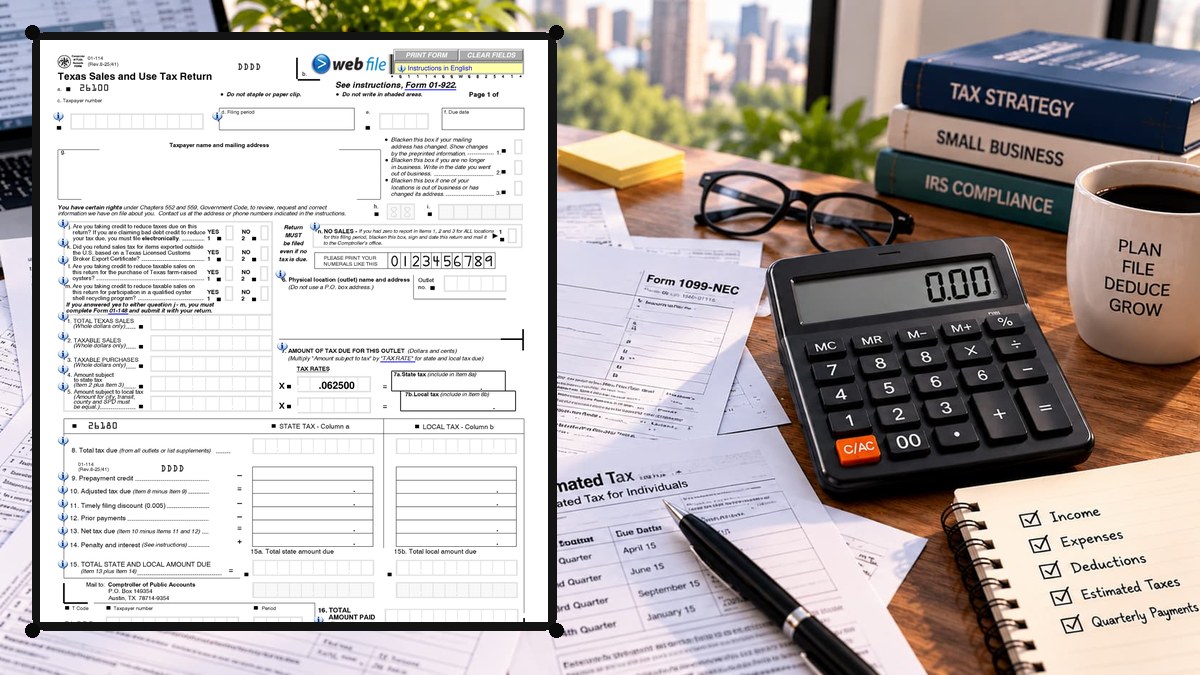
How to Complete Form 01-114 Line by Line
Top of the Return — Identification and Questions (a–n)
Check your taxpayer number, filing period and due date. Blacken the boxes if your mailing address changed, if you are no longer in business (with the date), or if one of your locations closed or changed its address. Answer the yes/no questions about taking credit, refunds for exports based on a Texas Licensed Customs Broker Export Certificate, and credits for Texas farm-raised oysters or a qualified oyster shell recycling program. If any answer is yes, complete Form 01-148 and submit it with the return. If you had zero to report in items 1, 2 and 3 for every location, blacken the No Sales box, sign, date and mail it.
Items 1–4 — Sales, Taxable Sales and Taxable Purchases
Item 1, Total Texas Sales: all sales, services, leases and rentals of tangible personal property, with related charges, made in Texas, not including tax. This covers sales from a Texas location and sales into Texas from out of state. Enter 0 if none. Item 2, Taxable Sales: the taxable portion; claim a credit here by subtracting purchases or sales you paid tax on in error or refunded to a customer. Item 3, Taxable Purchases: items bought, leased or rented for your own use on which no sales or use tax was paid, including out-of-state purchases, exempt items taken from inventory for use and items given away. Inventory held for resale is not included. Item 4 adds items 2 and 3 and does not include item 1.
Items 5–7 — Local Amounts, Outlets and Tax by Outlet
Item 5 is the amount subject to local tax, which must be the same for the city, transit, county and special purpose district for that outlet; if amounts differ, use the List Supplement. Item 6 is the trade name, actual location and five digit outlet number of each physical location, with no P.O. box. Item 7 computes the tax for that outlet: 7a is state tax (amount subject to state tax times .0625) and 7b is local tax (amount times the local rate).
Items 8–13 — Totals, Prepayment, Discount and Net Tax
Item 8 combines state tax due (column a) and local tax due (column b) from all outlets. Item 9 is the prepayment credit, which includes your timely prepayment plus the allowable prepayment discount; if it is not preprinted, divide the prepaid amount by .9825. Item 10 is item 8 minus item 9. Item 11 is the timely filing discount: multiply the tax due by 1/2 percent (.005) if the return and payment are on time; do not take it if either is late. Item 12 shows prior payments or overpayments applied to the period. Item 13 is net tax due.
Items 14–16 — Penalty, Interest and Total Due
Item 14 is penalty and interest: 5% if 1–30 days late, 10% if 31–60 days late, and 10% plus interest if more than 60 days late, in whole dollars. Item 15 is the total state and local amount due (15a state, 15b local). Item 16 is the total amount paid. Sign and date the declaration.
Common Mistakes to Avoid
- Not filing for a no-sales period. A return is required every period.
- Including tax in item 1 or item 2. Report sales without the tax.
- Adding item 1 into item 4. Only taxable sales and taxable purchases go into item 4.
- Taking the discount on a late return. The 0.5% discount applies only when both the return and the payment are on time.
- Using the same local amount for outlets that differ. Use the List Supplement when local amounts differ.
- Forgetting use tax. Purchases for your own use with no tax paid belong in item 3.
- Stapling or clipping the paper return. The form asks you not to.
Frequently Asked Questions
When is the Texas sales tax return due? By the 20th of the month after the reporting period ends, or the next business day if that date falls on a weekend or holiday.
Do I have to file if I had no sales? Yes. Use the No Sales box, sign and date it.
What is the timely filing discount? 0.5% of the tax due for filing and paying on time.
What are the late penalties? 5% for up to 30 days, 10% for 31–60 days, and 10% plus interest after 60 days, plus $50 for a late return.
Can I file amended returns? Yes, on paper or electronically through Webfile or EDI.
Where do I mail Form 01-114? Comptroller of Public Accounts, P.O. Box 149354, Austin, TX 78714-9354.
Final Review Before Filing
- Reporting period and due date match the return.
- Items 1 to 4 are in whole dollars and exclude sales tax.
- Each outlet is listed with the five digit outlet number.
- State and local tax are computed with the correct rates.
- Prepayment, prior payments and the 0.5% discount are applied only when eligible.
- Penalty and interest are added if late.
- Return is signed and mailed to P.O. Box 149354, or filed electronically.
Sources & verification
- Issuing agency: Texas Comptroller of Public Accounts
- Official documents: Form 01-114 (PDF) · Form 01-922 instructions (PDF)
- Checked against: Form 01-114 (Rev. 8-25/41) and the Form 01-922 instructions
- Last verified: September 29, 2026
Spot an error or an out-of-date figure? Tell us and we will check it against the official source.
General information from the official form and its instructions, not advice for your circumstances. See the full disclaimer.
More Texas Tax Forms forms
- Texas Form 01-339 — Sales and Use Tax Resale Certificate and Exemption Certification
- Texas Form 05-102 — Franchise Tax Public Information Report
- Texas Form 05-158 — Franchise Tax Report (Long Form) 2025-2026
- Texas Form 05-164 — Franchise Tax Extension Request 2025-2026
- Texas Form 05-169 — Franchise Tax EZ Computation Report 2025-2026