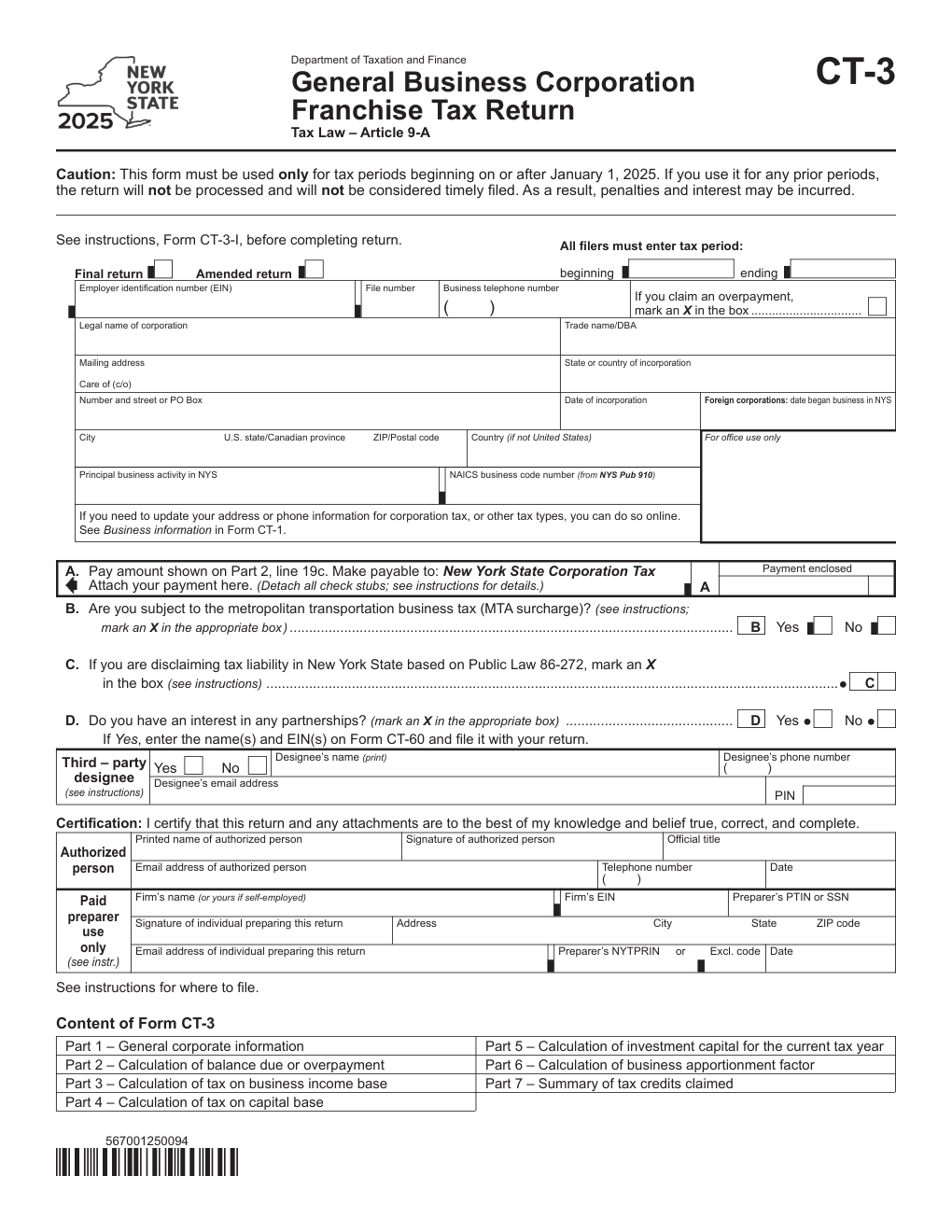
What is Form CT-3?
Quick answer: Form CT-3 is the New York General Business Corporation Franchise Tax Return under Article 9-A. A C corporation (including an LLC or other entity taxed as a corporation) that does business, employs capital, owns or leases property, maintains an office or derives receipts in New York files it. The tax is the largest of three computations: the business income base tax (6.5%, or 7.25% above a $5 million income base), the capital base tax (0.1875%) or a fixed dollar minimum ($25 to $200,000 by New York receipts). A calendar-year return is due April 15; a six-month extension is requested on Form CT-5.
New York’s franchise tax is a minimum-tax structure: the corporation figures all three bases and pays the greatest. That means a corporation with little or no income can still owe tax based on its capital or its New York receipts.
New York S corporations file a different return, Form CT-3-S. Corporations doing business in the Metropolitan Commuter Transportation District file Form CT-3-M for the MTA surcharge.
Key Figures — Form CT-3 (tax periods beginning on or after January 1, 2025) and CT-3-I (2025)
- Business income base tax rates: 6.5% for most general business taxpayers; 7.25% if the business income base is more than $5,000,000; 4.875% for qualified emerging technology companies; 0% for qualified New York manufacturers.
- Capital base tax rate: 0.1875% for most taxpayers; 0% for qualified New York manufacturers, qualified emerging technology companies, cooperative housing corporations and small business taxpayers.
- Fixed dollar minimum: $25 (NY receipts up to $100,000), $75, $175, $500, $1,500 (over $1M to $5M), $3,500, $5,000, $10,000, $20,000, $50,000, $100,000, and $200,000 over $1 billion.
- Tax due: the largest of the business income base tax, the capital base tax and the fixed dollar minimum (Part 2, line 2).
- Due date: within 3 months after the end of the reporting period; April 15 for a calendar-year corporation (next business day if a weekend or holiday). Domestic international sales corporations file by the 15th day of the 9th month.
- Extension: six months by filing Form CT-5 and paying the properly estimated tax by the original due date.
- Tax periods: this version of the form is for tax periods beginning on or after January 1, 2025; using it for earlier periods leads to rejection.
Source: the New York State Department of Taxation and Finance, Form CT-3 and Instructions for Form CT-3 (CT-3-I, 2025). Last verified October 14, 2026.
Who Must File Form CT-3?
Corporations subject to Article 9-A file Form CT-3. For this purpose a corporation includes associations, limited liability companies, limited liability partnerships and publicly traded partnerships that are taxed as corporations for federal purposes.
Domestic and foreign corporations. A foreign corporation is liable during the period in which it does business, employs capital, owns or leases property, maintains an office, or derives receipts from activity in New York. A domestic corporation that is no longer doing any of these things is exempt from the fixed dollar minimum after its final tax year and need not file if it meets the listed requirements.
Who files something else: insurance corporations, transportation and transmission corporations and certain other entities are taxed under other articles. Corporations that qualify for a combined return file Form CT-3-A, and New York S corporations file Form CT-3-S.
Public Law 86-272. A corporation that is not protected by Public Law 86-272 and is subject to tax solely because it derives receipts in New York answers the corresponding question in Part 1.
Common trap: assuming no income means no tax. The fixed dollar minimum or the capital base tax can exceed the business income base tax, and the greatest of the three is the amount due.
How to File Form CT-3
- Complete Part 1 (general corporate information) and mark the boxes for any special status, such as qualified emerging technology company or qualified New York manufacturer.
- Attach a complete copy of your federal return and any required forms and schedules; mark the box that shows which federal return was filed.
- Compute all three bases: business income base (Part 3, with apportionment in Part 6), capital base (Part 4, with investment capital in Part 5) and the fixed dollar minimum.
- Claim credits in Part 7 using the separate credit forms.
- Pay the balance due and reconcile installments: mandatory first installment (Form CT-300), second to fourth installments (Form CT-400) and any extension payment (Form CT-5).
- E-file through approved software, or mail the return. To amend, follow the amended return instructions and mark the amended return box.
When Is Form CT-3 Due?
File within 3 months after the end of the reporting period. For a calendar-year corporation the return is due on or before April 15; if that falls on a Saturday, Sunday or legal holiday, file by the next business day. To request a six-month extension, file Form CT-5 and pay your properly estimated franchise tax and MTA surcharge on or before the original due date; most corporations must request it electronically. If you pay after the due date, interest runs from the original due date on any underpayment, and late filing and late payment penalties apply. Estimated tax installments follow the CT-300 and CT-400 forms.
Where to Mail Form CT-3
Mail the return to: NYS Corporation Tax, PO Box 15181, Albany NY 12212-5181. Private delivery services: see Publication 55. Many corporations must or may e-file through approved corporation tax software.
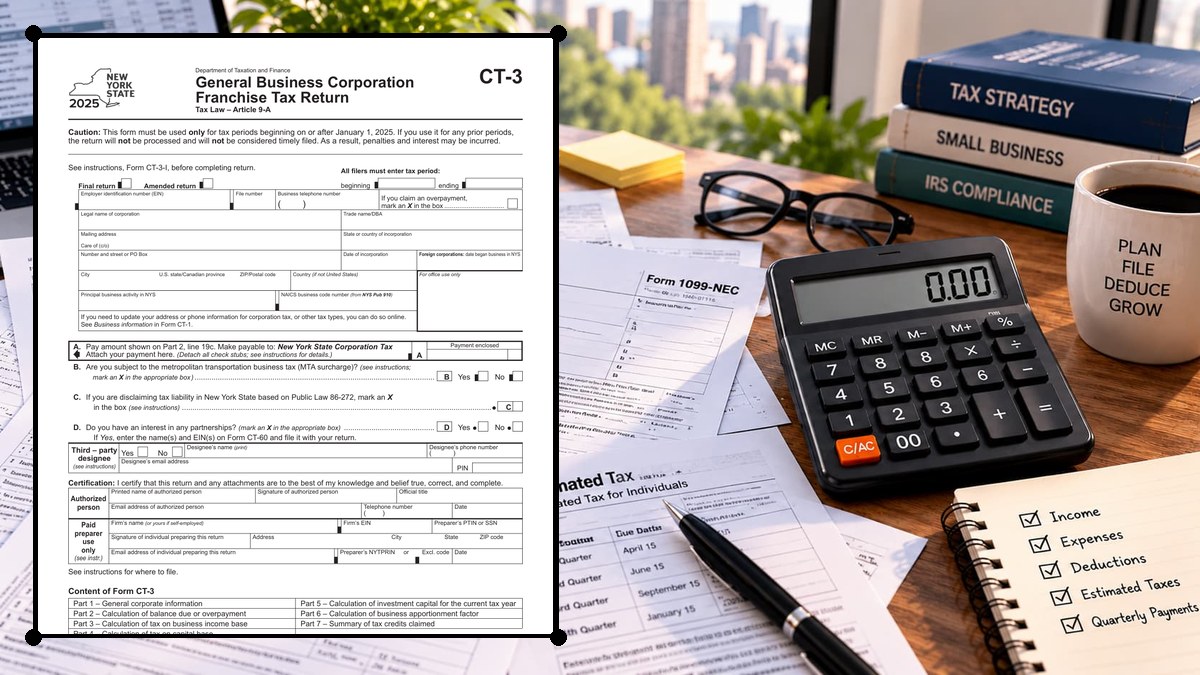
How to Complete Form CT-3 Line by Line
Part 1 — General Corporate Information
Part 1 identifies the corporation and asks about special statuses: a qualified emerging technology company (QETC) eligible for lower rates, qualified New York manufacturers (based on the principally engaged test or the significant employment and property test), cooperative housing corporations and innovation hot spot entities. It also asks for the number of New York employees, wages paid to them, the number of business establishments in the state and whether you have an interest in or have rented New York real property, plus whether you claim an exception to the related-member expense addback.
Part 2 — Calculation of Balance Due or Overpayment
| Line | What to enter |
|---|---|
| Lines 1a–1c | Show the business income base tax, the capital base tax and the fixed dollar minimum. |
| Line 2 | The largest. |
| Lines 3–4 | Subtract tax credits. |
| Lines 5–8 | Add the estimated tax penalty, interest on late payment, and late filing and payment penalties. |
| Line 10 | The total amount due. |
| Lines 11–17 | List prepayments, including the mandatory first installment (CT-300), second to fourth installments (CT-400), extension payment (CT-5) and overpayments credited from prior periods. |
| Line 18 | Total of the lines above. |
| Lines 19–26 | Give the underpayment or balance due, or the overpayment to credit forward or refund, including unused tax credits. |
Part 3 — Tax on the Business Income Base
Start with federal taxable income before net operating loss and special deductions (line 1), make the additions and subtractions the instructions require, apportion the result using the business apportionment factor from Part 6, and apply the rate: 6.5% generally, 7.25% for a business income base over $5,000,000, 4.875% for QETCs and 0% for qualified New York manufacturers.
Parts 4–5 — Capital Base Tax and Investment Capital
Part 4 starts with total assets from the federal return and subtracts real property and marketable securities that fall outside the base, then applies the 0.1875% rate (0% for qualifying taxpayers). Part 5 computes investment capital; stocks held for more than one year and capital that generates income claimed to be not taxable by New York under the U.S. Constitution are reported there, using Form CT-3.1.
Parts 6–7 — Apportionment Factor and Tax Credits
Part 6 computes the business apportionment factor from receipts, with sourcing rules for sales of tangible property, services, digital products, loans, brokerage commissions and other categories. Part 7 totals the tax credits used; the number of credit forms filed is also reported in Part 1. Credits are claimed on their own forms.
Common Mistakes to Avoid
- Paying only the income-based tax. The tax due is the largest of the three bases.
- Missing the CT-5 extension request. The extension is for filing only, and you must pay the estimated tax by the original due date.
- Leaving out the federal return. Attach a complete copy.
- Skipping installments. The mandatory first installment and later installments are reconciled on lines 11–14.
- Using the wrong year’s form. This form is only for tax periods beginning on or after January 1, 2025.
- Forgetting the MTA surcharge. Corporations doing business in the commuter district file Form CT-3-M.
- Filing CT-3 for an S corporation. A New York S corporation files Form CT-3-S.
Frequently Asked Questions
What is the New York corporate franchise tax rate? 6.5% of the business income base for most corporations (7.25% above $5,000,000 of business income base), compared with a 0.1875% capital base tax and a fixed dollar minimum.
When is Form CT-3 due? Within 3 months after the end of the reporting period; April 15 for a calendar-year corporation.
Can I get an extension? Yes, six months by filing Form CT-5 and paying the estimated tax by the original due date.
What is the fixed dollar minimum? A minimum tax from $25 to $200,000 based on the corporation’s New York receipts.
Do LLCs file CT-3? An LLC taxed as a corporation does.
Where do I mail it? NYS Corporation Tax, PO Box 15181, Albany NY 12212-5181, or e-file.
Final Review Before Filing
- The corporation is subject to Article 9-A and the correct form (CT-3, CT-3-A or CT-3-S) is used.
- A complete copy of the federal return is attached.
- All three tax bases are computed and the largest is entered on Part 2, line 2.
- Credit forms are attached and counted in Part 1.
- Installments and any extension payment are reconciled.
- The return is filed by the due date or the CT-5 extension is filed with payment.
Sources & verification
- Issuing agency: New York State Department of Taxation and Finance
- Official documents: Form CT-3 (PDF) · CT-3-I instructions (PDF)
- Checked against: Form CT-3 (tax periods beginning on or after January 1, 2025) and CT-3-I (2025)
- Last verified: October 14, 2026
Spot an error or an out-of-date figure? Tell us and we will check it against the official source.
General information from the official form and its instructions, not advice for your circumstances. See the full disclaimer.
More New York Tax Forms forms
- New York Form IT-201 — Resident Income Tax Return 2025-2026
- New York Form IT-201-X — Amended Resident Income Tax Return 2025-2026
- New York Form IT-203 — Nonresident and Part-Year Resident Income Tax Return 2025-2026
- New York Form IT-204 — Partnership Return 2025-2026
- New York Form IT-2104 — Employee’s Withholding Allowance Certificate
- New York Form IT-2105 — Estimated Tax Payment Voucher for Individuals
- New York Form IT-214 — Claim for Real Property Tax Credit for Homeowners and Renters
- New York Form IT-370 — Application for Automatic Six-Month Extension of Time to File for Individuals
- New York Form NYS-45 — Quarterly Combined Withholding, Wage Reporting, and Unemployment Insurance Return
- New York Form ST-100 — New York State and Local Quarterly Sales and Use Tax Return