
What is Form ST-1?
Quick answer: Form ST-1 is the Illinois Sales and Use Tax and E911 Surcharge Return that retailers file for sales, leases and rentals of general merchandise, qualifying drugs and medical appliances, groceries and prepaid wireless service. It is due by the 20th day of the month following the end of the reporting period. The State rate is 6.25% (1.00% for qualifying drugs and medical appliances), plus local taxes by location. Retailers who file and pay on time may take a discount of 1.75% of the tax due (at least $5 per calendar year, up to $1,000 a month). Most filers use MyTax Illinois.
Illinois sales tax is built from several layers: the State rate, home-rule and non-home-rule taxes, mass transit and other district taxes, and location-specific rates that depend on where the sale is made. The Department’s Tax Rate Finder at mytax.illinois.gov gives the rates for each location.
A retailer with more than one selling location files one ST-1 and attaches Form ST-2, Multiple Site Form, to show the tax from each site. Beginning January 1, 2025, leases of most tangible personal property are treated as retail sales, so lessors file ST-1.
Key Figures — Form ST-1 (R-01/26) and its instructions
- State rate: 6.25%; 1.00% for qualifying drugs and medical appliances. Local rates vary by site.
- Groceries: from January 1, 2026 the State 1% tax on grocery sales is eliminated, but municipalities and counties may impose it, and local grocery taxes in the RTA and Metro-East Transit District remain.
- Due date: on or before the 20th day of the month following the end of the reporting period; the next business day if it falls on a weekend or holiday.
- Filing frequency (set by the Department): monthly if average monthly liability exceeds $200, quarterly if it is between $50 and $200, and annual if it is under $50.
- Retailers’ discount: 1.75% of tax due or $5 per calendar year, whichever is greater, with a maximum of $1,000 per month for returns due on or after January 1, 2025, for on-time filing and payment.
- Rounding: round to the nearest dollar (drop under 50 cents, round 50 cents or more up); negative receipts cannot be reported.
- Multiple sites: attach Form ST-2. For destination sales, missing location information can lead to tax assessed at 15% of gross receipts.
Source: the Illinois Department of Revenue, Form ST-1 (R-01/26) and ST-1 Instructions (R-01/26). Last verified October 14, 2026.
Who Must File Form ST-1?
File Form ST-1 if you make Illinois retail sales, leases or rentals, or transfer (incident to a sale of service) general merchandise, qualifying drugs and medical appliances, groceries or prepaid wireless telecommunications service.
Remote retailers and marketplace facilitators that make destination retail sales into Illinois report them using Form ST-2 by local tax jurisdiction, where the customer is located. From January 1, 2026 similar rules apply to destination sales of service.
Register every location where you make sales before you file; MyTax Illinois lets you add or remove locations under Maintain Locations.
Electronic filing is mandatory for some taxpayers; check the Department’s website. Aviation fuel sales are reported on Form ST-70, not ST-1.
Common trap: reporting receipts that exclude tax. Line 1 must include all gross receipts, including service charges, the E911 surcharge, the ITAC assessment and all State and local taxes collected; tax collected is then deducted on Schedule A.
How to File Form ST-1
- File and pay through MyTax Illinois at mytax.illinois.gov; rates are filled in for your registered sites, and you can set up ACH payment.
- Or use direct-file software registered through the Business Electronic Filing Enrollment process.
- Attach Form ST-2 if you report more than one location or make destination sales.
- Complete Schedule A for deductions and Schedule B for the E911 surcharge and ITAC assessment.
- To correct an error, file Form ST-1-X for the period.
- Keep records for destination sales, including the full name and street address of each delivery; see Publication 113.
When Is Form ST-1 Due?
The return and any payment are due on or before the 20th day of the month following the end of the reporting period. If the 20th is a weekend or holiday, the due date is the next business day. The Department decides how often you file based on your registration and average monthly liability: monthly above $200, quarterly between $50 and $200, annually below $50. It will also notify you if you must pay on an accelerated schedule. To qualify for the retailers’ discount, a filer who must file electronically has to file and pay on or before the due date.
Where to Mail Form ST-1
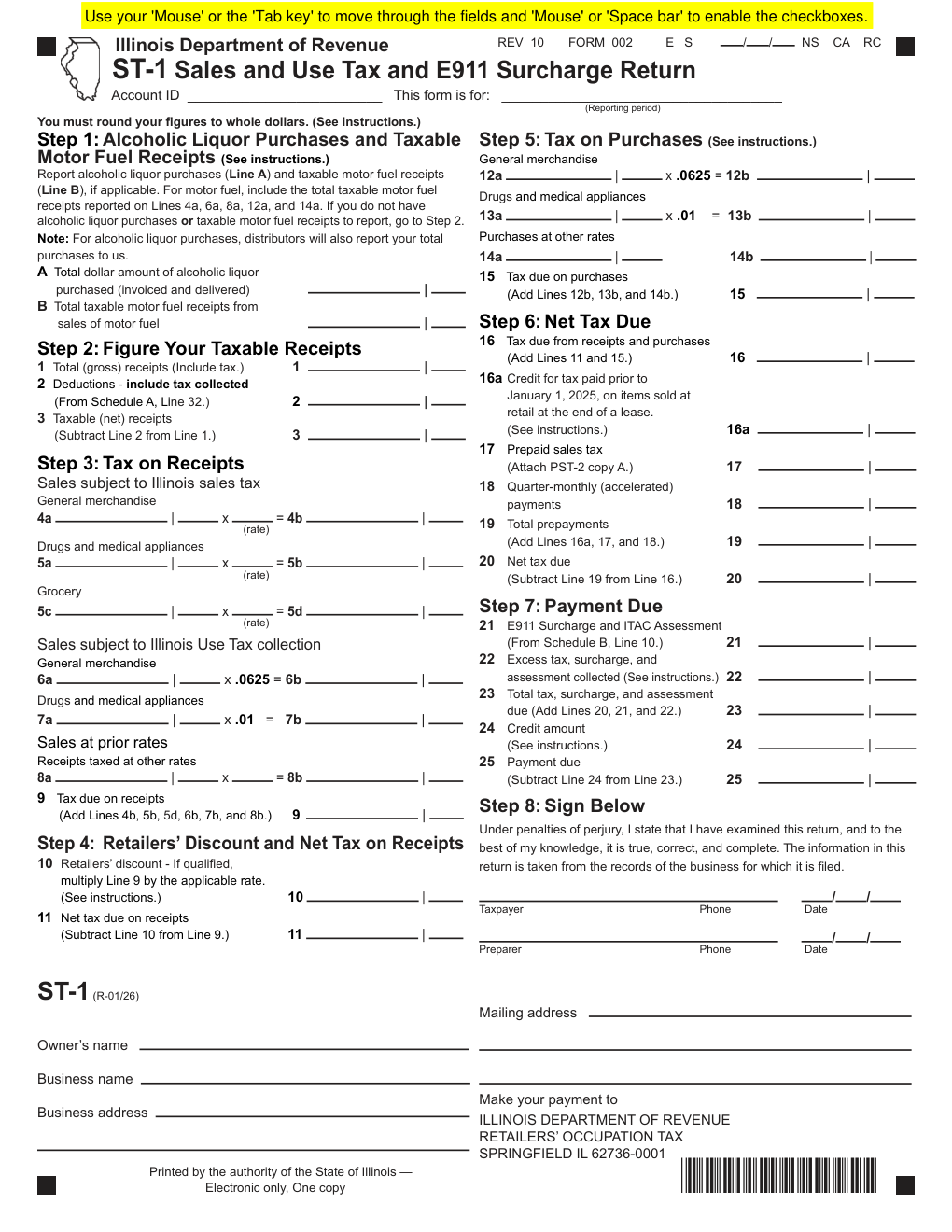
Most retailers file electronically. If you file on paper, make your payment to Illinois Department of Revenue, Retailers’ Occupation Tax, Springfield IL 62736-0001, the address shown on the form.
How to Complete Form ST-1 Line by Line
Step 1 — Alcoholic Liquor Purchases and Taxable Motor Fuel Receipts
Line A is the total dollar amount of alcoholic liquor purchased (invoiced and delivered) during the period, for liquor stores, taverns and restaurants that serve alcohol and are not required to make quarter-monthly payments. Line B is total taxable motor fuel receipts, combined from the motor fuel receipts reported on Lines 4a, 6a, 8a, 12a and 14a. Skip this step if neither applies.
Step 2 (Lines 1–3) — Taxable Receipts
| Line | What to enter |
|---|---|
| Line 1 | Total gross receipts from all sales, leases and rentals of merchandise and sales of service, including service charges, the E911 surcharge, the ITAC assessment and all State and local taxes collected. |
| Line 2 | Deductions from Schedule A, including tax collected. |
| Line 3 | Taxable (net) receipts. |
Do not include purchases on which you are paying use tax in Step 5.
Steps 3–4 (Lines 4–11) — Tax on Receipts and Retailers’ Discount
| Line | What to enter |
|---|---|
| Line 4a | The general merchandise base. |
| Line 4b | The tax at the location’s rate. |
| Line 5a | The drugs and medical appliances base (5b the tax). |
| Line 5c–5d | Report groceries where a local grocery tax is imposed. |
| Lines 6–8 | Report sales subject to use tax collection (for voluntary collectors and direct wine shippers below the $100,000 threshold). |
| Line 9 | Totals the tax on receipts. |
| Line 10 | The retailers’ discount (1.75% of tax due or $5 a year, whichever is greater, capped at $1,000 a month). |
| Line 11 | Net tax due on receipts. |
Steps 5–7 (Lines 15–25) — Use Tax, Prepayments and Payment Due
| Line | What to enter |
|---|---|
| Line 15 | Tax due on purchases (use tax). |
| Line 16 | Adds Lines 11 and 15. |
| Line 16a | A credit for tax paid previously. |
| Line 17 | Prepaid sales tax on motor fuel (attach PST-2 statements). |
| Line 18 | Quarter-monthly (accelerated) payments. |
| Line 19 | Total of the lines above. |
| Line 20 | Net tax due. |
| Line 21 | The E911 surcharge and ITAC assessment from Schedule B. |
| Line 22 | Excess tax, surcharge and assessment collected. |
| Line 23 | Total of the lines above. |
| Line 25 | The payment due after any credit on Line 24. |
Schedule A — Deductions
Section 1 lists deductions from receipts: taxes collected on general merchandise (Line 1), drugs and medical appliances (2a) and groceries (2b), E911 and ITAC collected (Line 3), resale (Line 4), interstate commerce (Line 5), manufacturing machinery and equipment (Line 6), farm machinery (Line 7), graphic arts equipment (Line 8), SNAP purchases (Line 9), enterprise zone, high impact business and River Edge deductions (Lines 10–12), exempt organizations (Line 13), uncollectible debt on which tax was previously paid (Line 14), sales of service (Line 15) and other deductions (Line 16). Receipts from aviation fuel are deducted on Line 16 as “Sales of Aviation Fuel.” Line 17 totals Section 1.
Common Mistakes to Avoid
- Leaving out service charges, E911 and tax collected from Line 1. Gross receipts must include them; deduct tax collected on Schedule A.
- Using one rate for all locations. Rates differ by site; use the Tax Rate Finder or ST-2.
- Reporting negative receipts. File an amended return for the original period instead.
- Missing the discount deadline. The retailers’ discount requires timely filing and payment.
- Putting aviation fuel on ST-1. Report it on ST-70 and deduct the receipts on Schedule A, Line 16.
- Forgetting use tax. Purchases where you owe use tax go in Step 5.
- Not registering a new location. Register every site before filing.
Frequently Asked Questions
When is Form ST-1 due? By the 20th day of the month following the end of the reporting period.
What is the Illinois State sales tax rate? 6.25%, or 1.00% for qualifying drugs and medical appliances, plus local taxes that vary by location.
How often do I file? The Department sets monthly, quarterly or annual filing based on average monthly liability.
What is the retailers’ discount? 1.75% of tax due or $5 per calendar year, whichever is greater, up to $1,000 per month for on-time filing and payment.
Do I file ST-1 if I only lease equipment? Yes. Since January 1, 2025, leases of most tangible personal property are retail sales.
How do I fix an error? File Form ST-1-X.
Final Review Before Filing
- Every selling location is registered and rates are correct for each site.
- Line 1 includes all gross receipts and the tax collected.
- Schedule A deductions are supported by records.
- Schedule B (E911 surcharge and ITAC assessment) is complete.
- Form ST-2 is attached for multiple sites or destination sales.
- Use tax purchases are on Line 15.
- The return and payment are filed by the 20th to preserve the discount.
Sources & verification
- Issuing agency: Illinois Department of Revenue
- Official documents: Form ST-1 (PDF) · ST-1 Instructions (PDF)
- Checked against: Form ST-1 (R-01/26) and ST-1 Instructions (R-01/26)
- Last verified: October 14, 2026
Spot an error or an out-of-date figure? Tell us and we will check it against the official source.
General information from the official form and its instructions, not advice for your circumstances. See the full disclaimer.
More Illinois Tax Forms forms
- Illinois Form IL-1040 — Individual Income Tax Return 2025-2026
- Illinois Form IL-1040-X — Amended Individual Income Tax Return 2025-2026
- Illinois Form IL-1065 — Partnership Replacement Tax Return 2025-2026
- Illinois Form IL-1120 — Corporation Income and Replacement Tax Return 2025-2026
- Illinois Form IL-W-4 — Employee’s and Other Payee’s Illinois Withholding Allowance Certificate
- Illinois Form RUT-50 — Private Party Vehicle Use Tax Transaction Return
- Illinois Schedule ICR — Illinois Credits 2025-2026
- Illinois Schedule NR — Nonresident and Part-Year Resident Computation of Illinois Tax 2025-2026