What is Form 1310?
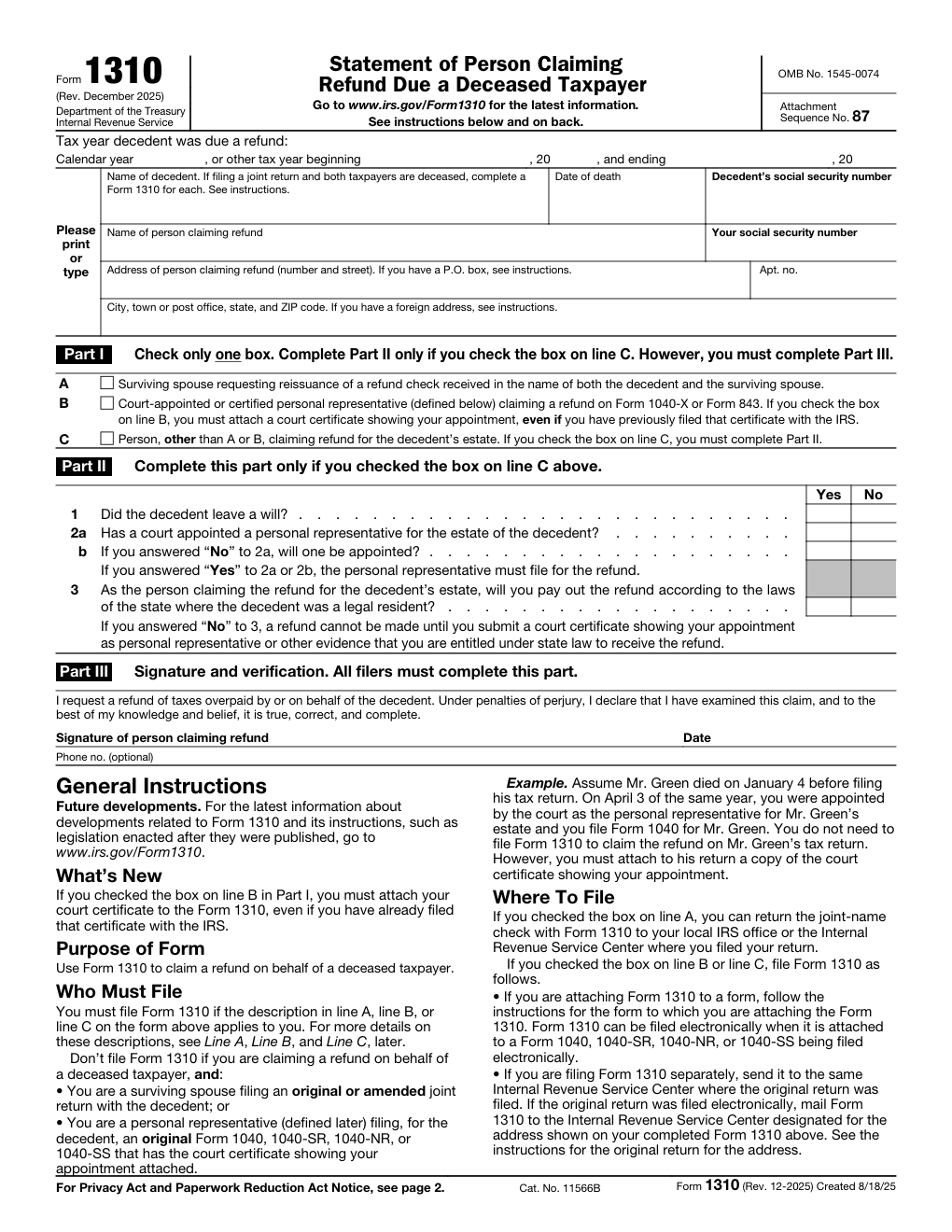
Quick answer: IRS Form 1310 is the Statement of Person Claiming Refund Due a Deceased Taxpayer. You use it to claim a tax refund owed to someone who has died, when you are not already covered by the exceptions that let you skip it. You check one box in Part I, answer Part II only if you are claiming as someone other than a spouse or personal representative, and sign Part III.
When a taxpayer dies owed a refund, the IRS needs to know who is entitled to it. Form 1310 is how a person other than the decedent says so. Which box you check depends on your relationship to the decedent and whether a court has appointed a personal representative of the estate.
Many people never need the form. A surviving spouse who files a joint return with the decedent, and a court-appointed personal representative who files the decedent’s return with the court certificate attached, are the main exceptions. This guide follows the version of the form posted as Rev. December 2025.
Key Figures — Form 1310 (Rev. December 2025)
- Purpose: to claim a refund on behalf of a deceased taxpayer.
- Part I: check only one box, A (surviving spouse), B (personal representative) or C (anyone else).
- Part II: complete only if you checked box C.
- Part III: everyone signs it, under penalties of perjury.
- Line B filers: attach the court certificate showing your appointment every time, even if the IRS already has it.
- Proof of death: if you check box C, keep a copy of the death certificate or government notification; do not attach it.
Source: the IRS, Form 1310 and its instructions. Last verified October 27, 2026.
Who Must File Form 1310?
A surviving spouse who received a refund check in both names and wants it reissued in the survivor’s name (line A).
A court-appointed or certified personal representative, meaning the executor or administrator appointed or certified by the court, who is claiming a refund on Form 1040-X or Form 843 (line B). A copy of the will is not accepted as proof of that role.
Any other person claiming the refund for the decedent’s estate, such as a sole survivor when no personal representative has been appointed (line C).
You do not file Form 1310 if you are a surviving spouse filing an original or amended joint return with the decedent, or a personal representative filing the decedent’s original Form 1040, 1040-SR, 1040-NR or 1040-SS with the court certificate showing your appointment attached.
Common trap: checking box C when a court has appointed a personal representative. If one has been appointed, that person must file for the refund.
How to File Form 1310
- Decide which box applies: A, B or C. Check only one.
- Fill in the identification section with the tax year, the decedent’s name, date of death and SSN, and your own name, address and SSN.
- Complete Part II only if you checked box C. Answer lines 1, 2a, 2b and 3.
- Sign Part III. Everyone who files the form must sign.
- Attach what the box requires: the court certificate for line B, the voided check and a written request for line A, and keep proof of death on file for line C.
- File it the right way: attached to the return or claim form it relates to, or separately as described under Where to File.
When Is Form 1310 Due?
Form 1310 has no due date of its own. It goes with the return or claim that asks for the refund, so it follows that form’s timing. For a refund claimed with an amended return on Form 1040-X or with a claim on Form 843, the time limits for those forms apply; check the instructions for the form you are attaching it to.
Where to Mail Form 1310
If you checked line A, you can return the joint-name check with Form 1310 to your local IRS office or to the IRS service center where you filed the return. If you checked line B or C and you are attaching Form 1310 to a return or claim form, follow the instructions for that form. If you file Form 1310 separately, send it to the same service center where the original return was filed. If the original return was filed electronically, mail it to the service center designated for the address on your Form 1310. Form 1310 can be filed electronically when it is attached to a Form 1040, 1040-SR, 1040-NR or 1040-SS that is e-filed.
How to Complete Form 1310 Line by Line
Identification — Tax Year, Decedent and Claimant
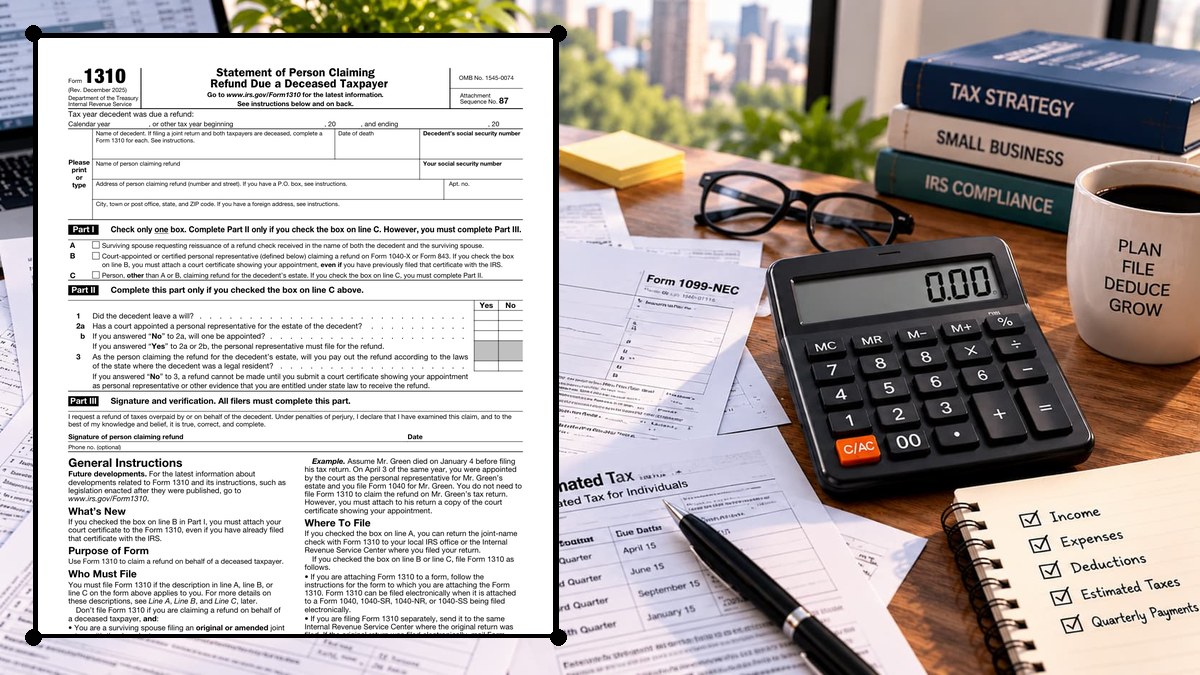
The top of the form identifies the refund and the people involved.
| Item | What to enter |
|---|---|
| Tax year | The tax year the decedent was due a refund for: a calendar year, or the beginning and ending dates of another tax year. |
| Name of decedent | The name of the person who died. If a joint return is being filed and both spouses have died, complete a separate Form 1310 for each and attach both to the return. |
| Date of death and SSN | The date of death and the decedent’s social security number. |
| Your name, address and SSN | The name and address of the person claiming the refund, and your own social security number. Enter a P.O. box number only if your post office does not deliver to your home. For a foreign address, enter the city, province or state, and country, in that order. |
Part I — Who Is Claiming the Refund (Lines A–C)
Check only one box.
| Box | What to enter |
|---|---|
| Line A | Check this box only if you are a surviving spouse and received a refund check made out to both you and the decedent, and you are asking for it to be reissued in your name. You can return the joint-name check, marked “VOID”, with Form 1310 and a written request to the IRS. |
| Line B | Check this box if you are the court-appointed or certified personal representative claiming a refund for the decedent on Form 1040-X or Form 843. You must attach a copy of the court certificate showing your appointment, even if you have already sent it to the IRS. |
| Line C | Check this box if you are any other person claiming the refund for the decedent’s estate, when there is no surviving-spouse check to reissue and no court-appointed personal representative. You must also complete Part II and keep proof of death. |
If you check box C, you must have proof of death: a copy of the death certificate or the formal government notification of death. Do not attach it to Form 1310; keep it for your records and provide it if the IRS asks.
Part II — Estate Questions (Lines 1–3)
Complete Part II only if you checked line C.
| Line | What to enter |
|---|---|
| Line 1 | Did the decedent leave a will? Answer Yes or No. |
| Line 2a | Has a court appointed a personal representative for the decedent’s estate? |
| Line 2b | If the answer to 2a is No, will one be appointed? If you answered Yes to 2a or 2b, the personal representative must file for the refund. |
| Line 3 | As the person claiming the refund for the estate, will you pay out the refund according to the laws of the state where the decedent was a legal resident? If the answer is No, a refund cannot be made until you submit a court certificate of appointment or other evidence that you are entitled to the refund under state law. |
Part III — Signature and Verification
Everyone who files Form 1310 must complete Part III.
| Item | What to enter |
|---|---|
| Signature | Sign to confirm, under penalties of perjury, that you have examined the claim and, to the best of your knowledge, it is true, correct and complete. Every filer must complete Part III. |
| Date and phone | Enter the date. A daytime phone number is optional. |
Worked Example — Box C
The IRS’s own instructions give this example. A father died in August and left no will, and the court did not appoint a personal representative. His child is the sole survivor, and the father is owed a $300 refund on his final return. The child completes Form 1310, checks line C, answers all of Part II, signs Part III and attaches the form to the father’s final return. The child keeps a copy of the death certificate or other proof of death and gives it to the IRS only if asked.
Common Mistakes to Avoid
- Filing it when you do not need to. A surviving spouse filing a joint return, and a personal representative filing the original return with the court certificate attached, do not file Form 1310.
- Checking more than one box. Part I allows only one box.
- Forgetting the court certificate on line B. It must be attached every time, even if the IRS already received it.
- Attaching the death certificate. Keep proof of death for your records; attach it only if the IRS asks.
- Skipping Part II on line C. If you check box C, answer all of lines 1 to 3.
- One form for two spouses. If both spouses on a joint return have died, complete a separate Form 1310 for each.
Frequently Asked Questions
When do I need Form 1310? When you are claiming a refund for a deceased taxpayer and none of the exceptions applies, such as filing a joint return as the surviving spouse or filing the original return as a court-appointed personal representative with the court certificate attached.
What is a personal representative? For this form, the executor or administrator of the decedent’s estate, as appointed or certified by the court.
Is a copy of the will enough to show I am the personal representative? No. A copy of the decedent’s will cannot be accepted as evidence that you are the personal representative.
Do I attach the death certificate? No. If you check box C you must have proof of death, but keep it for your records and provide it only if the IRS requests it.
Where does Form 1310 go? Attach it to the return or claim form it supports. If you file it separately, send it to the service center where the original return was filed.
Can Form 1310 be e-filed? Yes, when it is attached to a Form 1040, 1040-SR, 1040-NR or 1040-SS that is being filed electronically.
Final Review Before Filing
- You confirmed that you actually need Form 1310 and are not covered by an exception.
- Only one box is checked in Part I.
- The court certificate is attached if you checked line B.
- Part II is complete if you checked line C, and you are keeping proof of death.
- Part III is signed and dated.
- The form goes with the return or claim, or to the correct service center if filed separately.
Sources & verification
- Issuing agency: Internal Revenue Service
- Official documents: Form 1310 (PDF) · IRS Form 1310 page · Publication 559, Survivors, Executors, and Administrators
- Checked against: Form 1310 (Rev. December 2025) from the Internal Revenue Service
- Last verified: October 27, 2026
Spot an error or an out-of-date figure? Tell us and we will check it against the official source.
General information from the official form and its instructions, not advice for your circumstances. See the full disclaimer.