What is Form IT-201?
Quick answer: Form IT-201 is the New York State income tax return for people who were New York residents for the entire year. One form covers New York State tax, New York City resident tax, the Yonkers surcharge, and the Metropolitan Commuter Transportation Mobility Tax (MCTMT). For tax year 2025 it was due April 15, 2026; filers who submitted Form IT-370 and paid what they owed have until October 15, 2026. If you lived in New York only part of the year, you file Form IT-203 instead.
IT-201 is a four-page return that starts from your federal income figures, applies New York’s own additions and subtractions to reach New York adjusted gross income, takes the standard or itemized deduction, and then calculates state, city and Yonkers taxes in one place. It is also where full-year residents report their use tax on line 59 and claim most refundable credits, such as the Empire State child credit and the New York earned income credit.
Key Figures — Tax Year 2025 (Form IT-201)
- Filing threshold: you must file if you had to file a federal return, or if your federal adjusted gross income plus New York additions was more than $4,000 ($3,100 if you are single and can be claimed as a dependent on someone else’s federal return).
- Standard deduction: $8,000 single, $16,050 married filing jointly or qualifying surviving spouse, $8,000 married filing separately, $11,200 head of household, and $3,100 for a single filer who can be claimed as a dependent.
- Dependent exemption: $1,000 per dependent listed in item H.
- State tax rates are graduated, from 4% at the bottom to 10.9% at the top; filers with New York adjusted gross income above $107,650 use a separate tax computation worksheet.
- Due date: April 15, 2026, or October 15, 2026 with an approved IT-370 extension (payment was still due April 15).
Source: the New York State Department of Taxation and Finance, 2025 Form IT-201 and Form IT-201-I instructions. Last verified September 29, 2026.
Who Must File Form IT-201?
You file Form IT-201 if you were a New York State resident for the whole of 2025 and any one of these applies:
- you were required to file a federal income tax return;
- you did not have to file federally, but your federal adjusted gross income plus New York additions was more than $4,000 ($3,100 if you are single and can be claimed as a dependent);
- you want a refund of New York State, New York City or Yonkers tax withheld from your pay or unemployment benefits; or
- you want to claim any refundable or carryover credit.
If you moved into or out of New York on any day other than January 1 or December 31, do not use this form; file Form IT-203. A married couple where one spouse was a full-year resident and the other was a nonresident or part-year resident must generally file separate New York returns, though the two can choose to file a joint IT-201 and be taxed as full-year residents.
Common trap: people who only had New York tax withheld assume they can skip filing. Withholding is only returned if you file, and a return is the only way to claim refundable credits such as the Empire State child credit or the New York earned income credit.
How to File Form IT-201
- E-file if you can. The Tax Department says e-file combined with direct deposit is the fastest way to get a refund, and you must e-file if your software allows it or if you are a preparer subject to the e-file mandate.
- Use whole dollars only. The cents are preprinted as .00; round amounts under 50 cents down and 50 cents or more up.
- Send a complete return. Include every page of IT-201 and every schedule or credit form that applies; a return with missing pages or entries cannot be processed.
- Pay by check or money order only with Form IT-201-V; otherwise pay by electronic funds withdrawal on lines 83–84, through Online Services, or by credit card.
- Use black ink, mark boxes with an X (not a check mark), and put a minus sign, not brackets, in front of any loss.
When Is Form IT-201 Due?
| Date | What it means |
|---|---|
| April 15, 2026 | Due date for the 2025 return and any tax owed. Also the deadline to file Form IT-370 for an extension. |
| June 15, 2026 | For filers who qualify for the federal June 15 date, such as U.S. citizens living abroad or military personnel outside the U.S. |
| October 15, 2026 | Extended due date if you filed IT-370 and paid what you owed by April 15. Interest and penalties still run from April 15 on any unpaid balance. |
| April 15, June 15, September 15, 2026; January 15, 2027 | 2026 estimated tax due dates. Estimated tax is generally required if you expect to owe at least $300. |
To claim a refund later, you generally have three years from when you filed the return, or two years from when you paid the tax, whichever is later.
Where to Mail Form IT-201
- With a payment (check or money order and Form IT-201-V): State Processing Center, PO Box 15555, Albany NY 12212-5555.
- Without a payment: State Processing Center, PO Box 61000, Albany NY 12261-0001.
Private delivery services are allowed only if they are designated in the Tax Department’s Publication 55.
How to Complete Form IT-201 Line by Line
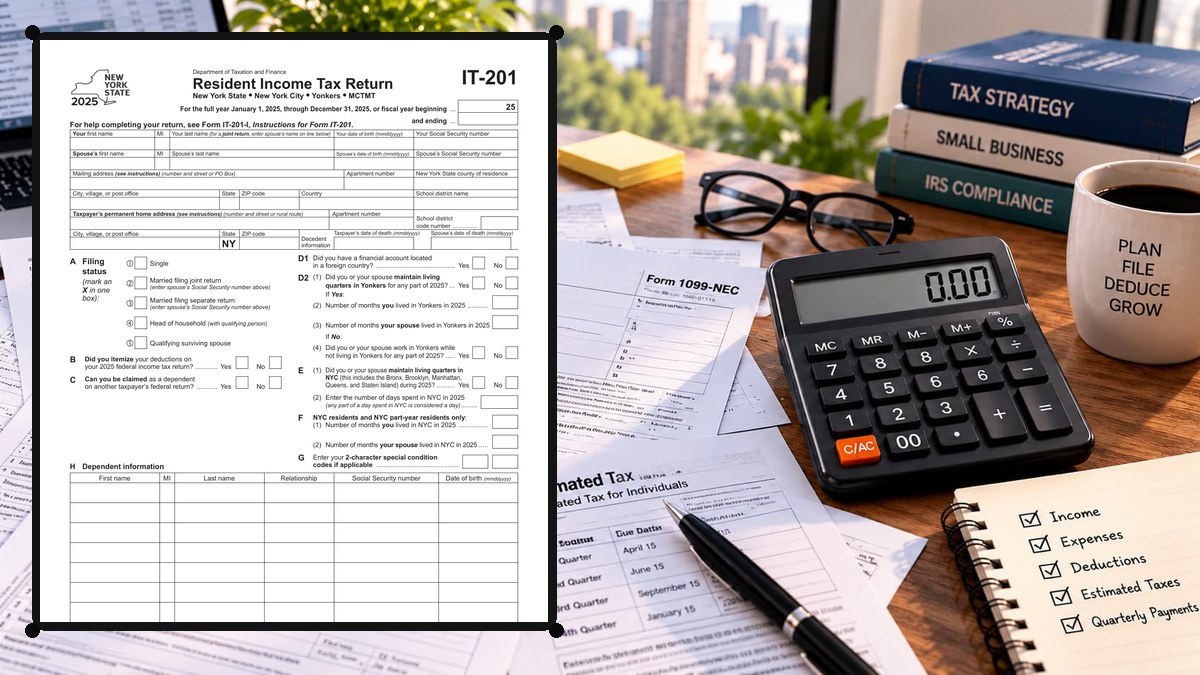
Page 1 — Filing Status and Residency Items (A–H)
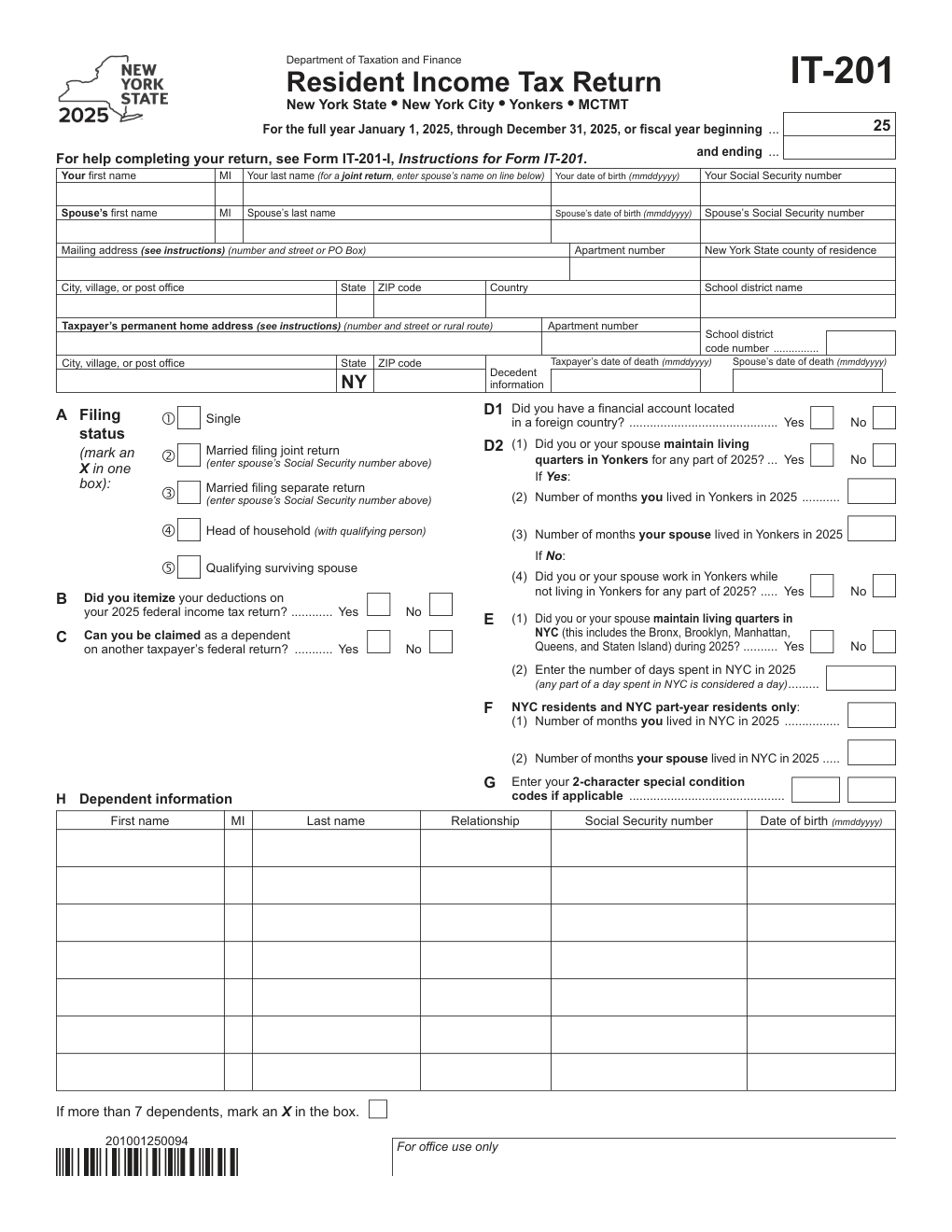
Item A: Filing status. Single, married filing joint, married filing separate, head of household with a qualifying person, or qualifying surviving spouse. For joint or separate returns, enter your spouse’s Social Security number at the top.
Items B and C. B asks whether you itemized on your federal return; your answer decides whether you must use the standard deduction (see line 34). C asks whether someone else can claim you as a dependent, which lowers a single filer’s standard deduction to $3,100 and disqualifies you from the household credit on line 40.
Items D1, D2, E, F and G. D1 asks about foreign financial accounts. D2 covers Yonkers living quarters and months. E and F cover New York City living quarters, days spent in the city, and months as a resident. G is for any two-character special condition codes the instructions tell you to enter.
Item H: Dependents. List each dependent with relationship, Social Security number and date of birth. Each one is worth a $1,000 exemption on line 36.
Lines 1–19 — Federal Income and Adjustments
Lines 1 through 16 copy your income from the federal return: wages, taxable interest, dividends, taxable state tax refunds (line 4), business income (line 6), capital gains, IRA and pension distributions, rental and partnership income, farm income, unemployment compensation, taxable Social Security, and other income. Line 17 adds the income lines, line 18 subtracts your total federal adjustments, and line 19 is your federal adjusted gross income. Attach copies of federal Schedule C, D, E, F or Form 4797 where the line says to.
Lines 20–33 — New York Additions and Subtractions
New York adds back interest from other states’ bonds (line 20), public employee 414(h) contributions (line 21) and nonqualified withdrawals from New York’s 529 college savings program (line 22), plus items from Form IT-225 on line 23. Subtractions on lines 25 to 31 include the state tax refund already counted on line 4, government pensions, taxable Social Security (line 27), U.S. government bond interest (line 28), the pension and annuity exclusion (line 29, up to $20,000 for eligible filers), and the New York 529 deduction (line 30). Line 33, New York adjusted gross income, is line 24 minus line 32. Do not leave it blank.
Lines 34–38 — Deduction, Exemptions and Taxable Income
Line 34 takes the New York standard deduction or the itemized deduction from Form IT-196. Compare the standard deduction for your filing status with the itemized total on Form IT-196, line 49, enter the larger, and mark the Standard or Itemized box; if you itemize, submit Form IT-196. Married couples filing separately must both take the standard deduction unless both itemize. Line 36 multiplies your dependents by $1,000. Subtract it from line 35 to get taxable income on lines 37 and 38.
Lines 39–46 — New York State Tax and Credits
Line 39 is the state tax from the tax rate schedule (or the tax computation worksheet if your New York AGI is over $107,650). Line 40 is the household credit, which you cannot take if you answered Yes to item C. Line 41 is the resident credit for income tax paid to another state, a local government of another state, the District of Columbia or a Canadian province (Forms IT-112-R and IT-112-C), line 42 carries other nonrefundable credits from Form IT-201-ATT, and line 45 adds other New York taxes from the same attachment. Line 46 is your total New York State tax.
Lines 47–61 — City, Yonkers, MCTMT and Use Tax
Lines 47 to 58 calculate New York City resident tax, Yonkers surcharges and the MCTMT, using the city tax rate schedule and the instructions’ zone rules for self-employed filers. Line 59 is the use tax line and cannot be left blank; enter 0 if you owe none. You owe use tax on taxable items delivered to you without New York tax being collected, such as online purchases. The instructions’ chart lets you estimate it from your federal AGI for purchases under $1,000 each, from $3 at the lowest income bracket up to the smaller of 0.0175% of income or $125 for incomes above $200,000. If you prefer exact figures, use Form ST-141; if the amount on line 59 is $1,700 or more you must also complete Form IT-135. Line 60 covers voluntary contributions, and line 61 totals everything.
Lines 62–76 — Refundable Credits and Payments
Line 62 repeats line 61. Then list refundable credits: the Empire State child credit (line 63, calculated on Form IT-213 for filers with a qualifying child under 17), child and dependent care credit (64), New York earned income credit (65, figured on Form IT-209, or by the Tax Department if you write EIC in the box and submit Form IT-215), noncustodial parent EIC (66), real property tax credit (67, from Form IT-214), college tuition credit (68), and the New York City school tax credit (69 and 69a). Lines 72 to 74 are New York State, New York City and Yonkers tax withheld from your W-2s and 1099-Gs; do not send the W-2 copies unless the form says to. Line 75 totals estimated tax payments, any 2024 overpayment you applied forward, and anything paid with IT-370. Line 76 adds all payments.
Lines 77–84 — Refund or Amount You Owe
If line 76 is more than line 62, the difference is your overpayment on line 77. You can deposit part into a NY 529 account (78a), apply part to 2026 estimated tax (79), and take the rest as a refund; direct deposit is fastest. If line 76 is less than line 62, enter what you owe on line 80. Line 81 is the estimated tax penalty and line 82 is other penalties and interest. Enter your bank details on lines 83 and 84 for direct deposit or electronic withdrawal, sign and date the return, and add a preparer’s information if applicable. Refunds can be reduced to pay certain past-due debts, such as child support or federal and state obligations; a spouse who does not owe the debt can file Form IT-280.
Common Mistakes to Avoid
- Leaving line 59 blank. The instructions say to enter 0 if you owe no use tax. Blank lines delay processing.
- Using IT-201 as a part-year resident. Anyone who moved in or out of New York mid-year files IT-203, not IT-201.
- Forgetting the credit forms. Apart from the household credit and the New York City school tax credit, credits are claimed on their own forms, and you must complete and submit the matching credit form to claim it.
- Sending cents. Whole dollars only, and never write dollar signs or commas.
- Mailing to the wrong PO box. Payments go to PO Box 15555; returns with no payment go to PO Box 61000.
- Sending a full Social Security number on a check. Write only the last four digits on checks and money orders, but include the complete number on the return and IT-201-V.
- Assuming an extension moves the payment date. IT-370 extends the time to file, not the time to pay.
Frequently Asked Questions
Is IT-201 the same as the federal Form 1040? No. Form 1040 is federal; IT-201 is New York’s own resident return and starts from your federal figures.
Do I file a separate New York City return? No. New York City resident tax, Yonkers surcharges and the MCTMT are all figured on IT-201.
What if I already filed my federal return on extension? File Form IT-370 by April 15 with any payment due, and your IT-201 is then due by October 15.
Can I e-file IT-201? Yes, and most New Yorkers do. The Tax Department also lists free e-file options on its website.
What if I made a mistake after I filed? File an amended return on Form IT-201-X.
Do I need to file if I only had unemployment benefits? You must report Department of Labor 1099-G income on your federal and New York returns if you are required to file, and you can retrieve the form from your NY.gov ID account.
Final Review Before Filing
- Residency status is full-year for 2025, otherwise switch to Form IT-203.
- Items A through H on page 1 are complete, including every dependent’s Social Security number.
- Federal income lines match your federal return, with required schedules attached.
- Line 33 is filled in and the standard or itemized deduction on line 34 is marked correctly.
- Line 59 has an amount or a 0, never blank.
- Every credit form you claimed is attached.
- Bank routing and account numbers on lines 83 and 84 are correct.
- The return is signed, and Form IT-201-V is enclosed if you pay by check.
- Mailed to PO Box 15555 with a payment, or PO Box 61000 without.
Sources & verification
- Issuing agency: New York State Department of Taxation and Finance
- Official documents: Form IT-201 (PDF) · Form IT-201-I instructions (PDF)
- Checked against: 2025 Form IT-201 and 2025 Form IT-201-I
- Last verified: September 29, 2026
Spot an error or an out-of-date figure? Tell us and we will check it against the official source.
General information from the official form and its instructions, not advice for your circumstances. See the full disclaimer.
More New York Tax Forms forms
- New York Form IT-201-X — Amended Resident Income Tax Return 2025-2026
- New York Form IT-203 — Nonresident and Part-Year Resident Income Tax Return 2025-2026
- New York Form IT-2104 — Employee’s Withholding Allowance Certificate
- New York Form IT-2105 — Estimated Tax Payment Voucher for Individuals
- New York Form IT-214 — Claim for Real Property Tax Credit for Homeowners and Renters
- New York Form IT-370 — Application for Automatic Six-Month Extension of Time to File for Individuals
- New York Form NYS-45 — Quarterly Combined Withholding, Wage Reporting, and Unemployment Insurance Return
- New York Form ST-100 — New York State and Local Quarterly Sales and Use Tax Return