
What is Form MI-1040ES?
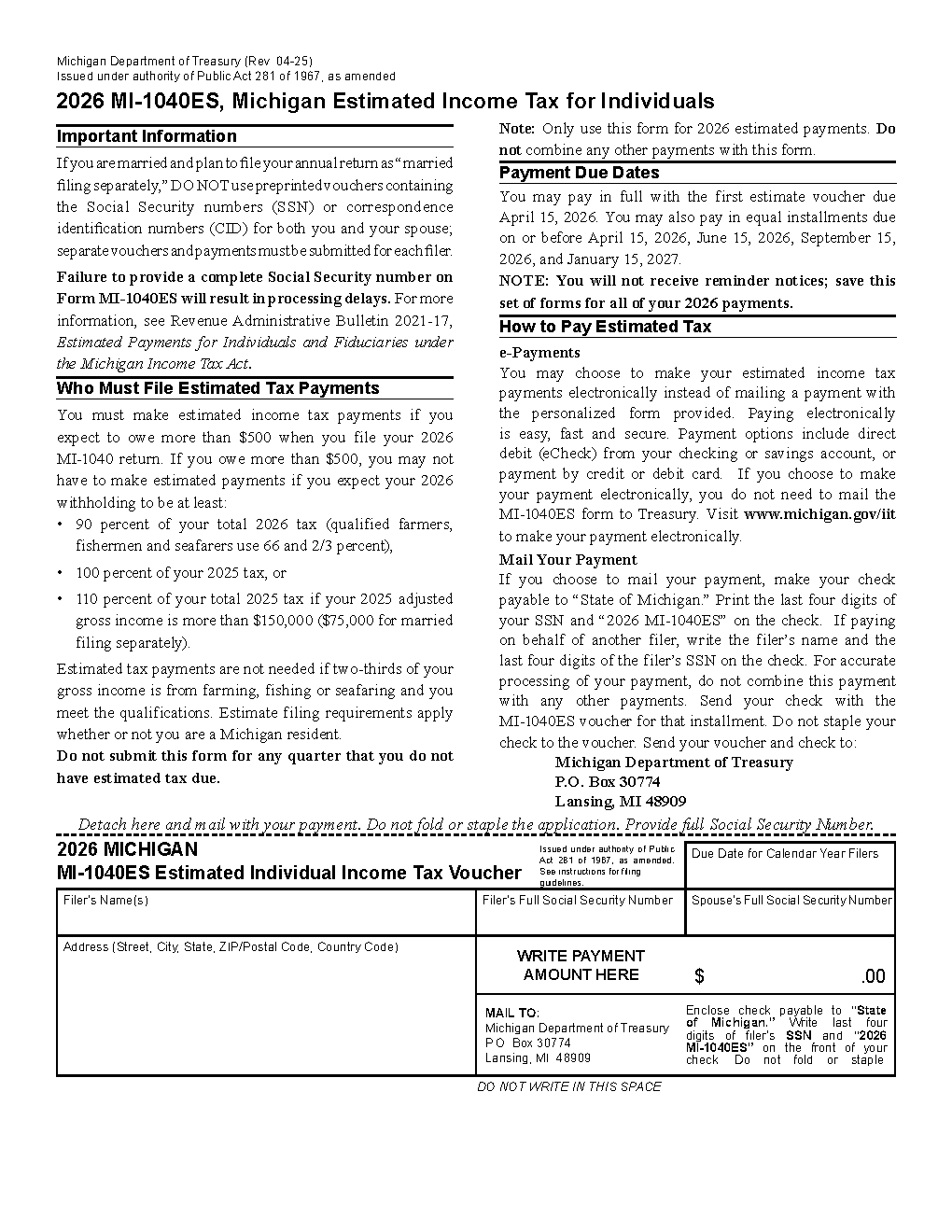
Quick answer: Form MI-1040ES is Michigan’s quarterly estimated income tax voucher for anyone who expects to owe more than $500 on their MI-1040 after subtracting withholding and credits — typically the self-employed, freelancers, landlords, and anyone with significant investment income. Michigan taxes income at a flat 4.25% rate for 2026. Payments are due April 15, June 15, and September 15 of the tax year, and January 15 of the following year, and can be made online through Michigan Treasury eServices or by mailing a voucher with a check. Meeting one of three safe-harbor thresholds — generally 90% of the current year’s tax or 100% of last year’s — avoids an underpayment penalty even if the estimate turns out low.
Michigan’s income tax is largely a pay-as-you-go system: employees have it withheld from every paycheck, but income without withholding — self-employment earnings, rental income, investment gains, and Michigan-source income for nonresidents — needs to be paid in during the year through estimated vouchers instead of all at once at filing time.
MI-1040ES is four vouchers (one per quarter) rather than a single form. Each voucher pairs a payment with basic identifying information; there is no complex worksheet on the voucher itself, though the instructions include a worksheet to help calculate the right amount.
Key Figures — Tax Year 2026 (Michigan MI-1040ES)
- Estimated payments are required if the expected balance due on the MI-1040 — after withholding and credits — exceeds $500.
- Michigan’s flat tax rate for 2026: 4.25%. Personal exemption for 2026: $5,900 per exemption.
- Quarterly due dates: April 15, June 15, September 15 of the tax year, and January 15 of the following year.
- Safe harbor #1: pay at least 90% of the current year’s actual tax (66⅔% for qualifying farmers, fishermen, and seafarers).
- Safe harbor #2: pay at least 100% of the prior year’s tax (from a full 12-month return).
- Safe harbor #3: pay at least 110% of the prior year’s tax if the prior year’s AGI exceeded $150,000 ($75,000 if married filing separately).
- Underpayment penalty: 10% of the shortfall (minimum $10) per quarter if estimates were filed but insufficient; 25% (minimum $25) per quarter if no estimates were filed at all, plus interest at 1% above the Michigan prime rate.
Who Must File Michigan Form MI-1040ES?
Anyone who expects to owe more than $500 on their Michigan MI-1040 after subtracting withholding and refundable credits must make quarterly estimated payments. In practice this is most often:
- Self-employed individuals and independent contractors with no withholding on their income.
- Business owners and partners receiving pass-through income.
- Landlords with rental income.
- Investors with significant capital gains, interest, or dividend income.
- Nonresidents with Michigan-source income not covered by withholding.
Employees whose Michigan withholding already covers their expected liability generally do not need to file MI-1040ES, even with some side income, as long as the total shortfall stays at or below $500.
How to File Michigan Form MI-1040ES
- Online: Pay directly through Michigan Treasury eServices — no paper voucher needed.
- By mail: Complete a personalized or blank MI-1040ES voucher for the quarter, and mail it with a check — do not staple the check to the voucher.
- Estimate the payment using the worksheet in the MI-1040ES instructions: project annual Michigan taxable income, subtract the personal exemption ($5,900 for 2026 per exemption), multiply by 4.25%, subtract expected withholding and refundable credits, then divide the net by four for equal quarterly installments.
When Is Michigan Form MI-1040ES Due?
- 1st quarter: April 15
- 2nd quarter: June 15
- 3rd quarter: September 15
- 4th quarter: January 15 of the following year
Dates shift to the next business day when they fall on a weekend or holiday. Income that arrives unevenly through the year (for example, a large gain in one quarter) can be annualized to adjust individual installments rather than paying a flat quarter each time — see the annualized income worksheet in the instructions.
Where to Mail Michigan Form MI-1040ES
Mail the voucher and payment to: Michigan Department of Treasury, PO Box 30774, Lansing, MI 48909. This is the same estimated-payment address used for the MI-1040-V annual payment voucher.
How to Complete Michigan Form MI-1040ES Line by Line
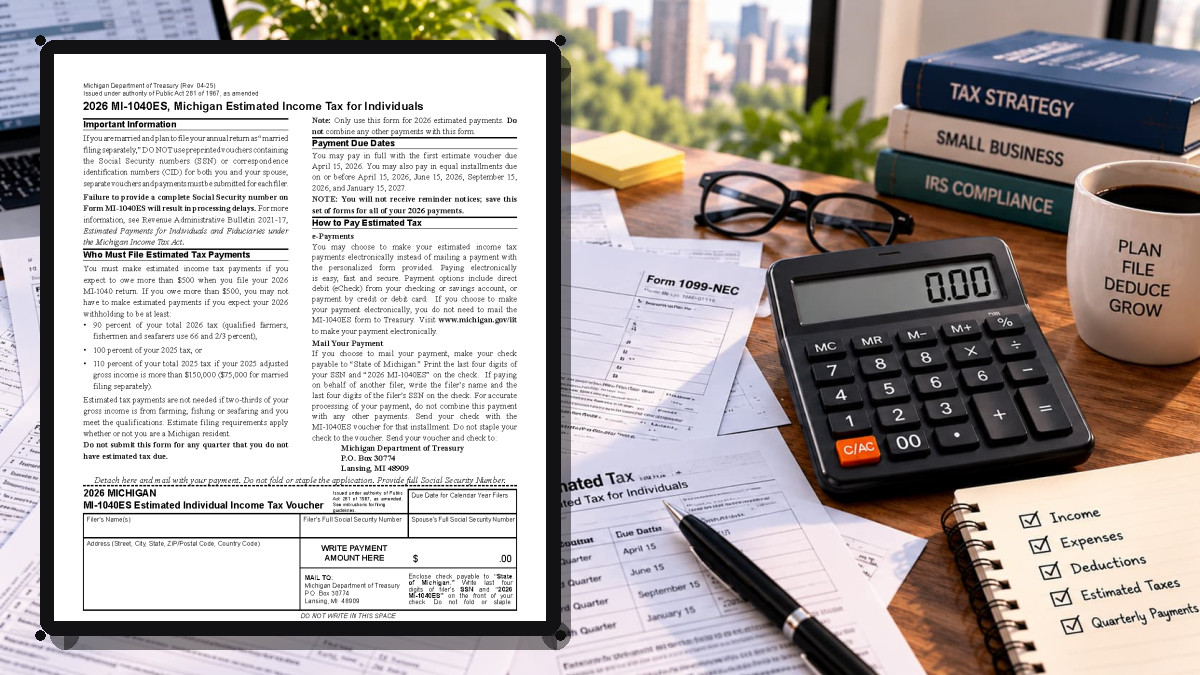
Taxpayer information. Name, Social Security number (and spouse’s, if a joint estimate), and current mailing address — printed identically on all four quarterly vouchers.
Payment amount. The dollar amount being paid for that quarter, generally one-fourth of the total estimated annual liability unless using the annualized income method for uneven income.
Voucher number. Each of the four vouchers is numbered 1 through 4, corresponding to its due date, so Treasury credits the payment to the correct quarter.
Tax year. The MI-1040ES vouchers are year-specific — a 2026 voucher applies payments to the 2026 MI-1040, filed in 2027. Using a prior year’s voucher can misapply the payment.
Common Mistakes to Avoid
- Assuming withholding from a day job covers side income. If the combined shortfall exceeds $500, estimated payments are required regardless of any withholding already happening elsewhere.
- Paying a flat quarter each time despite lumpy income. Large, uneven income in one quarter may call for the annualized income method instead of four equal payments.
- Using an old year’s voucher. MI-1040ES vouchers are tax-year specific; using the wrong year’s form can misapply a payment.
- Missing the 110% safe harbor for higher earners. If last year’s AGI was over $150,000 ($75,000 married filing separately), 100% of last year’s tax is not enough — 110% is required to avoid a penalty.
- Stapling the check to the voucher or mailing payment to the wrong address.
Frequently Asked Questions
Do I have to make estimated payments if I’m an employee with some freelance income? Only if the total shortfall — after your employer’s withholding — is expected to exceed $500 for the year.
What is Michigan’s estimated tax underpayment penalty? 10% of the shortfall per quarter (minimum $10) if estimates were filed but too low, or 25% per quarter (minimum $25) if none were filed, plus interest at 1% above the Michigan prime rate.
How do I avoid the penalty entirely? Pay at least 90% of the current year’s tax, or 100% of last year’s tax (110% if your prior-year AGI was over $150,000/$75,000 MFS).
Can I pay estimated tax online instead of mailing a voucher? Yes — Michigan Treasury eServices accepts estimated payments directly, without a paper voucher.
What if my income is uneven throughout the year? Use the annualized income installment method in the MI-1040ES instructions to adjust each quarter’s payment instead of paying a flat 25% each time.
Final Review Before Filing
- Expected shortfall (tax owed minus withholding and credits) is checked against the $500 threshold.
- The payment amount meets at least one safe harbor (90% current year, 100% prior year, or 110% for higher AGI).
- The correct tax-year voucher (2026, not an older year) is being used.
- Voucher number matches the quarter being paid (1–4).
- Uneven income has been considered for the annualized income method, if applicable.
- Payment is mailed to PO Box 30774, Lansing, MI 48909, or submitted through Treasury eServices, by the correct quarterly due date.
Sources & verification
- Issuing agency: Michigan Department of Treasury
- Official documents: Form MI-1040ES (2026) (PDF)
- Checked against: 2026 MI-1040ES and Michigan’s published estimated tax guidance
- Last verified: September 16, 2026
Spot an error or an out-of-date figure? Tell us and we will check it against the official source.
General information from the official form and its instructions, not advice for your circumstances. See the full disclaimer.
More Michigan Tax Forms forms
- Michigan Form 151 — Authorized Representative Declaration (Power of Attorney)
- Michigan Form 3372 — Sales and Use Tax Certificate of Exemption
- Michigan Form 5081 — Sales, Use and Withholding Taxes Annual Return
- Michigan Form 518 — Registration for Michigan Taxes
- Michigan Form 5713 — Request for Hearing/Informal Conference
- Michigan Form MI-W4 — Employee’s Michigan Withholding Exemption Certificate
- Michigan MI-1040CR — Homestead Property Tax Credit Claim
- Michigan Schedule 1 (Form 3423) — Additions and Subtractions Instructions