

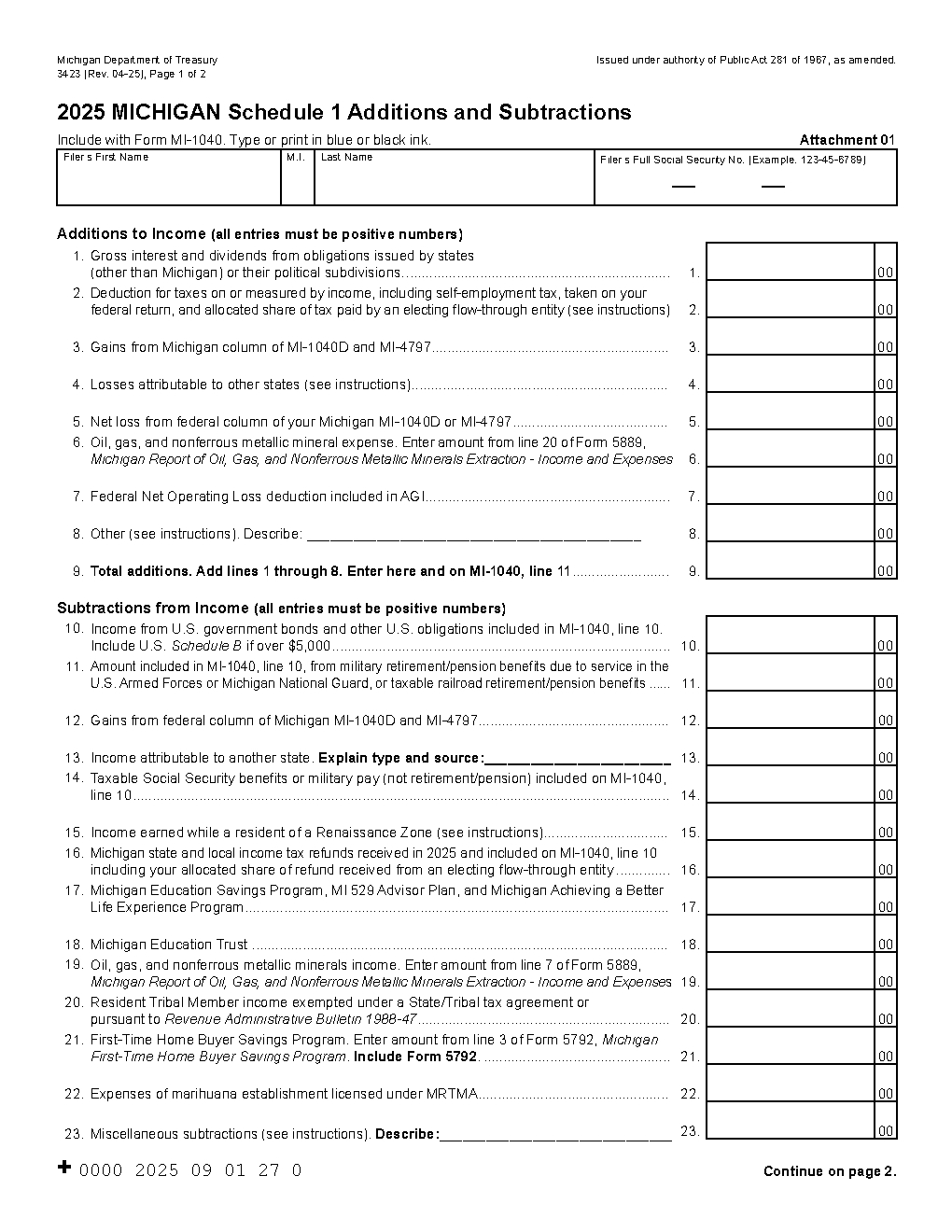
What is Michigan Schedule 1?
Quick answer: Schedule 1 (Form 3423), Additions and Subtractions, is the form that turns your federal adjusted gross income into Michigan taxable income. Part 1 adds back income Michigan taxes that the IRS doesn’t — like out-of-state municipal bond interest. Part 2 subtracts income Michigan exempts that the IRS taxed — the biggest ones being military retirement pay, Social Security benefits, and age-based retirement/pension subtractions that can run into tens of thousands of dollars. Schedule 1 is not filed alone; its totals flow to MI-1040 Lines 2 and 3, and it is mailed together with the MI-1040 to the address that matches whether a payment is enclosed.
Every Michigan resident, part-year resident, or nonresident who has any addition or subtraction item completes Schedule 1 and files it with Form MI-1040. If none of the listed items apply, Schedule 1 is skipped entirely and the federal AGI carries straight to the MI-1040.
The form is organized in two parts. Part 1 (Additions) covers income Michigan taxes even though it escapes federal tax, such as interest on other states’ municipal bonds and certain self-employment tax or flow-through entity tax deductions claimed federally. Part 2 (Subtractions) covers income Michigan does not tax even though it is in federal AGI — U.S. government bond interest, military pay and retirement, Social Security, several retirement/pension programs organized by birth year, 529 plan contributions, and more.
Key Figures — Tax Year 2025 (Michigan Schedule 1)
- Line 11 — Military retirement and active-duty pay: fully exempt from Michigan tax, no dollar cap.
- Line 14 — Social Security benefits: the taxable portion included in federal AGI is fully subtracted; active-duty military compensation is also fully exempt here.
- Line 17 — MESP/MI 529 plan contributions: up to $5,000 for a single filer, $10,000 for a joint return, per year.
- Line 25 — Tier 2 retirement standard deduction (born 1946–1952): a flat $20,000 single / $40,000 joint deduction against all income, in place of the older birth-year-based pension subtraction.
- Line 26 — Tier 3 retirement standard deduction (born after 1952, age 67+): $20,000 single / $40,000 joint, claimed instead of the Social Security exemption on the same income.
- Line 27 — Tier 1 pension subtraction (born before 1946, via Form 4884): up to $65,897 single / $131,794 joint of private pension income, plus investment income up to $14,688 single / $29,376 joint.
- Schedule 1 totals carry to MI-1040 Line 2 (additions) and Line 3 (subtractions).
Who Must File Michigan Schedule 1?
Anyone filing an MI-1040 who has at least one addition or subtraction item listed on the form must complete and attach Schedule 1. This is extremely common for retirees claiming a pension or Social Security subtraction, and for anyone with out-of-state municipal bond interest, U.S. government bond interest, or 529 plan contributions.
If none of the addition or subtraction items apply, Schedule 1 is not needed — federal AGI carries directly to the MI-1040 unchanged.
How to File Michigan Schedule 1
- Attach it to Form MI-1040 — Schedule 1 is never filed on its own.
- Carry the totals forward: total additions (Line 12) goes to MI-1040 Line 2; total subtractions (Line 47 in some years’ layouts) goes to MI-1040 Line 3.
- Attach supporting forms referenced on specific lines — Form 4884 for Tier 1 pension subtractions, Form 5674 for the Michigan net operating loss, Form 5889 for oil/gas/mineral income, Form 5792 for the first-time home buyer savings program.
- E-file or paper file along with the rest of the MI-1040 return, through Michigan’s e-file system or commercial tax software.
When Is Michigan Schedule 1 Due?
- Same deadline as Form MI-1040: April 15, 2026 for the 2025 tax year.
- Extensions: A federal extension automatically extends the Michigan filing deadline as well, but not the deadline to pay any tax owed.
Where to Mail Michigan Schedule 1
Schedule 1 is mailed together with the MI-1040, never separately. The correct address depends on whether a payment is enclosed:
- Return with a payment enclosed: Michigan Department of Treasury, Lansing, MI 48929
- Return without a payment (refund or zero due): Michigan Department of Treasury, Lansing, MI 48956
- Paying separately with Form MI-1040-V: Michigan Department of Treasury, PO Box 30774, Lansing, MI 48909

How to Complete Michigan Schedule 1 Line by Line
Part 1 — Additions
Line 1: Out-of-state municipal bond interest. Interest from bonds issued by other states or their local governments is taxable in Michigan even though it is federally tax-exempt; it can be reduced by related expenses that federal law disallowed.
Line 2: Self-employment tax and income-based tax deductions. Federal deductions for self-employment tax, or for state/local income-based taxes (including a taxpayer’s share of a flow-through entity tax), must be added back for Michigan purposes.
Line 4: Losses from other states. Business or property losses attributable to another state must generally be added back if the taxpayer is also apportioning income under MI-1040H (income taxed in more than one state).
Line 8: Business income recalculations under PA 24 (effective 2025). Depreciation, Section 179 expensing, business interest expense, and research/experimental cost deductions must be recalculated using pre-2025 federal rules for Michigan purposes where federal law changed.
Part 2 — Subtractions
Line 10: U.S. government bond interest. Interest and gains from U.S. Treasury bonds, savings bonds, and Federal Home Loan Bank obligations are subtracted, reduced by any related debt interest expense.
Line 11: Military retirement and active-duty pay. Michigan fully exempts both active-duty military pay and military retirement benefits, with no dollar cap.
Line 13: Income taxed by another state. Limited to business profits attributable to another state; wages taxed elsewhere are handled through a credit on the MI-1040 instead of a subtraction here.
Line 14: Social Security benefits and active-duty military pay. The taxable portion of Social Security included in federal AGI is fully deductible on Schedule 1; active-duty military compensation is fully exempt.
Line 15: Renaissance Zone income. Exempt income for residents/businesses in a Renaissance Zone, phased down during the zone’s final three years.
Line 16: Michigan state and local tax refunds. Prior-year state or local tax refunds included in federal AGI are subtracted here to avoid double taxation.
Line 17: MESP / MI 529 plan contributions. Up to $5,000 (single) or $10,000 (joint) of contributions to a Michigan Education Savings Program account per year.
Line 18: Michigan Education Trust contributions. Contributions to Michigan’s prepaid tuition program.
Line 19: Oil, gas, and mineral extraction income. Reported using Form 5889.
Line 21: First-time home buyer savings program. Reported using Form 5792.
Line 25: Tier 2 retirement standard deduction. For taxpayers born 1946–1952: a flat $20,000 (single) or $40,000 (joint) deduction against all types of income.
Line 26: Tier 3 retirement standard deduction. For taxpayers born after 1952 who are age 67 or older: $20,000 (single) or $40,000 (joint), claimed as an alternative to the Social Security exemption on Line 14.
Line 27: Tier 1 and other pension subtractions. Reported via Form 4884. For taxpayers born before 1946: up to $65,897 (single) or $131,794 (joint) of private pension and retirement income, plus investment income up to $14,688 (single) or $29,376 (joint).
Line 30: Michigan net operating loss. A state-specific NOL deduction reported on Form 5674.
Common Mistakes to Avoid
- Claiming both a Tier 3 standard deduction and a Social Security exemption on the same income — Line 26 is an alternative to the Social Security subtraction, not an addition to it.
- Using the wrong retirement tier for your birth year. The subtraction rules genuinely differ between taxpayers born before 1946, 1946–1952, and after 1952.
- Forgetting the supporting form a line requires — Form 4884 for pensions, Form 5674 for the NOL, Form 5889 for extraction income, Form 5792 for the home buyer program.
- Subtracting wages taxed by another state on Line 13. That line is limited to business profits; wage income taxed elsewhere is handled with a credit on the MI-1040 instead.
- Filing Schedule 1 separately instead of attaching it to the MI-1040 — it has no independent filing of its own.
Frequently Asked Questions
Do I always need to file Schedule 1? No — only if you have at least one addition or subtraction item. Otherwise your federal AGI carries straight to the MI-1040.
Is my Social Security taxed by Michigan? No. The taxable portion of Social Security included in your federal AGI is fully subtracted on Schedule 1, Line 14.
Is military retirement pay taxed by Michigan? No. Michigan fully exempts both active-duty pay and military retirement benefits on Line 11, with no cap.
Which retirement subtraction applies to me? It depends on your birth year: Tier 1 (born before 1946) uses Form 4884 with income caps; Tier 2 (born 1946–1952) and Tier 3 (born after 1952, age 67+) use flat standard deductions of $20,000/$40,000 instead.
How much can I contribute to a 529 plan and subtract? Up to $5,000 (single) or $10,000 (joint) per year in MESP contributions.
Where does Schedule 1 go on my return? Its totals carry to MI-1040 Line 2 (additions) and Line 3 (subtractions); the schedule itself is attached to the return.
Final Review Before Filing
- Every addition or subtraction claimed is actually listed on Schedule 1 — nothing was assumed instead of checked.
- The correct retirement tier (1, 2, or 3) is used based on birth year, and Form 4884 is attached if Tier 1 applies.
- Line 26 (Tier 3) is not combined with a separate Social Security subtraction on the same income.
- Required supporting forms (4884, 5674, 5889, 5792) are attached where applicable.
- Line 12 (total additions) and the subtraction total match what was entered on MI-1040 Lines 2 and 3.
- Schedule 1 is attached to the MI-1040, not mailed separately, to the address matching whether a payment is enclosed.
Sources & verification
- Issuing agency: Michigan Department of Treasury
- Official documents: Schedule 1 (PDF) · Schedule 1 Instructions (PDF)
- Checked against: 2025 Michigan Schedule 1 (Form 3423) and its instructions
- Last verified: September 16, 2026
Spot an error or an out-of-date figure? Tell us and we will check it against the official source.
General information from the official form and its instructions, not advice for your circumstances. See the full disclaimer.
More Michigan Tax Forms forms
- Michigan Form 151 — Authorized Representative Declaration (Power of Attorney)
- Michigan Form 3372 — Sales and Use Tax Certificate of Exemption
- Michigan Form 5081 — Sales, Use and Withholding Taxes Annual Return
- Michigan Form 518 — Registration for Michigan Taxes
- Michigan Form 5713 — Request for Hearing/Informal Conference
- Michigan Form MI-W4 — Employee’s Michigan Withholding Exemption Certificate
- Michigan MI-1040CR — Homestead Property Tax Credit Claim
- Michigan MI-1040ES 2026 — Estimated Individual Income Tax Voucher