

What is Schedule NR?
Quick answer: Schedule NR is the worksheet nonresidents and part-year residents attach to Form IL-1040 to figure how much of their income Illinois can tax. You list your income and adjustments in two columns — federal total and Illinois portion — then use the ratio between the two to prorate your exemption allowance and calculate Illinois tax at the flat 4.95% rate. Full-year Illinois residents cannot use this schedule. It is filed with the IL-1040 by the same deadline and to the same place. Below, the Schedule NR instructions are walked through column by column, in plain language.
Schedule NR translates a federal return into the slice of income Illinois is allowed to tax. Illinois taxes a nonresident only on Illinois-source income, and a part-year resident on all income earned while an Illinois resident plus Illinois-source income earned while a nonresident. The schedule captures that by asking you to report each federal income and adjustment item twice — once as the federal total (Column A) and once as the Illinois portion (Column B).
From the Illinois portion it builds an Illinois base income, divides it by your total base income to get a ratio, applies that ratio to your exemption allowance, and taxes the remainder at 4.95%. The result flows back to Form IL-1040, Lines 11 and 12. Completing it correctly matters because the Column B rules differ by income type, reciprocal-state wages are excluded entirely, and the exemption proration means small Column B errors change your tax.
Key Figures — Tax Year 2025 (Schedule NR, revision R-12/25)
- Illinois income tax rate: 4.95% (0.0495), applied on Line 52.
- Reciprocal states: Iowa, Kentucky, Michigan, Wisconsin. Wages earned in Illinois by residents of these states are not Illinois income and are excluded from Column B (use Form IL-W-5-NR with the employer).
- Illinois State Lottery winnings are always Illinois income in Column B, regardless of where you live (Line 19).
- The Illinois exemption allowance is prorated by the income ratio on Line 48 (three decimal places; 1.000 maximum).
- Full-year Illinois residents (you or your spouse if filing jointly) cannot use this form.
- Attach to Form IL-1040, or to Form IL-1040-X if amending.
- Source: Illinois Department of Revenue — 2025 Schedule NR (revision R-12/25).
- Last verified: 2026-09-08
Who Must File Illinois Schedule NR?
Nonresidents who received income from Illinois sources during 2025 — wages for work physically performed in Illinois, income from a business or profession carried on in Illinois, rent or gain from Illinois real estate, a distributive share of Illinois partnership or S corporation income, or Illinois gambling and lottery winnings.
Part-year residents who moved into or out of Illinois during 2025 and had income while an Illinois resident, or Illinois-source income while a nonresident.
Who cannot use it. Anyone who was a full-year Illinois resident for 2025 — and, on a joint return, if either spouse was a full-year resident. Line 1 stops you if you answer “Yes.”
Reciprocal-state residents. A resident of Iowa, Kentucky, Michigan, or Wisconsin whose only Illinois income is wages does not owe Illinois tax on those wages; they file only to recover any Illinois tax withheld in error.
How to File Illinois Schedule NR
- Attach it to Form IL-1040. First complete Form IL-1040 Lines 1 through 10 as if you were a full-year resident; then complete Schedule NR; then carry Lines 51 and 52 back to Form IL-1040 Lines 11 and 12.
- Electronically: MyTax Illinois and approved software support Schedule NR and do the Column B math and proration for you.
- By mail: Attach the completed schedule to your IL-1040 and mail it to the address in the IL-1040 instructions.
Before you start, finish your federal return, and gather records that show where you earned each type of income — pay records by work location, closing statements for property sales, K-1s identifying Illinois amounts, and your residency dates.
When to Submit Illinois Schedule NR
Schedule NR has no separate deadline. Submit it attached to your Form IL-1040 (or IL-1040-X) by that return’s due date — April 15, 2026 for the 2025 calendar year, with Illinois’s automatic six-month filing extension (to October 15, 2026) available. A part-year or nonresident return filed without Schedule NR is incomplete, and the Department will bill Illinois tax as though all of your income were taxable.
Where to Send Illinois Schedule NR
Send it with your Form IL-1040. Do not mail it separately.
- By mail: Attach it behind the IL-1040 and mail the return to Illinois Department of Revenue, PO Box 19027, Springfield, IL 62794-9027 if a payment is enclosed, or PO Box 19041, Springfield, IL 62794-9041 if not.
- Electronically: File the IL-1040 with Schedule NR through MyTax Illinois or approved software.
- Amended returns: Check the box at the top of Schedule NR indicating it is attached to Form IL-1040-X.
How to Complete Illinois Schedule NR Line by Line
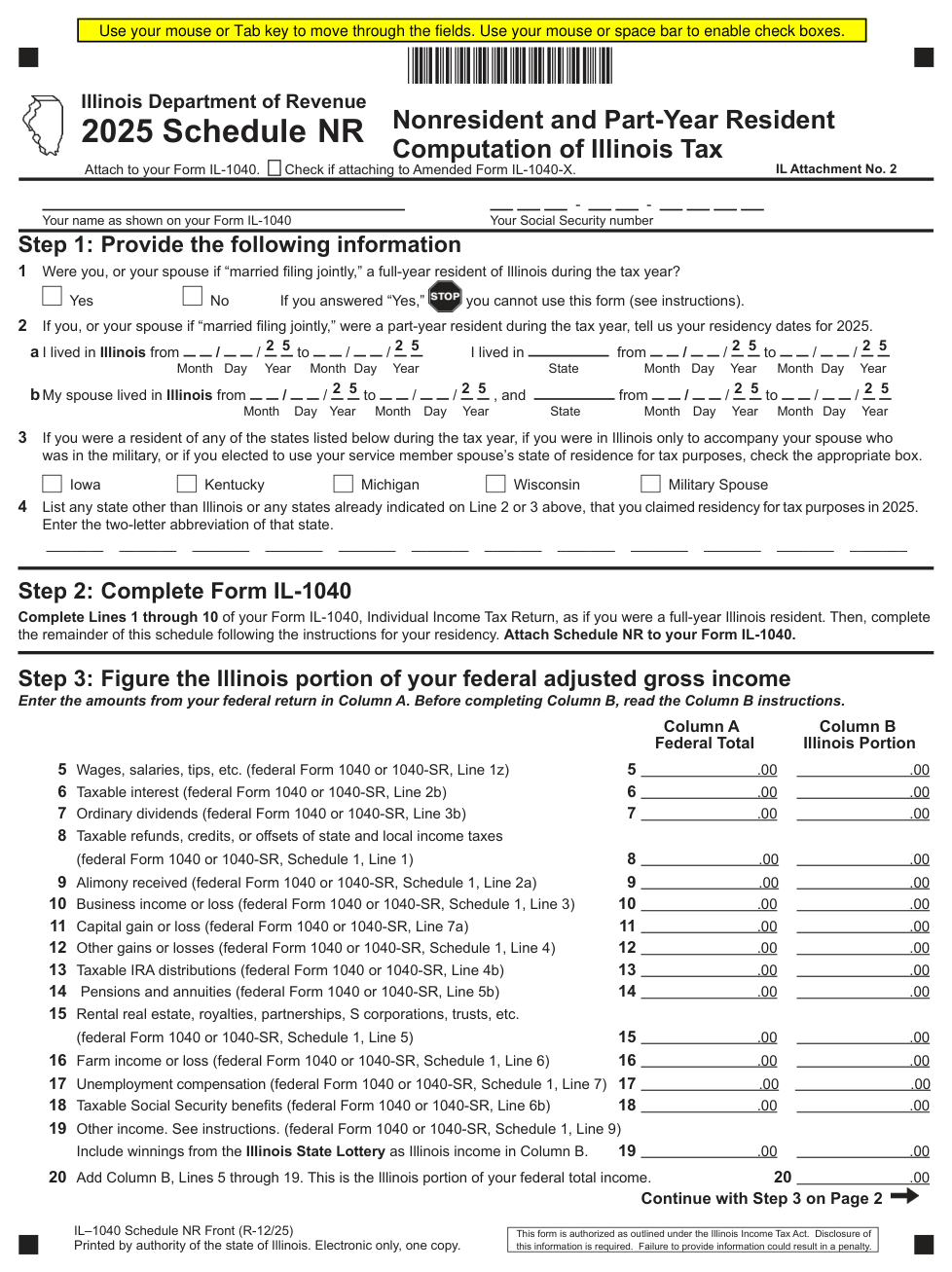
Step 1 — Provide the following information
Line 1: Full-year resident? Answer whether you, or your spouse if married filing jointly, were a full-year Illinois resident. If “Yes,” stop — you cannot use this form.
Line 2: Part-year residency dates. Enter the dates you lived in Illinois in 2025 and the dates and state where you lived outside Illinois. Line 2b is for your spouse’s dates.
Line 3: Reciprocal state or military spouse. Check Iowa, Kentucky, Michigan, or Wisconsin if you were a resident there, or the Military Spouse box if you were in Illinois only to accompany a servicemember spouse or elected their state of residence.
Line 4: Other states of residency. Enter the two-letter abbreviation of any other state in which you claimed residency for tax purposes in 2025 and that is not already shown on Line 2 or 3.
Step 2 — Complete Form IL-1040
Complete Form IL-1040, Lines 1 through 10, as if you were a full-year Illinois resident, then return here. Attach Schedule NR to the IL-1040.
Step 3 — Illinois portion of federal adjusted gross income
For Lines 5–19, enter the federal amount in Column A and the Illinois portion in Column B, following the Column B instructions for each type.
Line 5: Wages, salaries, tips. Column B is wages for work physically performed in Illinois. Exclude wages covered by a reciprocal agreement (Iowa, Kentucky, Michigan, Wisconsin).
Line 6: Taxable interest. Column B is generally interest received while an Illinois resident (part-year) and usually zero for a nonresident.
Line 7: Ordinary dividends. Same rule as interest — Illinois portion is generally the amount received while an Illinois resident.
Line 8: Taxable state and local refunds. Column B is the portion received while an Illinois resident.
Line 9: Alimony received. Column B is the amount received while an Illinois resident.
Line 10: Business income or loss. Column B is income from a business or profession carried on in Illinois, apportioned if the business operates in more than one state.
Line 11: Capital gain or loss. Column B includes gain on Illinois real estate and tangible property located in Illinois, plus gains realized while an Illinois resident.
Line 12: Other gains or losses. Column B follows the same sourcing as Line 11 for property used in a trade or business.
Line 13: Taxable IRA distributions. Column B is the amount received while an Illinois resident (nonresidents generally have no Illinois portion).
Line 14: Pensions and annuities. Same rule as IRA distributions.
Line 15: Rental real estate, royalties, partnerships, S corporations, trusts. Column B is income from Illinois property and the Illinois share of pass-through income.
Line 16: Farm income or loss. Column B is income from farming carried on in Illinois.
Line 17: Unemployment compensation. Column B is Illinois unemployment compensation, or compensation received while an Illinois resident.
Line 18: Taxable Social Security benefits. Illinois does not tax Social Security; this is captured as a subtraction later, and Column B generally follows the instructions.
Line 19: Other income. Column B follows the instructions and must include Illinois State Lottery winnings as Illinois income.
Line 20: Illinois portion of federal total income. Add Column B, Lines 5 through 19.
Step 3 continued — Adjustments to income (Lines 21–38)
Line 21: Enter the Illinois portion of federal total income from Line 20.
Lines 22–35: For each federal adjustment — educator expenses, reservist/performer/fee-basis expenses, HSA deduction, Armed Forces moving expenses, deductible self-employment tax, self-employed retirement plans, self-employed health insurance, early-withdrawal penalty, alimony paid, IRA deduction, student loan interest, (Line 33 reserved), Archer MSA deduction, and other adjustments — enter the federal amount in Column A and the Illinois-related portion in Column B, following the instructions. The Illinois portion of an adjustment generally tracks the income or activity it relates to.
Line 36: Add Column B, Lines 22 through 35. This is the Illinois portion of your federal adjustments.
Line 37: Enter your adjusted gross income from Form IL-1040, Line 1.
Line 38: Subtract Line 36 from Line 21. This is the Illinois portion of your federal adjusted gross income.
Step 4 — Illinois additions and subtractions
Line 39: Federally tax-exempt interest and dividend income. Column A is Form IL-1040, Line 2; Column B is the Illinois-taxable portion under the instructions.
Line 40: Other additions. Column A is Form IL-1040, Line 3; Column B is the Illinois portion.
Line 41: Add Column B, Lines 38, 39, and 40. Illinois portion of your total income.
Line 42: Federally taxed Social Security and retirement income. Column A is Form IL-1040, Line 5; Column B is the portion attributable to Illinois — this is the subtraction that removes retirement income Illinois does not tax.
Line 43: Illinois Income Tax overpayment in federal income. Column A is Form IL-1040, Line 6; Column B is the Illinois portion.
Line 44: Other subtractions. Column A is Form IL-1040, Line 7; Column B is the Illinois portion.
Line 45: Add Column B, Lines 42 through 44. Total Illinois subtractions.
Step 5 — Illinois income and tax
Line 46: Illinois base income. Subtract Line 45 from Line 41. If Line 45 is larger, enter zero. If Line 46 is zero, skip Lines 47–51 and enter “0” on Line 52.
Line 47: Enter the base income from Form IL-1040, Line 9.
Line 48: Income ratio. Divide Line 46 by Line 47 and round to three decimal places. If Line 46 is greater than Line 47, enter 1.000.
Line 49: Enter your exemption allowance from Form IL-1040, Line 10.
Line 50: Illinois exemption allowance. Multiply Line 49 by the decimal on Line 48.
Line 51: Illinois net income. Subtract Line 50 from Line 46. Enter this here and on Form IL-1040, Line 11.
Line 52: Illinois tax. Multiply Line 51 by 4.95% (0.0495). The result cannot be less than zero. Enter it here and on Form IL-1040, Line 12.
Common Mistakes to Avoid
- Including reciprocal-state wages in Column B. Illinois wages of Iowa, Kentucky, Michigan, and Wisconsin residents are not Illinois income.
- Omitting Illinois Lottery winnings. They are Illinois income in Column B no matter where you live.
- Copying Column A into Column B. Column B is only the Illinois-source or Illinois-resident-period portion.
- Rounding Line 48 to fewer than three decimals. The ratio must be carried to three decimal places.
- Forgetting to carry Lines 51 and 52 back. Form IL-1040, Lines 11 and 12, must come from Schedule NR for a nonresident or part-year resident.
- Using it as a full-year resident. A “Yes” on Line 1 means you cannot use this schedule.
- Missing property-sale sourcing. Gain on Illinois real estate is always Illinois income, even for a nonresident.
- Not attaching the schedule. An IL-1040 marked nonresident or part-year without Schedule NR is incomplete.
Frequently Asked Questions
Who has to file Schedule NR? Nonresidents with Illinois-source income and part-year residents. Full-year residents cannot use it.
I live in Indiana and work in Illinois. Do I file Schedule NR? Indiana is not a reciprocal state for wages, so yes — your Illinois wages are Illinois income, reported in Column B.
I moved to Illinois in July. What goes in Column B? All income you received after you became an Illinois resident, plus any Illinois-source income from before the move.
Are my out-of-state wages taxed by Illinois after I move here? Wages earned while you were an Illinois resident are Illinois income; wages earned before you moved generally are not, unless the work was performed in Illinois.
Does Illinois tax my pension if I am a nonresident? No. Retirement income is not Illinois-source, and Illinois does not tax it in any case.
How is my exemption affected? It is prorated by the Line 48 ratio, so you get only the Illinois-portion share of the full exemption allowance.
Where do I send Schedule NR? With your Form IL-1040, to the address in the IL-1040 instructions, or e-file both together.
What if my Illinois base income is zero or negative? Enter zero on Line 46, skip Lines 47–51, and enter “0” on Line 52.
Final Review Before Filing
- Line 1 is answered “No” for both spouses (otherwise you cannot use this form).
- Residency dates on Line 2 are complete for a part-year return.
- Reciprocal-state or military-spouse status is marked on Line 3 if it applies.
- Column A matches your federal return line by line.
- Column B contains only Illinois-source or Illinois-resident-period amounts.
- Illinois Lottery winnings are included in Column B, Line 19.
- Line 48 ratio is carried to three decimal places (1.000 maximum).
- Line 50 prorates the exemption by the Line 48 ratio.
- Line 52 equals Line 51 × 0.0495 and is not below zero.
- Lines 51 and 52 are entered on Form IL-1040, Lines 11 and 12.
- Schedule NR is attached to the IL-1040 (or IL-1040-X).
Sources & verification
- Issuing agency: Illinois Department of Revenue
- Official documents: Schedule NR (PDF) · instructions (PDF)
- Checked against: 2025 Schedule NR (R-12/25) + instructions
- Last verified: September 8, 2026
Spot an error or an out-of-date figure? Tell us and we will check it against the official source.
General information from the official form and its instructions, not advice for your circumstances. See the full disclaimer.
More Illinois Tax Forms forms
- Illinois Form IL-1040 — Individual Income Tax Return 2025-2026
- Illinois Form IL-1040-X — Amended Individual Income Tax Return 2025-2026
- Illinois Form IL-1065 — Partnership Replacement Tax Return 2025-2026
- Illinois Form IL-1120 — Corporation Income and Replacement Tax Return 2025-2026
- Illinois Form IL-W-4 — Employee’s and Other Payee’s Illinois Withholding Allowance Certificate
- Illinois Form RUT-50 — Private Party Vehicle Use Tax Transaction Return
- Illinois Schedule ICR — Illinois Credits 2025-2026