What is Form RUT-50?
Quick answer: Form RUT-50 is the return you file, and the tax you pay, when you buy or receive a car, motorcycle, or ATV from a private individual in Illinois. The state tax is a flat dollar amount from one of two tables — based on the vehicle’s age if the price is under $15,000, or on the price if it is $15,000 or more — with reduced flat amounts for family transfers and gifts. A local tax may also apply based on your address. It is due within 30 days of getting the vehicle, and it is filed with your title and registration paperwork through the Secretary of State, or online through MyTax Illinois. Everything here tracks the official RUT-50 instructions and the current Table A and Table B figures.
Form RUT-50 is Illinois’s private party vehicle use tax return. Illinois charges use tax on a vehicle bought from a private party — someone who is not a dealer — and RUT-50 is where that tax is reported and paid so the Secretary of State can title and register the vehicle in your name. The tax is not a percentage of the price; it is a fixed amount read from a table.
The form collects the buyer’s and seller’s information, a description of the vehicle, the purchase price or fair market value, and the transaction type, then directs you to the right table or flat amount and adds any local tax. Completing it correctly matters because the wrong table or a missed local tax leads to a bill later, gifts and family transfers have their own low flat rates, and the Secretary of State will not process your title and plates without the completed return.
Key Figures — Form RUT-50 Instructions (revision R-04/26)
- Due date: within 30 days of acquiring the vehicle in Illinois, or within 30 days of bringing it into Illinois if acquired elsewhere.
- Table A (purchase price or fair market value under $15,000): tax by vehicle age — $465 (age 1 or less), $365, $290, $240, $190, $165, $155, $140, $125, $115, down to $100 (age 11 or more).
- Table B (purchase price or fair market value $15,000 or more): $850 ($15,000–$19,999.99); $1,100; $1,350; $1,600 ($30,000–$49,999.99); $2,600 ($50,000–$99,999.99); $5,100 ($100,000–$999,999.99); $10,100 ($1,000,000 or more).
- Flat amounts: $0 for an exemption (Step 4, Line 1); $15 for an exception such as a transfer from a spouse, parent, sibling, or child, or an estate gift (Step 4, Line 2); $25 for a motorcycle or ATV (Step 4, Line 3).
- No trade-in allowance is permitted.
- Local (municipal and county) private party vehicle use tax may also apply based on your registration address — see Form RUT-6. Chicago and Cook County are the main examples: for a standard purchase, Chicago charges $80 (3 years or newer) down to $0 (15 years or older) and Cook County $225 down to $90 by vehicle age; both are lower for exception transfers and for motorcycles/ATVs.
- Source: Illinois Department of Revenue — Form RUT-50 Instructions (revision R-04/26) and RUT-6 Reference Guide (revision R-03/24).
- Last verified: 2026-09-08
Who Must File Illinois Form RUT-50?
File RUT-50 if you bought or received a motor vehicle from a private party — an individual, not a dealer — by purchase, gift, or transfer, and you are titling or registering it in Illinois.
Use a different form if: – you bought the vehicle from an unregistered out-of-state dealer, lending institution, leasing company, or retailer, or bought a passenger car from an unregistered Illinois lending institution or leasing company — file Form RUT-25 instead; – you bought from a registered Illinois dealer — the dealer handles the tax; or – you need to correct a RUT-50 you already filed — file Form RUT-50-X (paper only).
How to File Illinois Form RUT-50
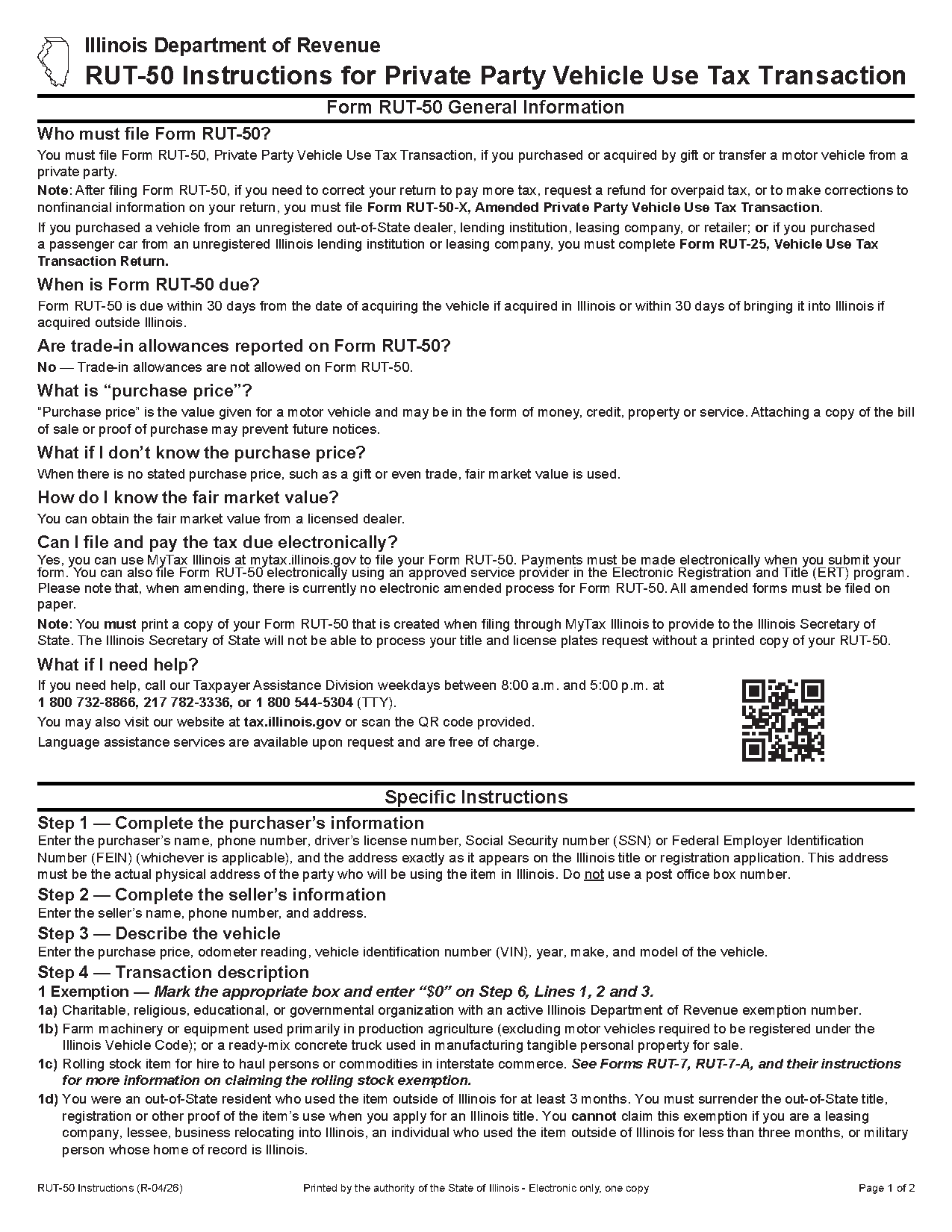
- Electronically: Use MyTax Illinois at mytax.illinois.gov, which calculates the tax and requires electronic payment when you submit. You must then print the completed RUT-50 and give it to the Secretary of State to get your title and plates. An approved Electronic Registration and Title (ERT) service provider can also file for you.
- On paper: Complete and sign the form, then submit it with your Illinois Secretary of State title and registration application and fees.
- Amended: File Form RUT-50-X on paper to pay more tax, claim a refund, or fix non-financial details.
Before you start, get the bill of sale or proof of purchase, the vehicle’s title, the VIN and odometer reading, and — for a gift or even trade with no stated price — a fair market value from a licensed dealer. Attaching the bill of sale can prevent later notices.
When Is Illinois Form RUT-50 Due?
- Within 30 days of the date you acquired the vehicle, if you acquired it in Illinois.
- Within 30 days of bringing the vehicle into Illinois, if you acquired it outside the state.
- In practice, the vehicle cannot be titled and registered until the tax is filed and paid, so RUT-50 is normally completed as part of the title transfer.
- Penalties: a late-filing penalty applies if you do not file a processable return by the due date; a late-payment penalty applies if you do not pay by the original due date; a bad-check penalty applies if your payment is not honored; and a cost-of-collection fee applies if you do not pay within 30 days of a bill from the Department.
Where to File Illinois Form RUT-50
- Electronically: File and pay through MyTax Illinois (mytax.illinois.gov). Print the completed RUT-50 and give it to the Secretary of State — do not mail the MyTax confirmation page to the Department or the Secretary of State.
- On paper: Send the signed RUT-50 with your Illinois Secretary of State registration application and fees to: Office of the Illinois Secretary of State, Vehicle Services Department, Howlett Building, Springfield, IL 62756. Make any remittance payable to “Illinois Department of Revenue.”
- Keep a copy for your records.
How to Complete Illinois Form RUT-50 Line by Line
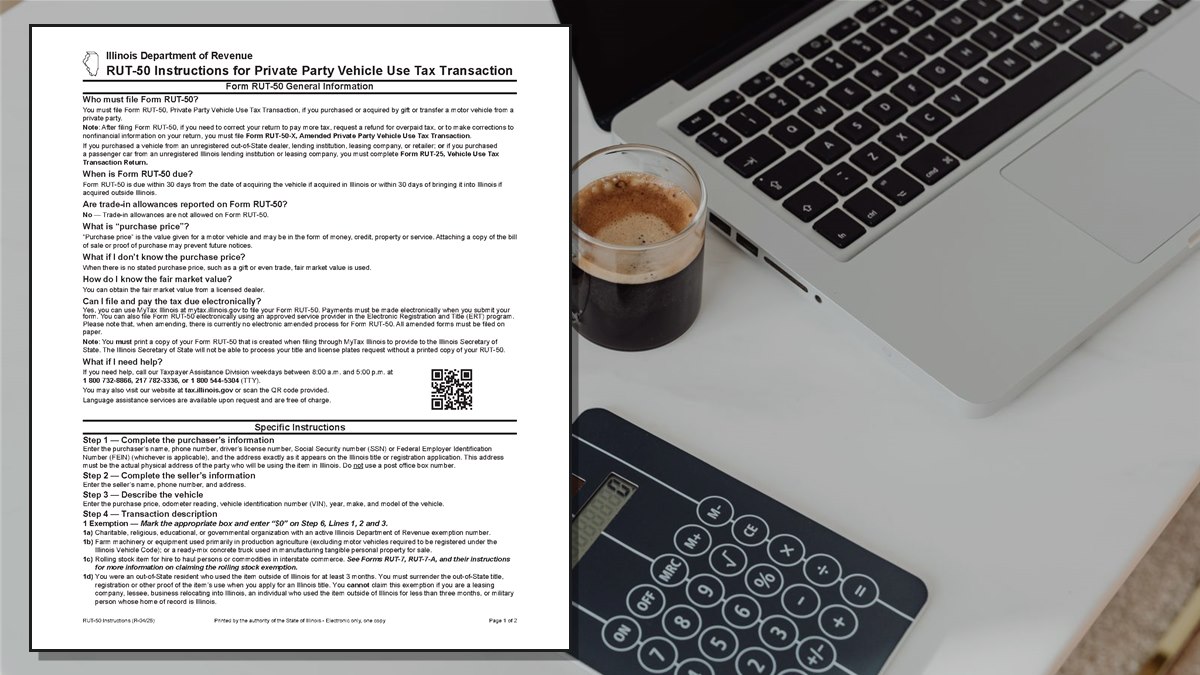
Step 1 — Purchaser’s information
Enter the purchaser’s name, phone number, driver’s license number, and Social Security number or FEIN, whichever applies. Enter the address exactly as it appears on the Illinois title or registration application. This must be the actual physical address of the person who will use the vehicle in Illinois — do not use a post office box. Your address also determines whether local tax applies.
Step 2 — Seller’s information
Enter the private seller’s name, phone number, and address.
Step 3 — Describe the vehicle
Enter the purchase price, the odometer reading, the vehicle identification number (VIN), and the year, make, and model. “Purchase price” is the total value given — money, credit, property, or services. If there is no stated price (a gift or an even trade), use fair market value obtained from a licensed dealer.
Step 4 — Transaction description
Line 1 — Exemption. Mark the box for your exemption and enter “$0” on Step 6, Lines 1, 2, and 3: – 1a: a charitable, religious, educational, or governmental organization with an active Illinois Department of Revenue exemption number; – 1b: farm machinery or equipment used primarily in production agriculture (not vehicles required to be registered under the Illinois Vehicle Code), or a ready-mix concrete truck used in manufacturing; – 1c: a rolling stock item for hire hauling persons or commodities in interstate commerce (see Forms RUT-7 and RUT-7-A); – 1d: you were an out-of-state resident who used the vehicle outside Illinois for at least three months and will surrender the out-of-state title or registration. You cannot claim 1d if you are a leasing company, a lessee, a business relocating into Illinois, someone who used the vehicle outside Illinois for less than three months, or a military member whose home of record is Illinois.
Line 2 — Exception. Mark the box for your exception and enter “$15” on Step 6, Line 1: – 2a: an estate gift to a beneficiary who is not the surviving spouse; – 2b: a transfer due to the organization, reorganization, dissolution, or partial liquidation of a business where beneficial ownership does not change; – 2c: a transfer or purchase from a spouse, parent, brother, sister, or child, including adopted children (spouses include civil-union partners; step-relatives, in-laws, and grandparent/grandchild relationships do not qualify).
Line 3 — Motorcycle or ATV. Enter “$25” on Step 6, Line 1 for a motorcycle, motor-driven cycle, three- or four-wheel ATV, or motorized pedalcycle.
Step 5 — Determine the Illinois tax
If none of the flat amounts in Step 4 applies, use the tables: – Table A if the purchase price or fair market value is less than $15,000 — the tax depends on the vehicle’s age. Figure age by subtracting the vehicle year from the year of the title application. – Table B if the purchase price or fair market value is $15,000 or more — the tax depends on the price bracket.
MyTax Illinois calculates this for you when you file electronically.
Step 6 — Figure your tax
Line 1 — Illinois Private Party Vehicle Use Tax. Enter the amount from Step 4 (a flat $0, $15, or $25) or from Step 5 (Table A or Table B).
Line 2 — Municipal tax. If your registration or titling address is within a municipality that imposes a local private party vehicle use tax, enter the municipal amount from Form RUT-6.
Line 3 — County tax. If your address is within such a county, enter the county amount from Form RUT-6.
A credit for tax already paid is allowed only if proof of payment is attached and the tax is separately stated. Paper filers make the remittance payable to “Illinois Department of Revenue”; electronic filers pay when they submit.
Step 7 — Sign
Verify every entry, then sign. On a paper return, the purchaser and any co-owner must sign. Send the return with your Secretary of State application and fees to the Vehicle Services Department in Springfield, and keep a copy. Electronic filers enter their name, Social Security number, and confirmed email in MyTax Illinois as their signature, and must print the completed return for the Secretary of State.
Common Mistakes to Avoid
- Trying to deduct a trade-in. RUT-50 does not allow a trade-in allowance.
- Using the wrong table. Table A is for a price or value under $15,000 (tax by age); Table B is for $15,000 or more (tax by price).
- Reporting a gift with no value. With no stated price, you must use fair market value from a licensed dealer, then check whether an exception ($15) or the tables apply.
- Missing the local tax. Municipal and county private party vehicle use tax can apply based on your address — check Form RUT-6.
- Using a P.O. box in Step 1. The address must be the buyer’s actual physical address.
- Missing the 30-day deadline. Late filing and late payment each carry a penalty.
- Mailing the MyTax confirmation page. Do not mail it; print the completed RUT-50 for the Secretary of State instead.
- Filing RUT-50 for a dealer or unregistered-seller purchase. A registered dealer handles the tax; certain unregistered sellers require Form RUT-25.
Frequently Asked Questions
When is RUT-50 due? Within 30 days of getting the vehicle in Illinois, or within 30 days of bringing it into Illinois.
How much is the tax? A flat amount: from Table A (by age) if the price is under $15,000, from Table B (by price) if it is $15,000 or more, or $15 for most family transfers and $25 for a motorcycle or ATV.
I got the car as a gift from my parent. What do I owe? A transfer from a parent is an exception — mark Step 4, Line 2c and enter $15 on Step 6, Line 1 (plus any local tax).
Do I owe local tax too? You may, based on the address where the vehicle is registered. Check Form RUT-6 for municipal and county amounts.
Can I file online? Yes, through MyTax Illinois, which calculates the tax and takes payment. Print the completed form for the Secretary of State.
What if I don’t know the purchase price? Use fair market value from a licensed dealer.
Where do I send a paper RUT-50? With your title and registration application and fees to the Illinois Secretary of State, Vehicle Services Department, Springfield, IL 62756.
How do I correct a RUT-50 I already filed? File Form RUT-50-X on paper; there is no electronic amended process.
Final Review Before Filing
- The seller is a private party, not a registered dealer (otherwise the dealer files, or use RUT-25).
- Step 1 shows the buyer’s actual physical address, not a P.O. box.
- The VIN, odometer reading, year, make, and model are entered in Step 3.
- The purchase price, or fair market value for a gift or even trade, is entered.
- Any exemption, exception, or motorcycle/ATV box in Step 4 is marked, with the matching $0, $15, or $25.
- The correct table is used — Table A under $15,000 (by age), Table B at $15,000 or more (by price).
- Municipal and county tax from RUT-6 are entered on Step 6, Lines 2 and 3 if your address is covered.
- The purchaser (and co-owner) signed in Step 7.
- Filed within 30 days, with payment.
- A copy is kept, and the completed form goes to the Secretary of State with your title and registration application.
Sources & verification
- Issuing agency: Illinois Department of Revenue
- Official documents: instructions (PDF)
- Checked against: RUT-50 Instructions (R-04/26) + RUT-6 (R-03/24)
- Last verified: September 8, 2026
Spot an error or an out-of-date figure? Tell us and we will check it against the official source.
General information from the official form and its instructions, not advice for your circumstances. See the full disclaimer.
More Illinois Tax Forms forms
- Illinois Form IL-1040 — Individual Income Tax Return 2025-2026
- Illinois Form IL-1040-X — Amended Individual Income Tax Return 2025-2026
- Illinois Form IL-1065 — Partnership Replacement Tax Return 2025-2026
- Illinois Form IL-1120 — Corporation Income and Replacement Tax Return 2025-2026
- Illinois Form IL-W-4 — Employee’s and Other Payee’s Illinois Withholding Allowance Certificate
- Illinois Schedule ICR — Illinois Credits 2025-2026
- Illinois Schedule NR — Nonresident and Part-Year Resident Computation of Illinois Tax 2025-2026