What is Form PA-1000?
Quick answer: Form PA-1000 is the claim older and disabled Pennsylvanians file to get part of the property tax or rent they paid on their home refunded by the state. You qualify based on age or disability status as of December 31 of the claim year and on total household income for that year. The claim covers one calendar year, is filed once a year, and can be submitted on paper to the Department of Revenue in Harrisburg or filed free online. For 2025 claims the filing deadline printed on the form is June 30, 2026. This page follows the Form PA-1000 instructions step by step, with the current rebate table.
Form PA-1000, the Property Tax or Rent Rebate Claim, is how Pennsylvania returns some of the property tax or rent paid by lower-income residents who are elderly, widowed, or permanently disabled. The program is funded by the Pennsylvania Lottery and gaming revenue, and the rebate is a payment back to you, not a credit against a tax you owe.
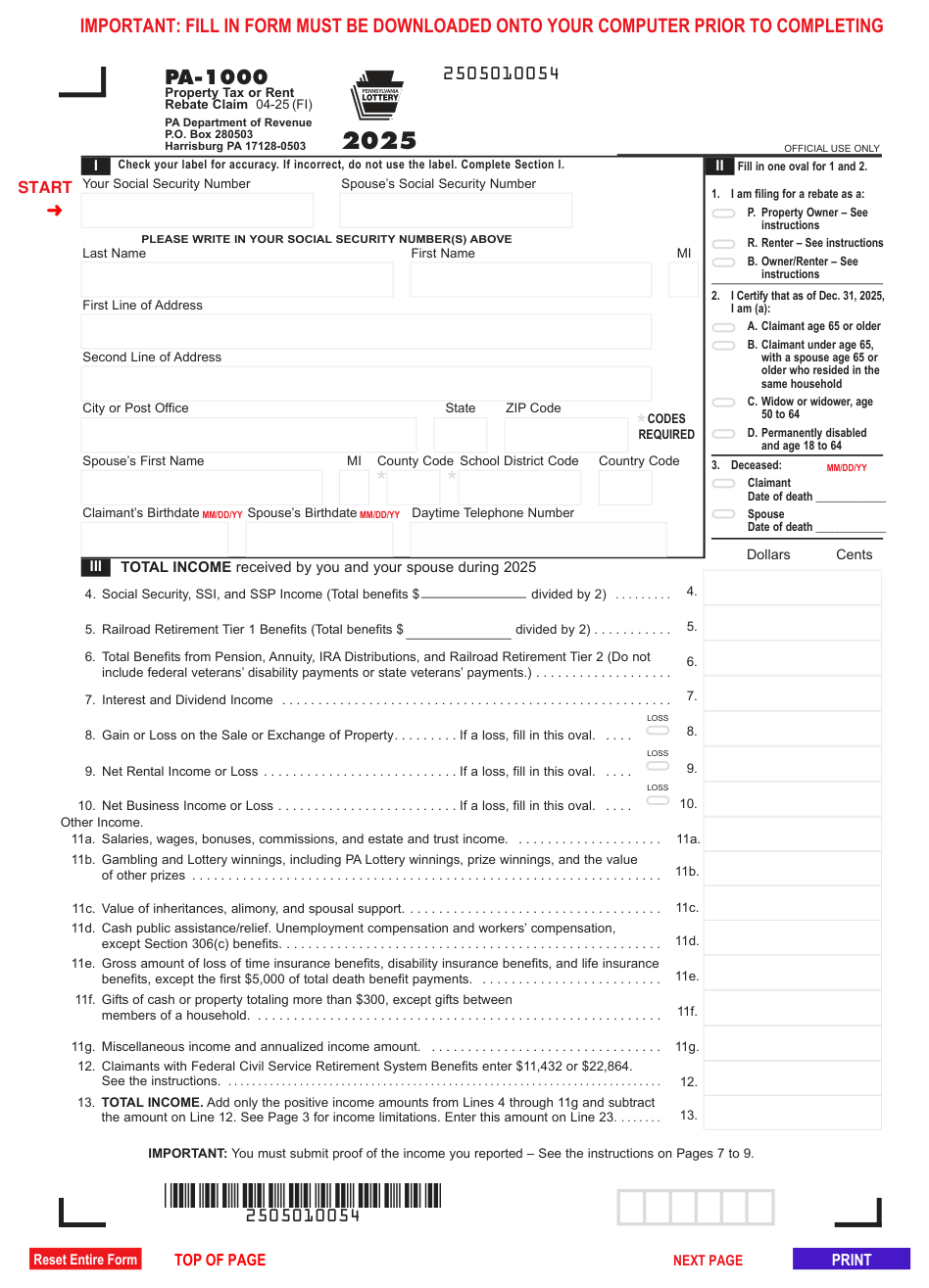
The form collects your identifying information, the basis for your eligibility (age, widow/widower status, or disability), every source of income you and your spouse received during the year, and the property tax or rent you paid on your Pennsylvania home. From those figures it produces a rebate amount capped by a sliding income-based table. Completing it correctly matters because the income calculation uses rules unique to this program — half of Social Security is excluded, some benefits are partly excluded, and losses cannot reduce your income — and because you must attach proof of the income and the tax or rent you report.
Key Figures — Tax Year 2025 (Form PA-1000, revision 04-25)
- Income limit: total income of $48,110 or less for 2025.
- Rebate table (maximum standard rebate by income level): $0–$8,550 → $1,000; $8,551–$16,040 → $770; $16,041–$19,240 → $460; $19,241–$48,110 → $380.
- Only one-half of Social Security, SSI, SSP, and Railroad Retirement Tier 1 benefits counts as income (Lines 4 and 5).
- Federal Civil Service Retirement System claimants subtract $11,432 (one claimant) or $22,864 (claimant and spouse) on Line 12.
- Renters multiply total rent paid by 20% (0.20) on Line 17.
- Gifts count as income only above $300 (Line 11f); the first $5,000 of death benefits is excluded (Line 11e).
- Filing deadline printed on the form: June 30, 2026. In recent claim years the Department has administratively extended the PA-1000 deadline to December 31; check the Department’s website for the current year before assuming extra time.
- Mail to: PA Department of Revenue, P.O. Box 280503, Harrisburg, PA 17128-0503.
- Claim status line: 1-888-728-2937, available after June 1.
- Source: Pennsylvania Department of Revenue — Form PA-1000, 2025 (revision 04-25).
- Last verified: 2026-09-08
Who Can File Pennsylvania Form PA-1000?
To file a claim for 2025 you must meet all of the following.
Residency and home. You lived in Pennsylvania and either owned and paid property tax on your home, or rented and paid rent on a residence where property taxes were paid by the landlord.
Age or disability, as of December 31, 2025. You must be one of: – age 65 or older; – under 65 with a spouse age 65 or older who lived in the same household; – a widow or widower age 50 to 64; or – permanently disabled and age 18 to 64.
Income. Your total income for 2025, figured the PA-1000 way, must be $48,110 or less.
One claim per household. Only one member of a household may file, and it must be the only claim filed by that household for the year.
Who cannot file. People who do not meet an age or disability category, households over the income limit, and anyone filing a second household claim. A claim may be filed on behalf of a person who died during the claim year if they lived at least one day of that year and otherwise qualified; the personal representative or a surviving spouse files it.
How to File Pennsylvania Form PA-1000
- Online: File free through the Department of Revenue’s myPATH system, which checks your entries and lets you attach documents electronically.
- By mail: Complete the form, attach your proof of income and your property tax receipts or rent certificate, sign it, and mail it to the Harrisburg address.
- Assistance: Free filing help is available through Department of Revenue district offices, Area Agencies on Aging, and legislators’ offices.
Before you start, gather: your 2025 Social Security benefit statement (SSA-1099) and any statements for pensions, annuities, IRA distributions, interest, and dividends; records of any wages, business, rental, gambling, or other income; receipted 2025 property tax bills if you own; a completed PA Rent Certificate signed by your landlord if you rent; and your bank routing and account numbers if you want direct deposit.
When Is Pennsylvania Form PA-1000 Due?
- Primary deadline: June 30, 2026 for a 2025 claim, as printed on the form.
- Deadline extensions: In recent claim years the Department of Revenue has administratively extended the PA-1000 deadline to December 31. Do not rely on an extension until the Department announces one for the current year — check its website before assuming you have extra time.
- Weekend/holiday rule: If the due date falls on a Saturday, Sunday, or legal holiday, a claim postmarked or submitted the next business day is on time.
- Processing: Paper claims take longer to process than online claims. The Department generally begins issuing rebates on July 1.
- Late claims: A claim received after the final deadline for that year is denied. There is no penalty for not filing — you simply forfeit that year’s rebate.
Where to Mail Pennsylvania Form PA-1000
– Mailing address: PA Department of Revenue, P.O. Box 280503, Harrisburg, PA 17128-0503. This address is printed on the form. – What to attach: – Property owners: copies of receipted 2025 property tax bills showing the tax was paid. – Renters: a completed and landlord-signed PA Rent Certificate (and rent receipts if the landlord will not sign). – All claimants: proof of every income item reported in Section III, following the instruction booklet’s income-proof pages. – Electronic alternative: File through myPATH instead of mailing. Online claims are processed faster and let you upload the same proof documents. – Direct deposit: Complete Lines 20–22 to have the rebate deposited to a U.S. checking or savings account; otherwise the Department mails a paper check.
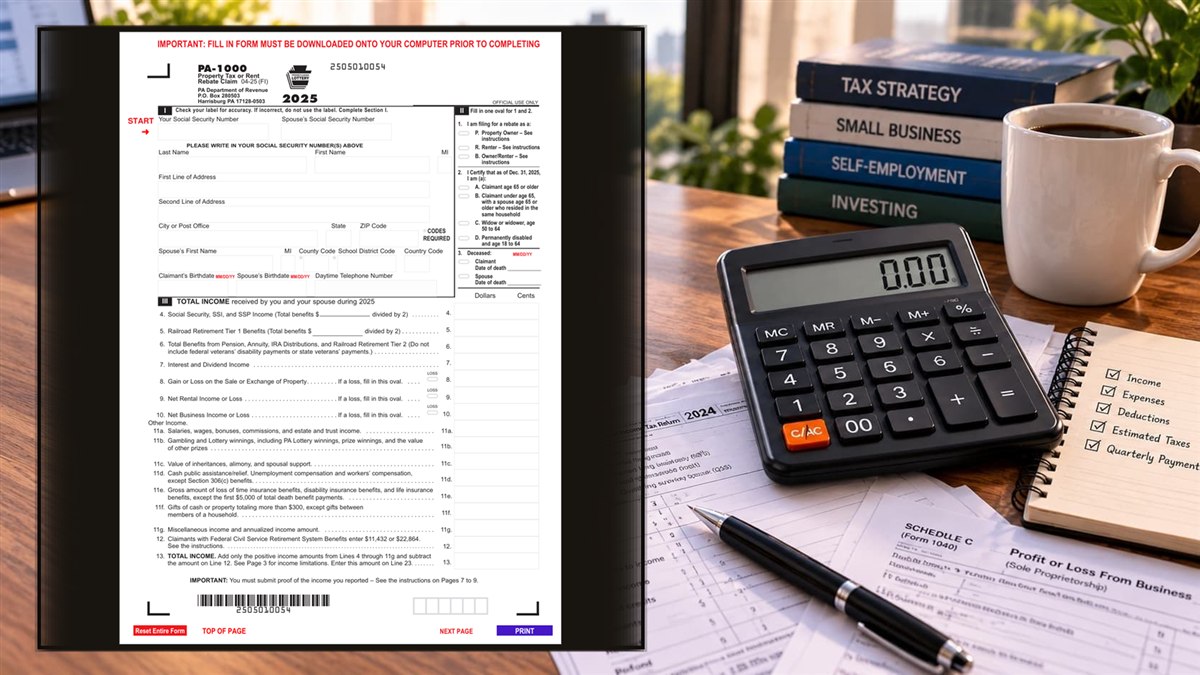
How to Complete Pennsylvania Form PA-1000 Line by Line
Section I — Claimant Information
Mailing label: If the Department mailed you a pre-printed label, check it for accuracy. If any part is wrong, do not use it — complete Section I by hand instead.
Your Social Security number and spouse’s Social Security number: Enter both, even if only one of you is the claimant.
Name: Enter the claimant’s last name, first name, and middle initial.
Address: Enter your street address on the first line, an apartment or unit on the second line if needed, then city or post office, state, and ZIP code.
Spouse’s first name and middle initial: Enter if you are married.
Claimant’s birthdate and spouse’s birthdate: Enter as MM/DD/YYYY. Your birthdate supports the age category you claim in Section II.
County code, school district code, country code: Enter the codes for where you live, from the lists in the instructions. The county and school district codes are required.
Daytime telephone number: Enter a number where the Department can reach you about the claim.
Section II — Rebate Type and Eligibility
Box 1 — I am filing for a rebate as a: Fill in one oval — P for a property owner, R for a renter, or B for someone who both owned and rented a home during the year.
Box 2 — I certify that as of December 31, 2025, I am (a): Fill in one oval — A (claimant age 65 or older), B (claimant under 65 with a spouse 65 or older in the household), C (widow or widower age 50 to 64), or D (permanently disabled and age 18 to 64). A disability claim requires supporting documentation described in the instructions.
Box 3 — Deceased: If the claimant or the spouse died during 2025, fill in the matching oval and enter the date of death.
Section III — Total Income (Lines 4–13)
Report all income you and your spouse received in 2025. Enter whole-dollar amounts.
Line 4: Social Security, SSI, and SSP Income. Enter total benefits, then divide by 2 and enter the result. Only half of these benefits counts as income for this program.
Line 5: Railroad Retirement Tier 1 Benefits. Enter total Tier 1 benefits, then divide by 2 and enter the result. Half is excluded, the same as Social Security.
Line 6: Total Benefits from Pension, Annuity, IRA Distributions, and Railroad Retirement Tier 2. Enter the full amount. Do not include federal veterans’ disability payments or state veterans’ payments.
Line 7: Interest and Dividend Income. Enter total taxable and tax-exempt interest and dividends.
Line 8: Gain or Loss on the Sale or Exchange of Property. Enter the gain. If the result is a loss, fill in the loss oval; a loss is not subtracted from your total income.
Line 9: Net Rental Income or Loss. Enter net rental income. If it is a loss, fill in the loss oval; the loss does not reduce total income.
Line 10: Net Business Income or Loss. Enter net business income. If it is a loss, fill in the loss oval; the loss does not reduce total income.
Line 11a: Salaries, wages, bonuses, commissions, and estate and trust income. Enter the total of these amounts.
Line 11b: Gambling and Lottery winnings. Enter all gambling and lottery winnings, including PA Lottery cash winnings, prize winnings, and the value of noncash prizes.
Line 11c: Value of inheritances, alimony, and spousal support. Enter the total received.
Line 11d: Cash public assistance/relief, unemployment compensation, and workers’ compensation. Enter these amounts, except Section 306(c) workers’ compensation benefits, which are not counted.
Line 11e: Loss of time, disability, and life insurance benefits. Enter the gross amount received, except the first $5,000 of total death benefit payments, which is excluded.
Line 11f: Gifts of cash or property totaling more than $300. Enter the total value of such gifts, except gifts between members of your household. Gifts of $300 or less are not counted.
Line 11g: Miscellaneous income and annualized income amount. Enter any other income and any income annualized under the instructions (for example, when eligibility is based on part of a year).
Line 12: Federal Civil Service Retirement System benefits offset. If you (or you and your spouse) receive Federal Civil Service Retirement System benefits, enter $11,432 for one such claimant or $22,864 if both you and your spouse receive them. This subtraction offsets the fact that CSRS recipients do not get the half-exclusion allowed for Social Security.
Line 13: Total Income. Add only the positive amounts from Lines 4 through 11g, then subtract Line 12. Do not subtract any loss from Lines 8, 9, or 10. Enter this figure here and again on Line 23. If it is more than $48,110, you do not qualify.
Rebate Calculation (Lines 14–19)
Line 14: Total 2025 property tax (property owners only). Enter the property tax you paid on your home for 2025. Attach receipted tax bills.
Line 15: Property Tax Rebate (property owners only). From the rebate table, find the maximum standard rebate for your income level and enter it in the parentheses. Compare it to Line 14 and enter the lesser of the two on the line.
Line 16: Total 2025 rent paid (renters only). Enter the rent you paid on your Pennsylvania residence for 2025. Attach the PA Rent Certificate.
Line 17: 20% of rent. Multiply Line 16 by 20% (0.20) and enter the result. This is the portion of rent treated as property tax.
Line 18: Rent Rebate (renters only). From the rebate table, find the maximum rebate for your income level and enter it in the parentheses. Compare it to Line 17 and enter the lesser of the two on the line.
Line 19: Property Tax/Rent Rebate (owner-renters only). From the rebate table, enter the maximum rebate for your income level in the parentheses. Compare it to the sum of Lines 15 and 18 and enter the lesser amount. Use this line only if you filled in Box 1-B.
Direct Deposit (Lines 20–22)
Line 20: Account type. Place an X in one box — Checking or Savings — to have the rebate deposited directly. Leave Lines 20–22 blank if your account is outside the U.S.; the Department will mail a check.
Line 21: Routing number. Enter your bank’s nine-digit routing number.
Line 22: Account number. Enter your account number.
Line 23 and the Rebate Table (Section IV)
Line 23: Income for the rebate table. Enter the amount from Line 13, then circle the maximum rebate that matches your income level in the table: $0–$8,550 → $1,000; $8,551–$16,040 → $770; $16,041–$19,240 → $460; $19,241–$48,110 → $380. This is the figure you carry to Line 15, 18, or 19.
Oath, Signatures, and Witnesses
Claimant oath: By signing, you declare the claim is true, correct, and complete, that it is the only claim from your household, and you authorize the Department to check federal and state income tax records, PACE records, Social Security Administration records, and Department of Human Services records to verify it.
Claimant’s signature and date: Sign and date. On a paper form, sign after printing.
Spouse’s signature and date: Required if you are married and filing jointly for the rebate.
Preparer’s section: If someone other than the claimant prepared the claim, that person signs, prints their name, and enters a telephone number.
Witnesses’ signatures: If the claimant cannot sign and makes only a mark, two witnesses must sign.
Power of attorney or nearest relative: If someone is filing on the claimant’s behalf, print that person’s name, telephone number, and home address.
Fraud warning: An excessive claim filed with intent to defraud is a misdemeanor punishable by a fine of up to $1,000 and up to one year in prison, plus a penalty of 25% of the entire amount claimed.
Common Mistakes to Avoid
- Reporting all of your Social Security. Only half of Social Security, SSI, SSP, and Railroad Tier 1 benefits counts — divide by 2 on Lines 4 and 5.
- Subtracting a loss. A loss on Line 8, 9, or 10 does not reduce total income; fill in the loss oval and add only positive amounts on Line 13.
- Skipping the Line 12 offset. Federal Civil Service Retirement System claimants must subtract $11,432 or $22,864, which can bring an otherwise over-limit claimant under the cap.
- Filing without proof. Claims without receipted tax bills, a signed rent certificate, or income documentation are delayed or denied.
- More than one claim per household. Only one household member may file.
- Using the mailing label when it is wrong. If any label detail is incorrect, complete Section I by hand instead.
- Missing the deadline. A late claim is denied outright; do not assume the deadline was extended.
- Leaving the county or school district code blank. Both are required.
- Entering rent rebate on the wrong line. Renters use Lines 16–18; owner-renters use Line 19 after completing Lines 15 and 18.
Frequently Asked Questions
Do I have to file PA-1000 every year? Yes. Each year’s rebate requires a new claim for that year’s income and property tax or rent.
What is the income limit? Total income, figured the PA-1000 way, of $48,110 or less for 2025. Remember that only half of Social Security counts.
When is the claim due? June 30, 2026 as printed on the form. The Department has administratively extended this to December 31 in recent claim years, but confirm the current-year deadline before relying on it.
Where do I send it? PA Department of Revenue, P.O. Box 280503, Harrisburg, PA 17128-0503, or file online through myPATH.
How much is the rebate? Between $380 and $1,000 depending on your income level, and never more than the property tax or 20% of the rent you actually paid.
Can renters get a rebate? Yes, if they meet the age or disability category and income limit and paid rent on a Pennsylvania residence subject to property tax.
When will I get my rebate? The Department generally begins issuing rebates on July 1. Direct deposit is faster than a mailed check.
Can I file for a parent who has died? Yes, if the person lived at least one day of the claim year and otherwise qualified; a surviving spouse or personal representative files and signs.
Does the rebate count as income elsewhere? No. The property tax/rent rebate is not taxable income for Pennsylvania purposes.
Final Review Before Filing
- You meet an age or disability category as of December 31, 2025.
- Box 1 (P, R, or B) and Box 2 (A, B, C, or D) each have exactly one oval filled.
- Social Security and Railroad Tier 1 amounts on Lines 4 and 5 are divided by 2.
- Line 13 adds only positive income and subtracts Line 12, and is $48,110 or less.
- Line 12 offset is taken if you receive Federal Civil Service Retirement System benefits.
- The correct rebate line for your status is completed (15 for owners, 16–18 for renters, 19 for owner-renters).
- Line 23 shows Line 13 income and the matching maximum rebate is circled.
- Property tax receipts (owners) or a signed PA Rent Certificate (renters) are attached.
- Proof of every income item is attached.
- The claim is signed and dated by the claimant (and spouse if married), after printing.
- Direct deposit Lines 20–22 are complete, or left blank to receive a check.
- Mailed to P.O. Box 280503, Harrisburg, PA 17128-0503, before the deadline.
- You kept a copy of the completed claim and all attachments.
Sources & verification
- Issuing agency: Pennsylvania Department of Revenue
- Official documents: Form PA-1000 (PDF)
- Checked against: 2025 PA-1000 (FI) 04-25
- Last verified: September 8, 2026
Spot an error or an out-of-date figure? Tell us and we will check it against the official source.
General information from the official form and its instructions, not advice for your circumstances. See the full disclaimer.