


What is Form 05-158?
Quick answer: Form 05-158 is the Texas Franchise Tax Report, Long Form. Texas has no personal income tax, but most corporations, LLCs, partnerships and other entities pay a franchise tax on their margin. For the 2026 report year, an entity whose annualized total revenue is $2,650,000 or less owes no tax and does not file a No Tax Due Report, though it must still file a Public Information Report or Ownership Information Report. The annual report is due May 15 (extensions run to August 17 or November 16, 2026). The Long Form is two pages, 05-158-A and 05-158-B, and its bottom line is item 35, total tax due.
The franchise tax is a tax on the privilege of doing business in Texas, calculated on how much revenue an entity earned, not on profit. An entity picks the lowest of four margin calculations, apportions it to Texas by its share of gross receipts and multiplies by the tax rate. Entities with $20 million or less in annualized total revenue may skip all of that and use the simpler EZ Computation Report.
The Long Form is only part of the filing. Almost every entity must also file a Public Information Report (Form 05-102) or an Ownership Information Report, and if it cannot file on time it should ask for an extension on Form 05-164.
Key Figures — Report Year 2026 (Form 05-158)
- No tax due threshold: $2,650,000 of annualized total revenue. At or below it, no tax is owed and no No Tax Due Report is filed for 2026, but a Public Information Report or Ownership Information Report is still required.
- Tax rates: 0.75% for most entities; 0.375% for qualifying retailers and wholesalers; 0.331% for entities using the EZ computation.
- Margin is the lowest of four figures: 70% of total revenue, revenue minus cost of goods sold, revenue minus compensation, or revenue minus $1 million.
- Compensation limit: $480,000 per person per 12-month period for reports due on or after January 1, 2026.
- Due date: May 15, 2026. If tax due is less than $1,000, no payment is required, but the report must still be filed.
- Penalties: $50 for a late report; 5% of tax for late payment plus another 5% after 30 days; interest starts 60 days after the due date at the prime rate plus 1%.
Source: the Texas Comptroller of Public Accounts, 2026 Franchise Tax Report forms and Form 05-915 instructions. Last verified September 29, 2026.
Who Must File Form 05-158?
Any taxable entity doing business in Texas, generally corporations, limited liability companies, limited partnerships, professional associations and similar entities, must file a franchise tax report unless it qualifies for a no-tax-due situation. In practice, you file Form 05-158 (or the EZ Computation) when:
- your annualized total revenue is above $2,650,000 for the 2026 report;
- you are a passive entity or a REIT that must affirm its status by blackening the correct circle on the report;
- you have zero Texas gross receipts and must report total revenue, Texas receipts and receipts everywhere;
- you are a combined group, or an entity making a tiered partnership election.
Entities at or below the threshold owe nothing and skip the Long Form, but they still file a Public Information Report or Ownership Information Report. Sole proprietorships (other than single-member LLCs) and general partnerships owned entirely by natural persons (other than limited liability partnerships) are not subject to the tax. Entities that stop doing business in Texas may need a final report, due 60 days after they cease doing business.
Common trap: assuming that being below the threshold means no filing at all. The No Tax Due Report no longer exists for 2026, but a Public Information Report or Ownership Information Report is still required, and missing it can put the entity’s right to transact business at risk.
How to File Form 05-158
- File and pay online through Webfile. The Comptroller encourages it because it does the math for you. You need your 11-digit Texas taxpayer number and the 6-digit XT Webfile number from your franchise tax notice.
- Or file on paper: complete both pages (05-158-A and 05-158-B), attach any schedules, and include the Public Information Report or Ownership Information Report.
- Pay by credit card, electronic check or TEXNET. If you pay by check, complete Form 05-170 and make the check payable to the Texas Comptroller.
- Mandatory EFT payors (those who paid $10,000 or more in the previous state fiscal year) must pay electronically.
- Sign the report. An officer, director or other authorized person, which can include an authorized paid preparer, must sign.
When Is Form 05-158 Due?
| Item | Date |
|---|---|
| 2026 annual report | May 15, 2026 |
| Extension for non-EFT payors (Form 05-164 or Webfile) | Through November 16, 2026 |
| First extension for mandatory EFT payors | Through August 17, 2026, with a second extension to November 16, 2026 |
| Final report | 60 days after the entity ceases doing business in Texas |
If the due date is a Saturday, Sunday or legal holiday, it moves to the next business day. Texas does not require estimated franchise tax payments.
Where to Mail Form 05-158
Mail reports and payments to: Texas Comptroller of Public Accounts, P.O. Box 149348, Austin, TX 78714-9348. If you use a designated private delivery service, address it to Texas Comptroller of Public Accounts, 111 E. 17th St., Austin, TX 78701-1334. Make checks payable to the Texas Comptroller, with your taxpayer number and report year on them.
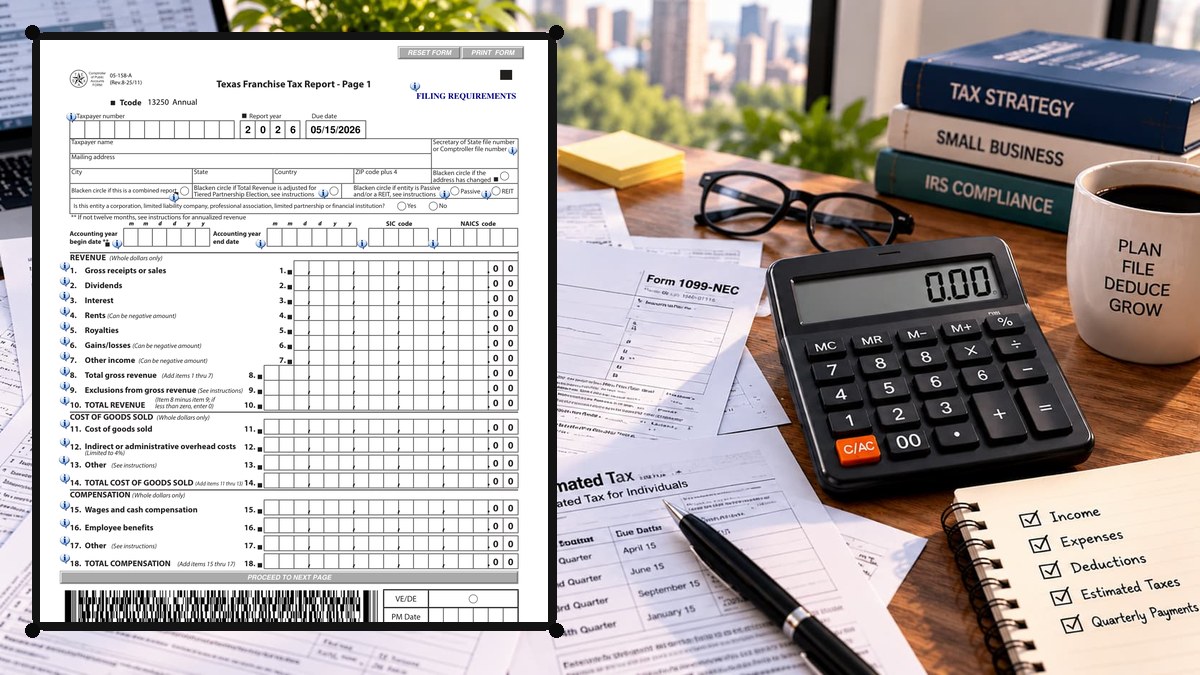
How to Complete Form 05-158 Line by Line
Top of Page 1 — Identifying Information
Confirm the report year (2026), due date (05/15/2026), Secretary of State file number, taxpayer number, name and mailing address. Blacken the circles that apply: combined report, address changed, Total Revenue adjusted for a tiered partnership election, or the entity is a passive entity or REIT. Enter the accounting year begin and end dates (the accounting period is generally the federal accounting year that ended in 2025), your SIC code (a blank code defaults to 0.75%) and NAICS code. If the period is not twelve months, annualize revenue to test the threshold and EZ eligibility.
Revenue — Items 1–10
Report gross receipts or sales (1), dividends (2), interest (3), rents (4), royalties (5), gains and losses (6) and other income (7); rents, gains and other income can be negative. Item 8 adds them. Item 9 is exclusions from gross revenue. Item 10, Total Revenue, is item 8 minus item 9, never below zero. If annualized total revenue is $2,650,000 or less and the entity is not making a tiered partnership election, you can stop: no report is required, only the PIR or OIR. If it is $20 million or less, you may choose the EZ computation.
Cost of Goods Sold — Items 11–14
Enter cost of goods sold (11), indirect or administrative overhead costs (12, limited to 4%) and other allowable amounts (13), then total them in item 14. COGS applies only to entities that acquire or produce goods; it is a deduction option, not a required one.
Compensation — Items 15–18
Wages and cash compensation (15) is limited to $480,000 per person per 12-month period, prorated for the period, and covers amounts such as Medicare wages and tips on Form W-2. Employee benefits (16) are not subject to the $480,000 limit, only to what is deductible for federal income tax. Add other compensation (17) and total in item 18.
Margin — Items 19–23 (Page 2)
Item 19 is 70% of revenue, item 20 is revenue minus COGS, item 21 is revenue minus compensation and item 22 is revenue minus $1 million. Item 23, Margin, is the lowest of items 19, 20, 21 and 22 (or zero if negative). An entity can use only one of these methods for the report, and a combined group must use the same method for the whole group.
Apportionment — Items 24–26
Enter gross receipts in Texas (24) and gross receipts everywhere (25), and divide item 24 by item 25 rounded to four decimals for the apportionment factor (26). An entity with zero Texas gross receipts has an apportionment factor of zero and owes no tax, but must still file the report and the PIR or OIR.
Taxable Margin and Tax Due — Items 27–35
Multiply margin by the apportionment factor for apportioned margin (27), subtract allowable deductions (28) for taxable margin (29). Enter the rate on item 30, 0.75% or 0.375% if you qualify as a primarily retail or wholesale entity, and multiply for tax due (31). Subtract credits from Form 05-181 (32) to get item 33 and enter the total tax due on item 35. Do not include a payment if item 35 is less than $1,000 or if annualized total revenue is at or below the no tax due threshold. A tiered partnership election means any amount is due.
Common Mistakes to Avoid
- Skipping the Public Information Report. Filing the Long Form without the PIR or OIR does not satisfy the filing requirement.
- Using the wrong tax rate. Leaving the SIC code blank defaults to 0.75%, which is too high for a qualifying retailer or wholesaler.
- Forgetting to annualize. Reports covering fewer than twelve months must be annualized to test the threshold and EZ eligibility.
- Exceeding the compensation cap. Individual compensation is capped at $480,000 per 12-month period.
- Missing the extension payment. An extension without at least 90% of the tax (or 100% of the prior year’s tax) reverts the due date to May 15.
- Sending a payment below $1,000. No payment is required, but the report still must be filed.
- Assuming a late filing has no cost when no tax is due. The $50 late report penalty applies regardless.
Frequently Asked Questions
Do I have to file if my revenue is under $2.65 million? You owe no tax and do not file a No Tax Due Report, but you must file a Public Information Report or Ownership Information Report.
What is the franchise tax rate? 0.75% for most entities, 0.375% for qualifying retailers and wholesalers, and 0.331% with the EZ computation.
When is the Texas franchise tax report due? May 15 each year for the annual report, or an extended date if a proper extension was made.
Can I file the EZ Computation instead? If your annualized total revenue is $20 million or less, yes. See the EZ Computation guide.
Does Texas require estimated franchise tax payments? No.
What happens if I never file? Penalties and interest accrue and, after notices, the entity’s right to transact business in Texas can be forfeited.
Final Review Before Filing
- Annualized total revenue is calculated correctly and compared with the $2,650,000 threshold.
- Report year, accounting period and SIC code are entered.
- Revenue, COGS, compensation and the four margin figures are consistent.
- Apportionment factor is rounded to four decimals.
- The correct tax rate is entered on item 30.
- Public Information Report or Ownership Information Report is attached.
- Payment is included only if item 35 is $1,000 or more.
- The report is signed and mailed to P.O. Box 149348, or filed on Webfile.
Sources & verification
- Issuing agency: Texas Comptroller of Public Accounts
- Official documents: Form 05-158-A (page 1) (PDF) · Form 05-158-B (page 2) (PDF) · 2026 Texas Franchise Tax Report Information and Instructions (05-915) (PDF)
- Checked against: the 2026 Forms 05-158-A and 05-158-B and the 2026 Form 05-915 instructions booklet
- Last verified: September 29, 2026
Spot an error or an out-of-date figure? Tell us and we will check it against the official source.
General information from the official form and its instructions, not advice for your circumstances. See the full disclaimer.
More Texas Tax Forms forms
- Texas Form 01-114 — Sales and Use Tax Return
- Texas Form 01-339 — Sales and Use Tax Resale Certificate and Exemption Certification
- Texas Form 05-102 — Franchise Tax Public Information Report
- Texas Form 05-164 — Franchise Tax Extension Request 2025-2026
- Texas Form 05-169 — Franchise Tax EZ Computation Report 2025-2026