

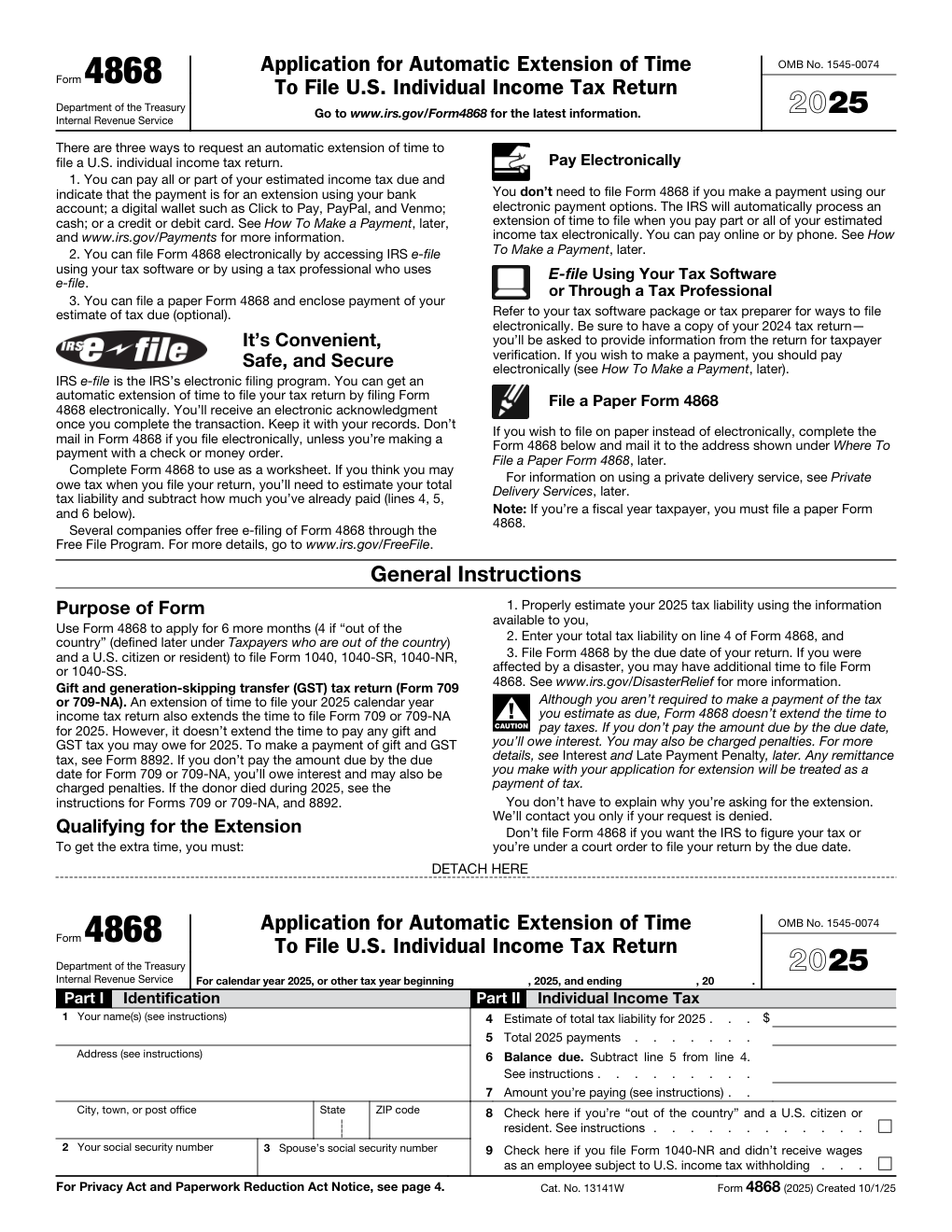
What is Form 4868?
Quick answer: IRS Form 4868 is the automatic extension of time to file a U.S. individual income tax return. It gives most people six more months to file, but it does not extend the time to pay. You can also get the extension without the form by paying part or all of your estimated tax electronically and marking the payment as an extension.
Form 4868 asks for very little: your name, address and social security number, and an estimate of your tax, payments and balance due. The IRS grants the extension automatically if you file it on time and your estimate was reasonable. You do not have to explain why you need more time.
What the form does not do is give you more time to pay. Interest starts on any unpaid tax after the regular due date, and a late payment penalty can apply as well. That is why the form has you estimate what you owe and why the best use of it is to pay as much as you can with the request. This guide follows the version of the form posted for tax year 2025.
Key Figures — Form 4868 (2025)
- What you get: an automatic extension of time to file Form 1040, 1040-SR, 1040-NR or 1040-SS of 6 months (4 more months for taxpayers out of the country).
- What you do not get: more time to pay. Interest runs on unpaid tax from the regular due date.
- When to file: by the regular due date of the return, April 15 for most calendar-year taxpayers.
- No form needed if you pay electronically: paying part or all of your estimated tax by an IRS electronic option and designating it as an extension processes the extension automatically.
- Late payment penalty: usually ½ of 1% of the unpaid tax for each month or part of a month, up to 25%.
- Late filing penalty: usually 5% of the unpaid tax for each month or part of a month after the extended due date, up to 25%.
Source: the IRS, Form 4868 and its instructions. Last verified October 27, 2026.
Who Must File Form 4868?
Individuals who cannot file their return by the regular due date. The form requests an extension for Form 1040, 1040-SR, 1040-NR or 1040-SS.
Taxpayers who owe gift tax. An extension of time to file the income tax return also extends the time to file Form 709 or 709-NA for the same year, but it does not extend the time to pay any gift and generation-skipping transfer tax.
Do not file Form 4868 if you want the IRS to figure your tax, or if you are under a court order to file your return by the due date.
Common trap: assuming the extension also covers the payment. Form 4868 extends the time to file only, so unpaid tax still collects interest and may draw a late payment penalty.
How to File Form 4868
- Estimate your tax. Use the information you have to estimate your total tax and payments. You can fill in the form as a worksheet even if you file electronically.
- Choose a way to request the extension. Pay electronically and mark it as an extension, e-file Form 4868 with tax software or a tax professional, or file a paper form.
- Pay what you can. The balance due is line 4 minus line 5. Paying electronically (IRS Direct Pay, your IRS online account, EFTPS, or a card or digital wallet) gives you a confirmation number to keep.
- Keep your records. Save the electronic acknowledgment or confirmation number. Do not attach a copy of Form 4868 to your return when you file.
- Claim the payment on your return. Enter any payment made with Form 4868 on the Schedule 3 line for amount paid with a request for extension (line 10 on the 2025 version), or on Form 1040-SS as the instructions say.
When Is Form 4868 Due?
File Form 4868 by the regular due date of your return, which is April 15 for most calendar-year taxpayers. The extension runs up to six months, to October 15 for most calendar-year taxpayers; the IRS generally cannot extend the due date of your return for more than that, apart from the exception for people living out of the country. If you were affected by a disaster, you may have additional time to file Form 4868; see the IRS disaster relief page.
Where to Mail Form 4868
If you file on paper, send Form 4868 to the IRS address that matches your state and whether you are making a payment. The addresses are listed by state group in the form’s “Where To File a Paper Form 4868” table, and filers with foreign addresses and certain other situations use a separate address. Use the U.S. Postal Service for any item going to an IRS P.O. box; private delivery services cannot deliver to P.O. boxes.

How to Complete Form 4868 Line by Line
Part I — Identification (Lines 1–3)
Part I identifies you and the return the extension is for.
| Line | What to enter |
|---|---|
| Line 1 | Your name(s) and address. If you plan to file a joint return, enter both spouses’ names in the order they will appear on the return. Use a different address only if you want correspondence about the extension sent elsewhere. |
| Line 2 | Your social security number. If you will file jointly, enter the SSN you will show first on the return. Estates and trusts filing Form 1040-NR enter the employer identification number (EIN) and write “estate” or “trust” in the margin. |
| Line 3 | Your spouse’s social security number, if you plan to file a joint return. |
If you changed your name since your last return, report it to the Social Security Administration before filing, and use Form 8822 for a change of address because the address on Form 4868 does not update your IRS record.
Part II — Individual Income Tax (Lines 4–9)
You can round to whole dollars on Form 4868, but if you round, round every amount.
| Line | What to enter |
|---|---|
| Line 4 | Your estimate of total tax liability: the total tax you expect to report on your return (line 24 of the 2025 Form 1040, 1040-SR or 1040-NR, or Part I, line 7 of Form 1040-SS). Enter -0- if you expect zero. Make the estimate as accurate as you can: if the IRS later finds it was not reasonable, the extension can be null and void. |
| Line 5 | Your estimate of total payments: the payments you expect to report (line 33 of the 2025 Form 1040, 1040-SR or 1040-NR, not counting the Schedule 3 line for the payment with this form, or Part I, line 12 of Form 1040-SS). Do not include the payment you are sending with Form 4868. |
| Line 6 | Balance due: line 4 minus line 5. If line 5 is more than line 4, enter -0-. |
| Line 7 | Amount you are paying with this request. You can still get the extension if you cannot pay the full balance, but pay as much as you can to limit interest. |
| Line 8 | Check the box if you are “out of the country” and a U.S. citizen or resident. |
| Line 9 | Check the box if you file Form 1040-NR and did not receive wages as an employee subject to U.S. income tax withholding. |
How Much Time You Get
The length of the extension depends on where you live and the type of return.
| Situation | Time you get |
|---|---|
| Most calendar-year taxpayers | An automatic extension to file of 6 months, which is October 15 for most calendar-year taxpayers. The regular due date is April 15. |
| U.S. citizen or resident out of the country | 2 extra months to file and pay without asking (June 15 for a calendar-year return), and Form 4868 with line 8 checked asks for the additional 4 months. Interest still runs on tax paid after the regular due date. |
| Form 1040-NR filers with no U.S.-withheld wages | Return due June 15; check the box on line 9 and file Form 4868 by that due date. |
| Fiscal-year taxpayers | File by the due date of the fiscal-year return, and file a paper Form 4868. |
Worked Example — Estimating the Balance Due
A taxpayer expects a total tax of $9,000 and has $6,500 in withholding and estimated payments already made. Line 4 is $9,000, line 5 is $6,500 and line 6 is $2,500 ($9,000 − $6,500). If the taxpayer pays the full $2,500 electronically by the regular due date and marks it as an extension payment, the extension is processed automatically and no paper form is needed. If the taxpayer pays only part, interest and a late payment penalty still apply to the unpaid part. (An illustration of the arithmetic on the form; the numbers are examples, not tax advice.)
Common Mistakes to Avoid
- Thinking the extension extends payment. It does not. Interest runs on unpaid tax from the regular due date.
- Underestimating the tax. If the IRS finds the estimate was not reasonable, the extension can be void.
- Filing after the regular due date. Form 4868 has to be filed by the due date of the return.
- Attaching the form to the return. Do not attach a copy of Form 4868 to your return when you file.
- Mailing a form you already filed electronically. Do not mail Form 4868 if you filed it electronically, unless you are paying with a check or money order.
- Fiscal-year filers e-filing. Fiscal-year taxpayers must file a paper Form 4868.
Frequently Asked Questions
Does Form 4868 give me more time to pay? No. It extends the time to file only. Interest runs on unpaid tax from the regular due date, and a late payment penalty may apply.
Do I have to explain why I need an extension? No. The IRS contacts you only if your request is denied.
Can I get an extension without filing Form 4868? Yes. If you pay part or all of your estimated tax electronically and indicate that the payment is for an extension, the IRS processes it automatically.
How long is the extension? Up to six months for most calendar-year taxpayers, which is October 15, with different rules for taxpayers out of the country.
What if I cannot pay the full balance? You can still get the extension, but pay as much as you can to limit interest. The unpaid part can still draw interest and a late payment penalty.
Does the extension apply to gift tax returns? An extension of time to file your income tax return also extends the time to file Form 709 or 709-NA, but not the time to pay any gift tax.
Final Review Before Filing
- Form 4868 is filed, or an extension payment is made, by the regular due date of the return.
- Line 4 is a reasonable estimate of your total tax, and line 5 excludes the payment you are sending now.
- You paid as much of the balance as you could, and you saved the confirmation or acknowledgment.
- Out-of-country and Form 1040-NR boxes (lines 8 and 9) are checked only if they apply.
- A copy of Form 4868 is not attached to your return, and the payment is claimed on the Schedule 3 line for extension payments.
Sources & verification
- Issuing agency: Internal Revenue Service
- Official documents: Form 4868 (PDF) · IRS Form 4868 page · IRS payment options
- Checked against: Form 4868 (2025) from the Internal Revenue Service
- Last verified: October 27, 2026
Spot an error or an out-of-date figure? Tell us and we will check it against the official source.
General information from the official form and its instructions, not advice for your circumstances. See the full disclaimer.