
What Is the New Jersey ANCHOR Program?
Quick answer: ANCHOR (Affordable New Jersey Communities for Homeowners and Renters) is a New Jersey property tax relief benefit for people who own or rent their main home in the state and meet income limits. The 2025 benefit is based on your residency, income and age in 2025. The Division of Taxation filed for most eligible homeowners under 65 and most eligible renters, and mailed them a confirmation letter on August 10, 2026. Everyone else who qualifies must apply on their own. The filing deadline is November 2, 2026.
ANCHOR is paid to both homeowners and renters, so you can qualify without owning your home as long as the property you rent is subject to local property taxes. The application for the 2025 benefit year asks about where you lived on October 1, 2025 and about your New Jersey gross income, which the Division takes from line 29 of your NJ-1040.
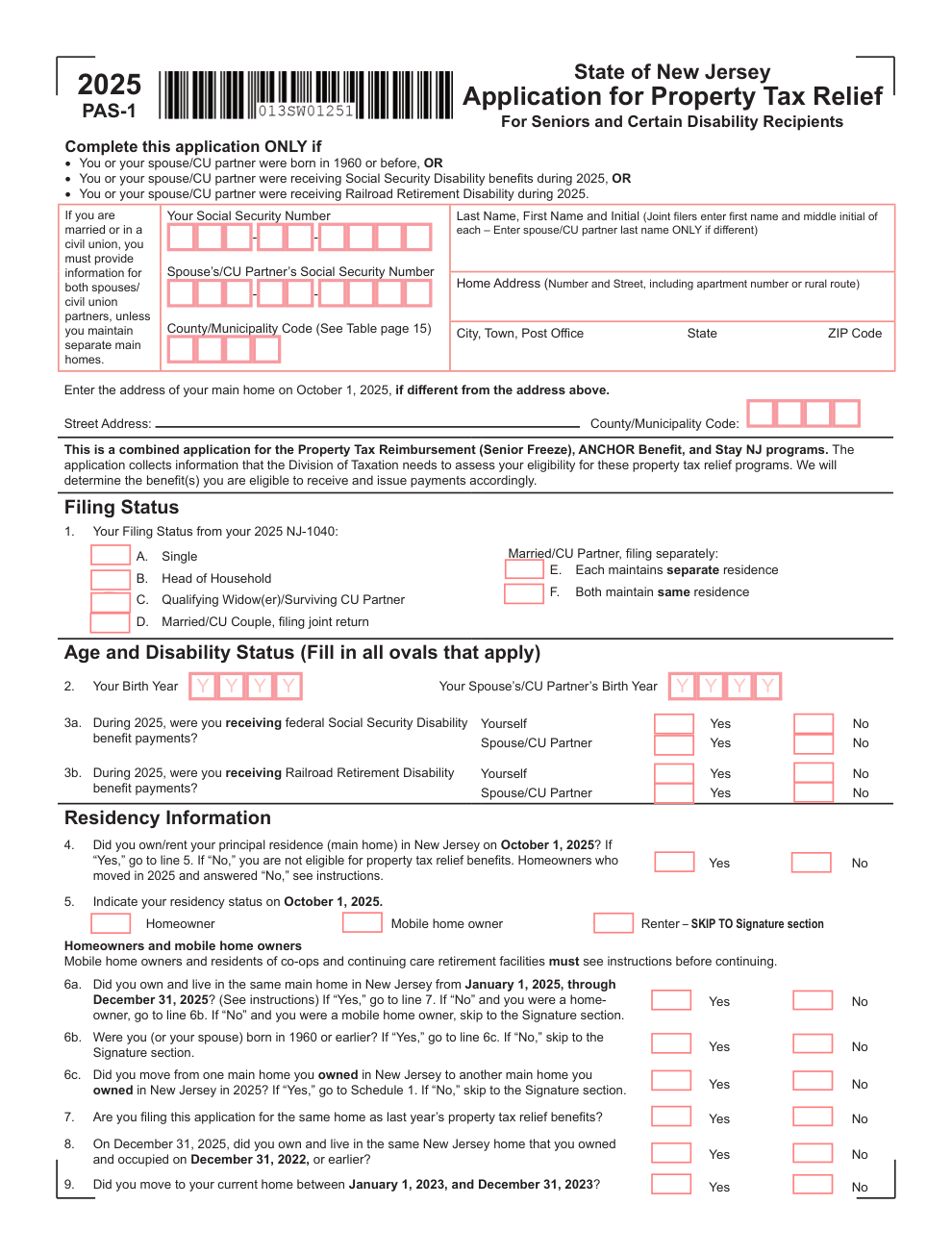
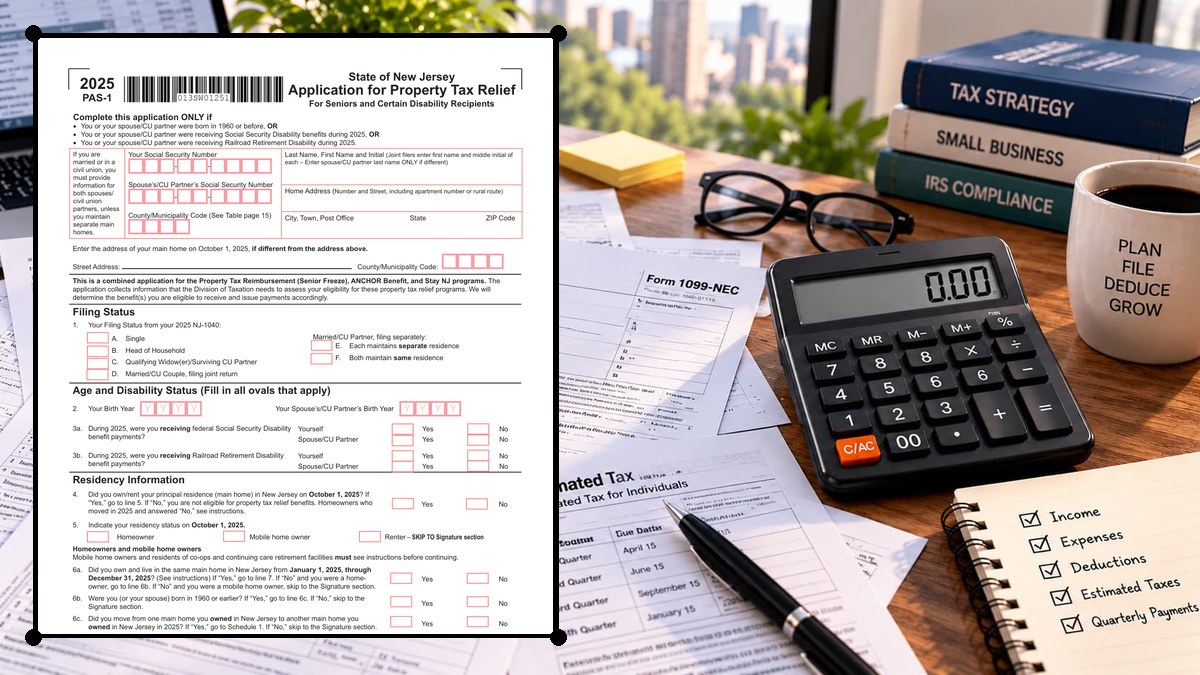
There is no separate “ANCHOR form” for most people. Homeowners under 65 and renters usually receive the benefit through an automatic filing or through the Division’s online Application for Property Tax Relief. Seniors and people who collect Social Security Disability or Railroad Retirement Disability benefits use the combined paper or online Form PAS-1, which covers ANCHOR together with the Senior Freeze and Stay NJ programs.
Who Qualifies for ANCHOR?
Homeowners qualify if all of these are true:
- You were a New Jersey resident and owned and lived in the home as your main home on October 1, 2025.
- The home was subject to property taxes.
- Your New Jersey gross income was $250,000 or less (line 29 of your NJ-1040). If it was above $250,000, you do not qualify.
Renters qualify if all of these are true:
- You were a New Jersey resident and rented your main home on October 1, 2025.
- The rental property was subject to local property taxes. Renters in P.I.L.O.T. units, mobile homes in a park, condominiums and co-ops can qualify.
- Your New Jersey gross income was $150,000 or less.
- Every renter on the lease files their own application.
Properties That Do Not Qualify
- A vacation home or second home.
- Property you rent to someone else.
- Property with more than four units, or with four units or fewer that has more than one commercial unit.
- A home that is completely exempt from property tax. For homeowners, P.I.L.O.T. payments to a municipality are not treated as property taxes.
- For renters: tax-exempt housing owned by a government or by a religious, charitable or other non-profit organization, and on-campus apartments at New Jersey colleges and universities.
A condominium or co-op owner who pays property taxes on the unit is a homeowner for ANCHOR, and a resident of a continuing care community whose contract passes on property taxes is treated the same way. Both answer “no” to the multi-unit question.
Key Dates for the 2025 ANCHOR Benefit
- August 10, 2026: the Division began mailing ANCHOR Benefit Confirmation Letters to people it filed for.
- September 15, 2026: the deadline for people with a letter to change bank information, ask for a paper check, or say they are not eligible for the property listed. This date has passed.
- November 2, 2026: the deadline for everyone who needs to file their own application, including seniors and people on disability benefits who use PAS-1.
If you did not file changes by September 15, the Division used the bank information from your previous ANCHOR benefit to pay the 2025 benefit.
How to Apply for ANCHOR
- Check whether you got a confirmation letter. If you did, the Division filed for you. Keep the letter: it is proof that you applied, and you can check the status of your benefit.
- If you got no letter and you qualify, file the Application for Property Tax Relief online on the New Jersey Division of Taxation ANCHOR page. You verify your identity through ID.me; the Division no longer requires an ID or PIN number.
- If you are 65 or older, or you collect Social Security Disability or Railroad Retirement Disability benefits, file the combined Form PAS-1, online or on paper. The Division does not file it for you.
- At the end of an online application, choose CONFIRM to get your confirmation number. Keep it with your records.
What You Need to File
Homeowners:
- Your Social Security number or ITIN, and your spouse’s or civil union partner’s if you file together.
- Your New Jersey gross income from line 29 of your NJ-1040, and your filing status (the online application asks for the 2024 return).
- Your date of birth, and your spouse’s or partner’s, plus a driver’s license or state non-driver ID number.
- You may be asked for the county or municipality code, the block, lot and qualifier, and the property tax amounts from your tax bill.
- If you own the property with someone other than your spouse or partner, your ownership percentage. Each owner files a separate application.
Renters:
- Your Social Security number or ITIN, and your spouse’s or partner’s if applicable.
- Your New Jersey gross income from line 29 of your NJ-1040, and your filing status.
- Your date of birth, whether you or your spouse were blind or disabled on December 31, 2024, and the names of anyone you shared the rent with.
- Your bank routing and account numbers if you want direct deposit.
How ANCHOR Is Paid and How to Check Your Status
If you received last year’s ANCHOR benefit by direct deposit, the Division used the same banking information for the 2025 benefit unless you changed it. People who file a paper PAS-1 receive their benefits by paper check mailed to the address on the application, while people who file PAS-1 online can choose direct deposit for some payments. The total of property tax relief benefits cannot exceed the property taxes you paid on your main home for the year.
The exact benefit amounts are set by the Division of Taxation each year. For the current figures and how the benefit is calculated, see the Division’s “How Benefits Are Calculated and Paid” page rather than relying on an old number. You can check the status of your own benefit with the Division’s Check Your ANCHOR Status service.
If you received a benefit check by mistake, return it to the New Jersey Division of Taxation, PO Box 266, Trenton, NJ 08695-0266.
Common Mistakes to Avoid
- Assuming the state filed for you. Seniors and people on disability benefits are not filed for automatically. File PAS-1 yourself by November 2, 2026.
- Filing for the wrong property. The address must have been your main home on October 1, 2025, not where you live now.
- Using the wrong income line. The limit is based on New Jersey gross income from line 29 of your NJ-1040, not federal income.
- Co-tenants filing one application. Each renter on the lease files separately.
- Missing the deadline. After November 2, 2026, an application for the 2025 benefit year is late.
- Forgetting to choose CONFIRM at the end of an online application, so you have no confirmation number.
Frequently Asked Questions
What does ANCHOR stand for?
Affordable New Jersey Communities for Homeowners and Renters. It is a property tax relief program run by the New Jersey Division of Taxation.
What is the ANCHOR deadline for 2025?
November 2, 2026, for people who must file on their own. The September 15, 2026 deadline for changes to an automatic filing has already passed.
What is the income limit?
New Jersey gross income of $250,000 or less for homeowners and $150,000 or less for renters.
Do I need to apply if I got a confirmation letter?
No, the letter confirms that the Division filed for you. Apply on your own only if the information in it is wrong and you did not make changes by September 15, 2026, or if the property is not one you qualify for.
Can I get ANCHOR if I rent?
Yes, if the rental property is subject to local property tax (with the P.I.L.O.T., mobile home park, condominium and co-op exceptions) and your New Jersey gross income was $150,000 or less.
What is Form PAS-1?
The combined Application for Property Tax Relief used by seniors and people on Social Security Disability or Railroad Retirement Disability benefits. It covers ANCHOR, the Senior Freeze (Property Tax Reimbursement) and Stay NJ.
Related New Jersey Forms
- Form NJ-1040 — Resident Income Tax Return: the return whose line 29 is the New Jersey gross income used for the ANCHOR income limits.
- Form NJ-1040-ES — Estimated Tax Payment: estimated payments for income that has no withholding.
- Form PAS-1 and the Senior Freeze and Stay NJ programs: the combined application for seniors and people on disability benefits.
Similar Forms in Other States
- Michigan MI-1040CR: Homestead Property Tax Credit Claim
- Pennsylvania Form PA-1000: Property Tax or Rent Rebate Claim
- New York Form IT-214: Claim for Real Property Tax Credit for Homeowners and Renters
Final Review Before Filing
- The property you are claiming was your main home on October 1, 2025.
- Your New Jersey gross income from line 29 of your NJ-1040 is within the $250,000 (homeowner) or $150,000 (renter) limit.
- You checked whether you received a confirmation letter before filing again.
- If you are 65 or older, or you collect Social Security Disability or Railroad Retirement Disability benefits, you are filing PAS-1 yourself.
- Every renter on the lease is filing their own application.
- You will file before November 2, 2026, and keep your confirmation number or letter.
Sources & verification
- Issuing agency: New Jersey Division of Taxation
- Official documents: ANCHOR program page · ANCHOR eligibility and filing information · Property tax relief FAQs · 2025 Form PAS-1 (PDF) · 2025 PAS-1 instructions (PDF)
- Checked against: the Division of Taxation’s ANCHOR pages (last updated September 16, 2026) and the 2025 Form PAS-1
- Last verified: October 23, 2026
Spot an error or an out-of-date figure? Tell us and we will check it against the official source.
General information from the official sources, not advice for your circumstances. See the full disclaimer.