What is Form F-1120?
Quick answer: Form F-1120 is the Florida Corporate Income/Franchise Tax Return. Florida taxes a corporation’s Florida net income at 5.5% after an exemption of up to $50,000. All corporations doing business, earning income or existing in Florida file it, even if no tax is due. For a calendar-year corporation, the return for tax year 2025 is due May 1, 2026; other year-ends are due the first day of the fifth month after the year closes (fourth month for a June 30 year-end). An extension requires Form F-7004 plus payment of the tentative tax by the original due date.
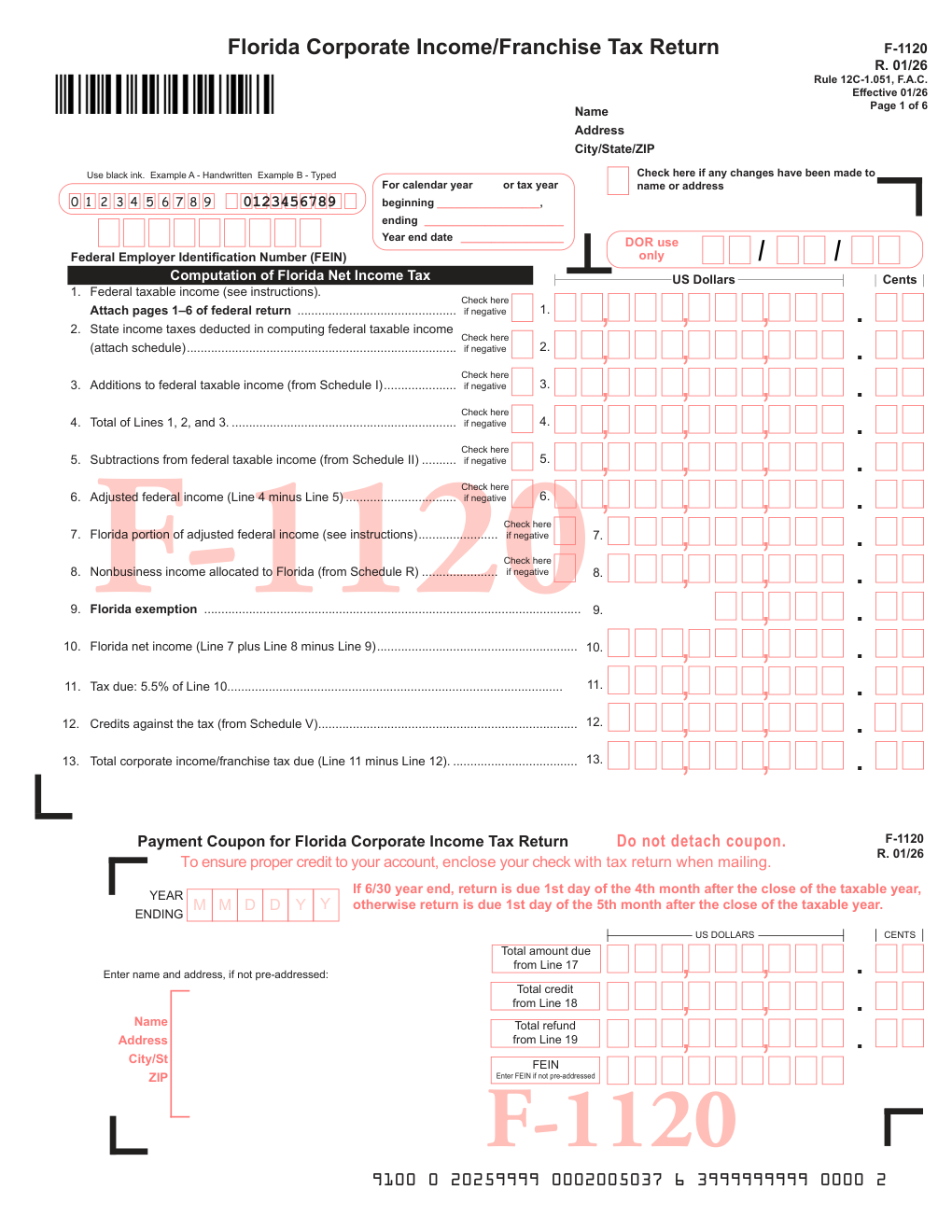
The return starts with your federal taxable income, adjusts it for Florida additions and subtractions, apportions the result to Florida, applies the $50,000 exemption and then multiplies by 5.5%. Most of the detail is in supporting schedules for additions (Schedule I), subtractions (Schedule II), nonbusiness income (Schedule R) and credits (Schedule V).
An S corporation files only if it pays federal income tax on Line 23c of federal Form 1120S, and tax-exempt organizations with unrelated business taxable income are subject to the tax.
Key Figures — Tax Years Beginning on or After January 1, 2025 (F-1120N R. 01/26)
- Tax rate: 5.5% of Florida net income (Line 11).
- Exemption: up to $50,000 of Florida net income (Line 9); prorated for a short tax year (multiply by days divided by 365). Only one exemption per controlled group.
- Due date: the first day of the fifth month after the tax year ends (fourth month for a June 30 year-end); for a calendar 2025 year, May 1, 2026. Or the 15th day after the related federal return’s due date, if later.
- Extension: Form F-7004; six months (seven for a June 30 year-end); one extension per tax year; pay the tentative tax by the original due date.
- Late return penalty: 10% per month up to 50% of the tax; if no tax is due, $50 per month up to $300.
- Estimated tax: required if you expect tax of more than $2,500 (Form F-1120ES); the underpayment penalty is 12% a year.
Source: the Florida Department of Revenue, Form F-1120 and Form F-1120N instructions. Last verified September 29, 2026.
Who Must File Form F-1120?
You must file if you are:
- a corporation, including a tax-exempt organization, doing business, earning income or existing in Florida;
- a bank or savings association doing business, earning income or existing in Florida;
- an association or artificial entity doing business, earning income or existing in Florida;
- a foreign corporation that is a partner or member in a Florida partnership or joint venture;
- an LLC classified as a corporation for Florida and federal income tax purposes;
- a homeowner or condominium association filing federal Form 1120 (not 1120-H), a political organization filing federal Form 1120-POL, or an S corporation that pays federal income tax on Line 23c of Form 1120S.
A single-member LLC that is disregarded for Florida and federal purposes doesn’t file its own return; its income is reported by the owner. You must file a return even if no tax is due.
Common trap: assuming a small profit means no filing. Florida requires the return whether or not tax is due, and a late-filed return carries a penalty even if the tax is zero.
How to File Form F-1120
- File and pay electronically through the IRS Modernized e-File program or the Department’s online payment application. E-filing is required if you paid $5,000 or more in corporate income tax in the prior state fiscal year or were required to e-file federally.
- Attach pages 1 to 6 of the federal return and any schedules the instructions list.
- Use Form F-7004 to extend. A copy of a federal extension does not extend the Florida due date.
- Pay by check with the payment coupon if you file on paper.
- Amend with Form F-1120X if you file an amended federal return or the IRS redetermines federal income.
When Is Form F-1120 Due?
| Tax year end | Due date |
|---|---|
| June 30 | First day of the fourth month after the year closes |
| All other year-ends | First day of the fifth month after the year closes |
| December 31, 2025 | May 1, 2026 |
| Alternate rule | The 15th day after the due date, without extension, of the related federal return, if later |
An extension from Form F-7004 is valid for six months (seven for June 30 year-ends). It is void if the tentative tax is not paid by the original due date or if the tax is underpaid by the greater of $2,000 or 30% of the tax shown on the return.
Where to Mail Form F-1120
- With payment: Florida Department of Revenue, 5050 W Tennessee St, Tallahassee, FL 32399-0135.
- For a refund (Line 19): Florida Department of Revenue, PO Box 6440, Tallahassee, FL 32314-6440.
How to Complete Form F-1120 Line by Line
Top of the Return — Identification and Tax Year
Enter the corporation’s name, address, FEIN, and the tax year beginning and ending dates. Check the box if the name or address changed. The questions on page 2 cover whether this is an initial or final return, controlled group membership and consolidated filing.
Lines 1–6 — Federal Income and Adjustments
| Line | What to enter |
|---|---|
| Line 1 | Federal taxable income (attach pages 1 to 6 of the federal return), with a box to check if negative. |
| Line 2 | Adds state income taxes deducted in computing federal taxable income. |
| Line 3 | Additions from Schedule I. |
| Line 4 | Totals Lines 1 to 3. |
| Line 5 | Subtractions from Schedule II. |
| Line 6 | Adjusted federal income, Line 4 minus Line 5. |
Lines 7–10 — Florida Income, Exemption and Net Income
| Line | What to enter |
|---|---|
| Line 7 | The Florida portion of adjusted federal income after apportionment. |
| Line 8 | Nonbusiness income allocated to Florida from Schedule R. |
| Line 9 | The Florida exemption of up to $50,000 (the lesser of $50,000 or Lines 7 plus 8). |
| Line 10 | Florida net income: Line 7 plus Line 8 minus Line 9. |
Lines 11–13 — Tax, Credits and Total Tax Due
| Line | What to enter |
|---|---|
| Line 11 | Multiplies Line 10 by 5.5%. |
| Line 12 | Credits against the tax from Schedule V, for example the Rural Community Investment Program credit, which equals 25% of an investor contribution once the fund receives a final order. |
| Line 13 | Total corporate income/franchise tax due. |
Lines 14–19 — Penalty, Payments, Amount Due or Refund
Line 14 is penalty and interest, with underpayment of estimated tax computed on Form F-2220. Line 15 totals Lines 13 and 14. Line 16 is payment credits: estimated tax payments (16a) and the tentative tax payment with the extension (16b). Line 17 is the total amount due; a negative result is an overpayment, which you enter as a credit on Line 18 and/or a refund on Line 19.
Common Mistakes to Avoid
- Skipping the return because no tax is due. A return is required, and a late return is penalized.
- Relying on the federal extension. Only Form F-7004 extends the Florida due date.
- Underpaying the tentative tax. The extension is void if it is unpaid or short by the greater of $2,000 or 30%.
- Claiming more than one $50,000 exemption in a controlled group.
- Not prorating the exemption for a short tax year.
- Filing on paper when e-filing is required. The penalty is 5% of tax per month, up to $250, or $10 if no tax is due.
- Forgetting estimated tax when you expect to owe more than $2,500.
Frequently Asked Questions
What is the Florida corporate income tax rate? 5.5% of Florida net income after the exemption.
What is the exemption? Up to $50,000 of Florida net income.
When is F-1120 due for a calendar-year corporation? May 1 of the following year, or May 1, 2026 for tax year 2025.
How do I extend? File Form F-7004 and pay the tentative tax by the original due date.
Do S corporations file? Only S corporations that pay federal income tax on Line 23c of Form 1120S.
How do I amend? Use Form F-1120X.
Final Review Before Filing
- The corporation is subject to Florida tax and has not overlooked a required return.
- Federal pages 1 to 6 are attached.
- Schedules I, II, R and V are complete where needed.
- The $50,000 exemption is calculated once and prorated if a short year.
- Line 11 uses 5.5%.
- Estimated tax and tentative tax payments are on Line 16.
- The return is filed electronically or mailed by the due date.
Sources & verification
- Issuing agency: Florida Department of Revenue
- Official documents: Form F-1120 (PDF) · Form F-1120N instructions (PDF)
- Checked against: Form F-1120 and the F-1120N instructions (R. 01/26)
- Last verified: September 29, 2026
Spot an error or an out-of-date figure? Tell us and we will check it against the official source.
General information from the official form and its instructions, not advice for your circumstances. See the full disclaimer.