
What is Form IL-1040?
Quick answer: Form IL-1040 is the annual return every Illinois resident, and every nonresident or part-year resident with Illinois income, files to report income and pay Illinois income tax. Illinois starts from your federal adjusted gross income, applies a short list of additions and subtractions, subtracts an exemption allowance, and taxes the result at one flat rate. Most people file electronically for free through MyTax Illinois or approved software; a paper return is mailed to a Springfield address that differs depending on whether you owe or expect a refund. For the 2025 tax year the return is due April 15, 2026.
Form IL-1040 is Illinois’s individual income tax return. It begins with your federal adjusted gross income, adds back a few items Illinois taxes that the federal return excludes (such as certain tax-exempt bond interest), subtracts items Illinois does not tax (most retirement income and Social Security), subtracts an exemption allowance, and applies the state’s single flat rate. It then reconciles that tax against your Illinois withholding, estimated payments, and credits to produce a refund or a balance due.
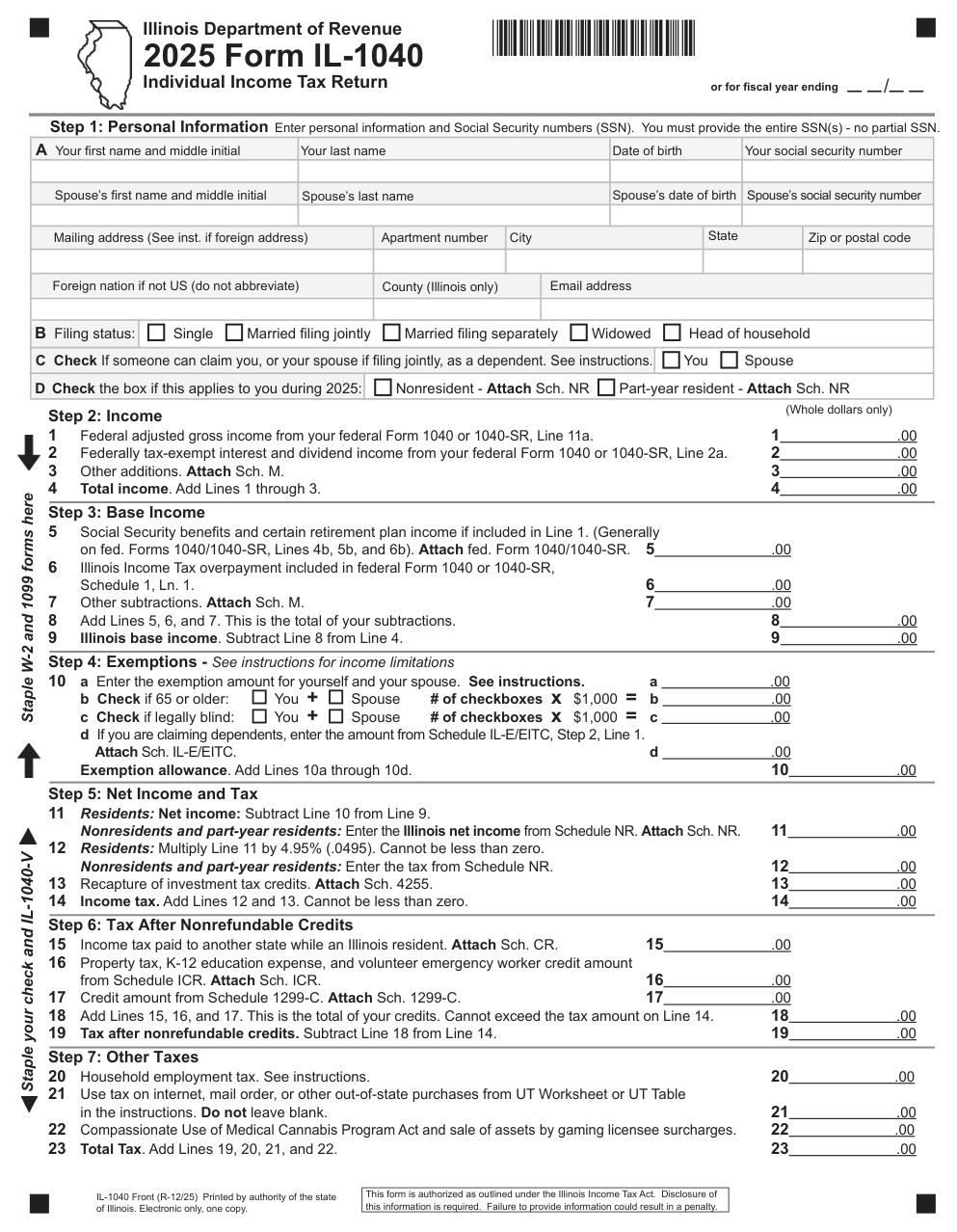
The form collects your personal information, filing status, residency, income figures carried from your federal return, Illinois-specific additions and subtractions, your exemption allowance, nonrefundable and refundable credits, use tax on untaxed purchases, and your refund or payment instructions. Completing it correctly matters because Illinois’s subtraction for retirement income is broad, the exemption allowance phases out at higher incomes, and the use tax line is mandatory rather than optional.
Key Figures — Tax Year 2025 (Form IL-1040, revision R-12/25)
- Illinois income tax rate: 4.95% (0.0495), applied on Line 12.
- Personal exemption (Line 10a) for 2025: $2,850 per person — $2,850 single, head of household, married filing separately, or widowed; $5,700 married filing jointly. You get no exemption allowance at all (enter zero on Line 10) if your federal AGI is over $250,000, or over $500,000 if married filing jointly.
- Additional exemption for being 65 or older and for being legally blind: $1,000 for each box checked (Lines 10b and 10c), for you and your spouse.
- Line 21 (use tax on out-of-state purchases) must not be left blank; enter zero if you owe none.
- Filing deadline: April 15, 2026. Illinois grants an automatic six-month filing extension to October 15, 2026 — but not an extension to pay; use Form IL-505-I to pay by April 15.
- Mailing address is not printed on the form. The 2025 IL-1040 instructions give two Springfield addresses: Illinois Department of Revenue, PO Box 19041, Springfield, IL 62794-9041 (no payment enclosed) and PO Box 19027, Springfield, IL 62794-9027 (payment enclosed).
- New for 2025: a full date of birth is required in Step 1, and the Illinois Child Tax Credit rises to 40% of your Illinois Earned Income Tax Credit.
- Source: Illinois Department of Revenue — 2025 Form IL-1040 (revision R-12/25).
- Last verified: 2026-09-08
Who Must File Illinois Form IL-1040?
Illinois residents must file if they were required to file a federal income tax return, or if they were not required to file federally but their Illinois base income is more than their Illinois exemption allowance.
Part-year residents file if they earned income from any source while an Illinois resident, or received income from Illinois sources while a nonresident. They attach Schedule NR.
Nonresidents file if they received income from Illinois sources — wages for work performed in Illinois, Illinois business or rental income, or Illinois gambling and lottery winnings — and attach Schedule NR. Residents of Iowa, Kentucky, Michigan, and Wisconsin are not taxed by Illinois on wages under the reciprocal agreements.
Others who should file include anyone who had Illinois tax withheld and wants it refunded, and anyone claiming a refundable credit such as the Illinois EITC.
Who does not file. A resident with no federal filing obligation whose Illinois base income does not exceed the exemption allowance, and a reciprocal-state resident whose only Illinois income is exempt wages.
How to File Illinois Form IL-1040
- Electronically: Free through MyTax Illinois, or through approved commercial software. Illinois strongly encourages e-filing and issues e-file refunds faster.
- By mail: Print the return, staple your W-2s and 1099s where indicated, attach every required schedule, and mail it to the correct Springfield address for a payment or non-payment return.
- Payment: Pay electronically through MyTax Illinois, or mail a check payable to “Illinois Department of Revenue” with Form IL-1040-V.
Before you start, complete your federal return; then gather all W-2s and 1099s, records for any Illinois additions or subtractions (Schedule M items), property tax and K-12 education receipts if claiming Schedule ICR, and your bank routing and account numbers for direct deposit.
When Is Illinois Form IL-1040 Due?
- Primary deadline: April 15, 2026 for the 2025 calendar year, the same date as the federal return.
- Weekend/holiday rule: If April 15 falls on a Saturday, Sunday, or legal holiday, the return is due the next business day.
- Extension: Illinois automatically extends the filing deadline six months, to October 15, 2026, with no form to file. This is not an extension to pay — pay any expected balance by April 15 using Form IL-505-I to avoid a late-payment penalty and interest.
- Estimated payments: If you expect to owe more than $1,000 after withholding and credits, Illinois estimated payments (Form IL-1040-ES) are generally due April 15, June 15, September 15, and January 15 of the following year.
- Late filing or payment: A late-filing penalty applies if you file after the extended due date with a balance due; a late-payment penalty and interest apply to tax not paid by April 15.
Where to Mail Illinois Form IL-1040
– Mailing address: Not printed on the form. The 2025 IL-1040 instructions give two Springfield addresses: – No payment enclosed (refund or zero balance): Illinois Department of Revenue, PO Box 19041, Springfield, IL 62794-9041 – Payment enclosed: Illinois Department of Revenue, PO Box 19027, Springfield, IL 62794-9027 – What to attach: W-2s and 1099s (stapled where the form indicates); Schedule IL-WIT for withholding; and every schedule you referenced — Schedule M, ICR, CR, NR, IL-E/EITC, 1299-C, G, IL-2210, 4255 — as applicable. – Payment: Make the check payable to “Illinois Department of Revenue,” include Form IL-1040-V, and write your SSN and “2025 IL-1040” on it. – Electronic alternative: File through MyTax Illinois (free) or approved software; e-filed returns are processed faster and reduce math errors.
How to Complete Illinois Form IL-1040 Line by Line
Step 1 — Personal Information
Your and your spouse’s name, date of birth, and Social Security number: Enter full names and complete SSNs — no partial numbers. A full date of birth is required for 2025 (new this year). Enter spouse information only if married.
Mailing address: Enter your street address, apartment number, city, state, and ZIP. Enter a foreign nation only if your address is outside the U.S.
County (Illinois only): Enter the Illinois county you lived in. Email address: Enter an email if you want the Department to be able to contact you, and complete it if you check the health-insurance box in Step 12.
B — Filing status: Check one — Single, Married filing jointly, Married filing separately, Widowed, or Head of household. Generally use the same status as your federal return.
C — Dependent of another: Check the You and/or Spouse box if someone else can claim you as a dependent; this limits your exemption allowance.
D — Residency: Check Nonresident or Part-year resident if either applied during 2025, and attach Schedule NR.
Step 2 — Income
Line 1: Federal adjusted gross income. Enter your federal AGI from your federal Form 1040 or 1040-SR.
Line 2: Federally tax-exempt interest and dividend income. Enter tax-exempt interest and dividends from your federal return; Illinois taxes some of this (for example, out-of-state municipal bond interest) through Schedule M.
Line 3: Other additions. Enter the total from Schedule M and attach it. These are income items Illinois taxes that are not in federal AGI.
Line 4: Total income. Add Lines 1 through 3.
Step 3 — Base Income
Line 5: Social Security and retirement income. Enter the Social Security benefits and qualified retirement plan income (federal Lines 4b, 5b, 6b) that are included in Line 1. Illinois does not tax this income. Attach your federal Form 1040 or 1040-SR.
Line 6: Illinois Income Tax overpayment. Enter any state income tax refund included as income on federal Schedule 1, Line 1. Illinois does not tax its own refund.
Line 7: Other subtractions. Enter the total from Schedule M and attach it (for example, U.S. government interest, certain college savings contributions).
Line 8: Total subtractions. Add Lines 5, 6, and 7.
Line 9: Illinois base income. Subtract Line 8 from Line 4.
Step 4 — Exemptions
Line 10a: Personal exemption. For 2025 the exemption is $2,850 per person — $2,850 if your filing status is single, head of household, married filing separately, or widowed, and $5,700 if married filing jointly. Enter zero if your federal AGI is over $250,000, or over $500,000 if married filing jointly — at those income levels you get no exemption allowance. (If someone can claim you as a dependent, the instructions’ table may also reduce this to $2,850 or zero.)
Line 10b: Age 65 or older. Check the box for you and/or your spouse, multiply the number of boxes by $1,000, and enter the result.
Line 10c: Legally blind. Check the box for you and/or your spouse, multiply the number of boxes by $1,000, and enter the result.
Line 10d: Dependents. If you claim dependents, enter the amount from Schedule IL-E/EITC, Step 2, Line 1, and attach that schedule.
Line 10: Exemption allowance. Add Lines 10a through 10d.
Step 5 — Net Income and Tax
Line 11: Net income. Residents subtract Line 10 from Line 9. Nonresidents and part-year residents enter the Illinois net income from Schedule NR and attach it.
Line 12: Tax. Residents multiply Line 11 by 4.95% (0.0495); the result cannot be less than zero. Nonresidents and part-year residents enter the tax from Schedule NR.
Line 13: Recapture of investment tax credits. Enter the amount from Schedule 4255 if you must recapture a previously claimed credit, and attach it.
Line 14: Income tax. Add Lines 12 and 13.
Step 6 — Tax After Nonrefundable Credits
Line 15: Credit for tax paid to another state. Residents enter the credit from Schedule CR for income tax paid to another state on income also taxed by Illinois, and attach it.
Line 16: Schedule ICR credits. Enter the total of the Illinois Property Tax Credit, K-12 Education Expense Credit, and Volunteer Emergency Worker Credit from Schedule ICR, and attach it.
Line 17: Schedule 1299-C credits. Enter income tax credits from Schedule 1299-C and attach it.
Line 18: Total credits. Add Lines 15, 16, and 17. This total cannot exceed Line 14.
Line 19: Tax after nonrefundable credits. Subtract Line 18 from Line 14.
Step 7 — Other Taxes
Line 20: Household employment tax. Enter Illinois household employment tax if you paid a household employee and owe it, following the instructions.
Line 21: Use tax. Enter use tax on internet, mail-order, and out-of-state purchases on which no sales tax was charged, from the UT Worksheet or UT Table in the instructions. Do not leave this line blank; enter zero if you owe none.
Line 22: Cannabis and gaming surcharges. Enter any Compassionate Use of Medical Cannabis Program Act surcharge or gaming licensee asset-sale surcharge that applies to you.
Line 23: Total tax. Add Lines 19, 20, 21, and 22.
Step 8 — Payments and Refundable Credits
Line 24: Total tax. Enter the amount from Line 23.
Line 25: Illinois Income Tax withheld. Enter total Illinois withholding from your W-2s and 1099s, supported by Schedule IL-WIT, which you must attach.
Line 26: Estimated payments. Enter estimated payments made on Forms IL-1040-ES and IL-505-I, including any prior-year overpayment you applied forward.
Line 27: Pass-through withholding. Enter Illinois tax withheld and passed through to you by a partnership, S corporation, or trust, from Schedule K-1-P or K-1-T, and attach it.
Line 28: Pass-through entity tax credit. Enter your share of pass-through entity (PTE) tax paid on your behalf, from Schedule K-1-P or K-1-T, and attach it.
Line 29: Earned Income Tax Credit. Enter the Illinois EITC from Schedule IL-E/EITC, Step 4, Line 9, and attach it.
Line 30: Child Tax Credit. Enter the Illinois Child Tax Credit from Schedule IL-E/EITC, Step 5, Line 12, and attach it. For 2025 this credit equals 40% of your Illinois Earned Income Tax Credit.
Line 31: Total payments and refundable credits. Add Lines 25 through 30.
Step 9 — Total
Line 32: Overpayment. If Line 31 is more than Line 24, subtract Line 24 from Line 31.
Line 33: Tax due. If Line 24 is more than Line 31, subtract Line 31 from Line 24.
Step 10 — Underpayment Penalty and Donations
Line 34: Late-payment penalty for underpayment of estimated tax. Enter the penalty figured on Form IL-2210 if you underpaid estimated tax during the year. – 34a: Check if at least two-thirds of your federal gross income is from farming. – 34b: Check if you or your spouse are 65 or older and permanently living in a nursing home. – 34c: Check if your income was uneven and you annualized on Form IL-2210, and attach it. – 34d: Check if you were not required to file an Illinois return for the previous tax year.
Line 35: Voluntary charitable donations. Enter total donations from Schedule G and attach it.
Line 36: Total penalty and donations. Add Lines 34 and 35.
Step 11 — Refund or Amount You Owe
Line 37: Overpayment after penalty and donations. If you have an amount on Line 32 that is more than Line 36, subtract Line 36 from Line 32. Otherwise go to Line 41.
Line 38: Refund amount. Enter the part of Line 37 you want refunded, and check a box on Line 39.
Line 39: Refund method. Check direct deposit and enter your routing number, account number, and account type; or check paper check.
Line 40: Credited forward. Subtract Line 38 from Line 37 to apply the rest to your 2026 estimated tax.
Line 41: Amount you owe. If you have an amount on Line 33, add Lines 33 and 36. If Line 32 is less than Line 36, subtract Line 32 from Line 36. If Lines 32 and 33 are both zero, enter Line 36.
Step 12 — Health Insurance Checkbox and Signature
Line 42: Health insurance information sharing. Check this box and provide your email in Step 1 to let the Department share return information with the Department of Insurance for Get Covered Illinois eligibility, and check who needs coverage.
Signature: Sign and date. Both spouses must sign a joint return. Enter a daytime phone number.
Paid preparer / Third party designee: A paid preparer completes their section; check the designee box and enter a name and phone if you want someone else to be able to discuss the return with the Department.
Common Mistakes to Avoid
- Leaving Line 21 (use tax) blank. It is mandatory; enter zero if you owe none.
- Not subtracting retirement income. Illinois does not tax Social Security or qualified retirement plan distributions — claim them on Line 5.
- Claiming the exemption at high income. You get no Line 10a exemption allowance at all if your federal AGI is over $250,000 (over $500,000 if married filing jointly) — enter zero.
- Forgetting Schedule IL-WIT. Illinois will not credit withholding on Line 25 without the attached schedule.
- Using resident lines as a nonresident. Nonresidents and part-year residents must complete Schedule NR and carry its results to Lines 11 and 12.
- Mailing to the wrong Springfield address. Payment returns and refund returns go to different addresses.
- Missing the reciprocal-state rule. Iowa, Kentucky, Michigan, and Wisconsin residents are not taxed by Illinois on wages.
- Not stapling W-2s and 1099s. A paper return without wage statements delays processing.
Frequently Asked Questions
Do I have to file IL-1040 every year? Yes, if you had a federal filing requirement or your Illinois base income exceeds your exemption allowance, and any year you want withheld Illinois tax refunded.
What is the Illinois income tax rate? A flat 4.95% on net income, regardless of income level.
Can I file IL-1040 for free? Yes. MyTax Illinois lets you file the return directly at no cost.
When is it due? April 15, 2026 for 2025, with an automatic six-month extension of time to file, to October 15, 2026 (not an extension to pay).
Where do I mail a paper return? Illinois Department of Revenue, PO Box 19027, Springfield, IL 62794-9027 if a payment is enclosed, or PO Box 19041, Springfield, IL 62794-9041 if not (refund or zero balance).
Does Illinois tax my pension or Social Security? No. Qualified retirement plan income and Social Security are subtracted on Line 5.
I live in Wisconsin and work in Illinois. Do I owe Illinois tax on my wages? No. Wisconsin has a reciprocal agreement with Illinois; file Form IL-W-5-NR with your employer.
How do I check my refund? Use the “Where’s My Refund?” tool on the Illinois Department of Revenue website or MyTax Illinois.
Final Review Before Filing
- Filing status matches your situation and generally your federal return.
- Federal AGI on Line 1 matches your filed federal return.
- Retirement income and Social Security are subtracted on Line 5.
- Exemption allowance on Line 10 reflects the AGI limitation if it applies.
- Residents: Line 12 equals Line 11 × 0.0495. Nonresidents/part-year: Lines 11 and 12 come from Schedule NR.
- Credits on Line 18 do not exceed Line 14.
- Line 21 use tax has a number (zero is acceptable).
- Schedule IL-WIT and all referenced schedules are attached.
- W-2s and 1099s are stapled where indicated.
- Return is signed and dated (both spouses if joint).
- Direct deposit information is correct, or paper check is selected.
- Mailed to the correct Springfield address, or filed through MyTax Illinois.
Official source: Illinois Department of Revenue — official Form IL-1040 (PDF) · instructions (PDF). This guide was verified against them on September 8, 2026.
This guide is general information, not legal, tax, or financial advice. It is not affiliated with the Illinois Department of Revenue or the IRS. Tax forms and rules change; confirm current figures and requirements with the Illinois Department of Revenue or a qualified tax professional before you file.